The Stock Market: Understanding the Opportunities, Risks & What Investors Should Watch
Master the fundamentals of stock investing to build wealth while managing risk effectively.

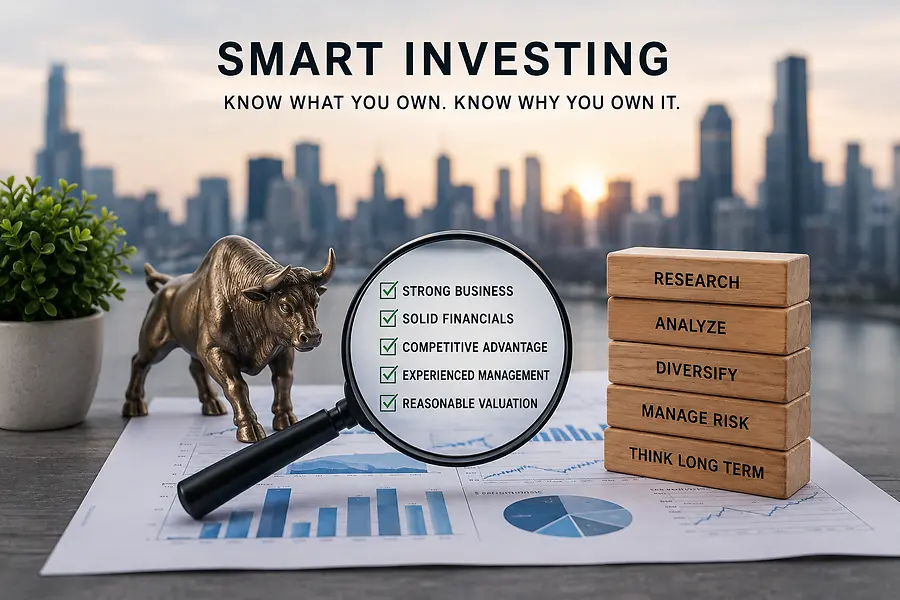
Investing in the stock market can be one of the most powerful ways to build long-term wealth—but it is not without risk. Successful investors understand that buying a stock means buying an ownership interest in a business, not simply purchasing a ticker symbol and hoping the price goes up.
The key is knowing what to look for before putting your money to work.
Look Beyond the Stock Price
One of the biggest mistakes investors make is focusing solely on whether a stock is trading at $10, $50, or $500.
A low-priced stock isn't necessarily cheap, and a high-priced stock isn't necessarily expensive.
Instead, investors should examine the underlying company. Is revenue growing? Are earnings increasing? Is the company generating strong cash flow? Does it have manageable debt? Most importantly, does the business have a realistic path to continued growth?
Understanding the business behind the stock is often more important than watching the stock price move from one day to the next.
Pay Attention to Valuation
A strong company can still be a poor investment if investors pay too much for it.
Valuation helps investors determine whether the current stock price appears reasonable compared with the company's earnings, sales, cash flow, growth prospects, and industry.
Investors commonly examine measures such as the price-to-earnings ratio (P/E), price-to-sales, and price-to-free-cash-flow ratios.
The objective isn't necessarily to find the cheapest stock. It is to determine whether the price makes sense for the quality and future potential of the business.
Understand the Company's Financial Health
A company's financial statements can tell investors a great deal.
Look at:
- Revenue growth
- Net income and earnings
- Free cash flow
- Profit margins
- Debt
- Cash reserves
- Share dilution
- Return on invested capital
Strong revenue growth with improving profitability can be an encouraging sign. Conversely, declining revenue, increasing debt, shrinking margins, or consistently negative cash flow may warrant additional caution.
Consider the Bigger Economic Picture
Companies don't operate in isolation.
Interest rates, inflation, employment, consumer spending, government policies, and economic growth can all influence the stock market.
For example, higher interest rates can increase borrowing costs for businesses and make bonds and other fixed-income investments more attractive relative to stocks. A recession can reduce consumer demand and corporate earnings.
Investors should therefore consider both the individual company and the environment in which that company operates.
The Pros of Investing in Stocks
The stock market offers several significant advantages.
Growth potential: Over long periods, stocks have historically provided investors with opportunities for substantial capital appreciation.
Dividends: Some companies return part of their profits to shareholders through dividends, creating a potential source of income.
Liquidity: Publicly traded stocks can generally be bought and sold during market hours.
Ownership: Stockholders participate in the economic success—or failure—of the businesses they own.
Compounding: Reinvesting dividends and allowing investments to grow over time can potentially accelerate wealth accumulation.
Accessibility: Investors can gain exposure to individual companies, broad market indexes, and specialized sectors through relatively accessible investment products.
The Cons and Risks
The potential for higher returns comes with higher risk.
Market volatility can cause substantial short-term price fluctuations. A stock can lose significant value even when an investor believes the underlying company remains strong.
Company-specific risk is another major concern. Poor management, declining sales, new competitors, lawsuits, technological changes, or unexpected events can negatively affect a company.
Concentration risk can become a problem when too much money is invested in one company or industry.
There is also emotional risk. Investors may panic when markets fall or become overly optimistic when markets rise. Buying because everyone else is buying—or selling because everyone else is selling—can lead to poor decisions.
A Better Way to Think About Investing
Rather than asking, "What stock is going to go up?", investors may benefit from asking:
"What business am I buying, what is it worth, and what could make my investment thesis wrong?"
That change in perspective can encourage more disciplined decision-making.
Investors should also determine their goals, time horizon, and tolerance for risk before choosing investments. Someone saving for retirement decades away may approach the market very differently from someone who needs their money within the next two years.
The Bottom Line
The stock market provides tremendous opportunities, but there are no guaranteed returns.
Smart investing isn't about predicting every market move. It is about understanding businesses, evaluating valuations, managing risk, diversifying appropriately, and maintaining a long-term perspective.
The best investors don't simply ask how much money they can make. They also ask how much they could lose—and whether they are being compensated adequately for taking that risk.
Before investing, do your own research and consider consulting a qualified financial professional who can evaluate your individual circumstances.