The Times Square Test
How to Decide What You Should Never Type Into an AI Tool

Think about the last email you rewrote four times before you sent it.
You softened a sentence. You took out the word "just," then put it back in, then took it out again. You read it once more, imagining your boss forwarding it to someone you have never met. Maybe you sat on it overnight.
Most of us have been told at some point that this is overthinking. That we are in our heads. That we should stop agonizing and hit send.
I want to make a different argument: that instinct is not a flaw. It is a real skill, and most women I know have it running all the time. The problem is not that we do it. The problem is what we point it at.
Where the Test Came From
In my book, I call this the Times Square Test. It is a single question you ask before you put something into writing.
Would you be fine seeing this, with your name attached, forty feet tall on a billboard in Times Square?
Not the polished version. Not the version you would write if you knew it was going public. The thing you actually typed, exactly as you typed it.
I wrote that chapter about artificial intelligence because that is where I first noticed how much we hand over without stopping. But the test is older than any chatbot. It is the same question you should ask before a text, a Slack message, a performance review, or a note in a shared document. Anything with your name on it that can be forwarded, screenshotted, or found later.
What Happened at MIT
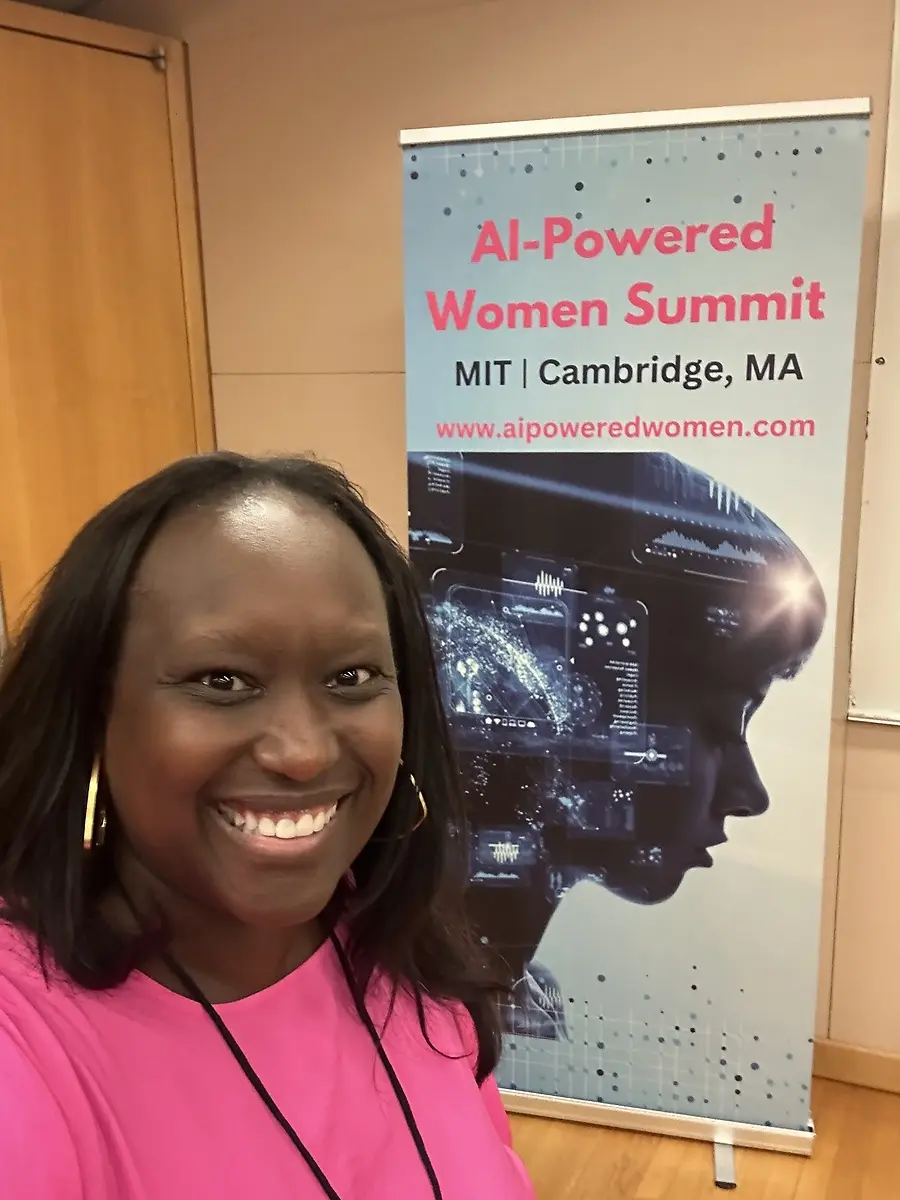
This past weekend, I led a workshop at the AI-Powered Women Conference at MIT. The room was full, and there were people standing at the door, which I say mostly because it made me more nervous, and I told them that before I started.
I opened by putting one of my own bad prompts on the screen.
It was a message I had asked AI to help me write about a struggling employee. I changed the name before I showed it, but everything else was real. I had typed in his mother's illness. I had typed in my own private opinion about whether he was ready for a promotion. I had used the phrase "honestly, between us."
Then I hit enter in front of everybody.
What came back was good. Better than good. It told me not to connect his mother's illness to the promotion decision. It warned me that written criteria become the standard I would be held to. It was more careful with him than I had been.
What it did not do, and what it is never going to do, is tell me that I probably should not have typed a real person's medical situation into a chat window in the first place.
I typed "honestly, between us" into a text box. There is no between us. There is me, and there is a record.
The Room Already Had Instincts
Then I asked the room to write down what they actually hand over most weeks and to sort it.
I loved how much expertise was sitting in those chairs. A lawyer spoke up. Several people who work in cybersecurity spoke up. Someone who described herself as a hacker spoke up. They took the question in directions I could not have taken it on my own, and the conversation got lively in the best way.
Here is what struck me. These were not careless people. The instincts in that room were sharp. What I heard, over and over, was a version of "I know I should not put that in there," followed by the admission that they had never actually sat down and decided where their line was.
That is not recklessness. That is what happens when nobody ever gives you a reason to stop and name it.
We Aim the Test at the Wrong Target
I think many of us run some version of this test constantly, and we aim it almost entirely at ourselves.
We run it on whether we sound too direct. On whether asking for the raise makes us difficult. On whether the follow-up email is pushy. On whether we said too much in the meeting.
We aim it at our own competence and our own likability, and we rarely aim it at exposure. At what we just wrote about a colleague. At the personal detail we included to give context. At the private assessment we put in a place we do not control.
So here is what I want to offer. Keep the instinct. Stop pointing it at whether you sound confident enough. Point it at what carries your name.
How to Actually Use It
Take three minutes and three lines. Paper, a notebook, your phone, whatever you already use.
- Green. Things you would not care who saw. Reformat this spreadsheet. Draft a post. Summarize this article.
- Yellow. Things you would want to explain first. Rewrite this email to my boss. Help me prepare for a hard conversation.
- Red. Things you would not want traced back to you. This is the one that matters, and it is the one people leave blank the longest.
Once you have them, turn them into instructions. Not for yourself, but for the tools you already use.
- Never include. This comes from your reds.
- Always ask me before. This comes from your yellows.
And the one almost nobody writes down: when I give you something sensitive, here is how I want you to handle it. Mine says not to keep it, not to bring it up in a later conversation, and to tell me if I have included something I probably did not mean to.
Every major AI tool has a place to put standing instructions. Paste yours in, and it applies going forward, without you having to remember.
The Part I Keep Thinking About
For a long time, I believed the way to protect myself professionally was to be careful about how I came across. Less blunt. More qualified. Softer.
That was never the actual risk.
The real exposure was in the things I put in writing without thinking twice because I was busy and because the tool in front of me was helpful and fast and did not push back.
Nobody is going to hand you these rules. There is no policy coming that will cover the specific things you type at eleven at night when you are tired and trying to finish. The women I watched work through this on Saturday did not wait to be told where the line was. They took twenty minutes and drew it.
You are going to use these tools for the rest of your career. Make sure everything you put into them is something you would be willing to see forty feet tall.
Wanjiku Kamau is an AI strategist, speaker, and author of "Out of the Loop, Into the Algorithm." She is the founder of TealBridge and writes and speaks as The Human Guide to AI.


