The Truth About Limb Length, Strength, and Muscle Shape
Why Longer Limbs Change the Way You Move, Build, and Experience Strength?

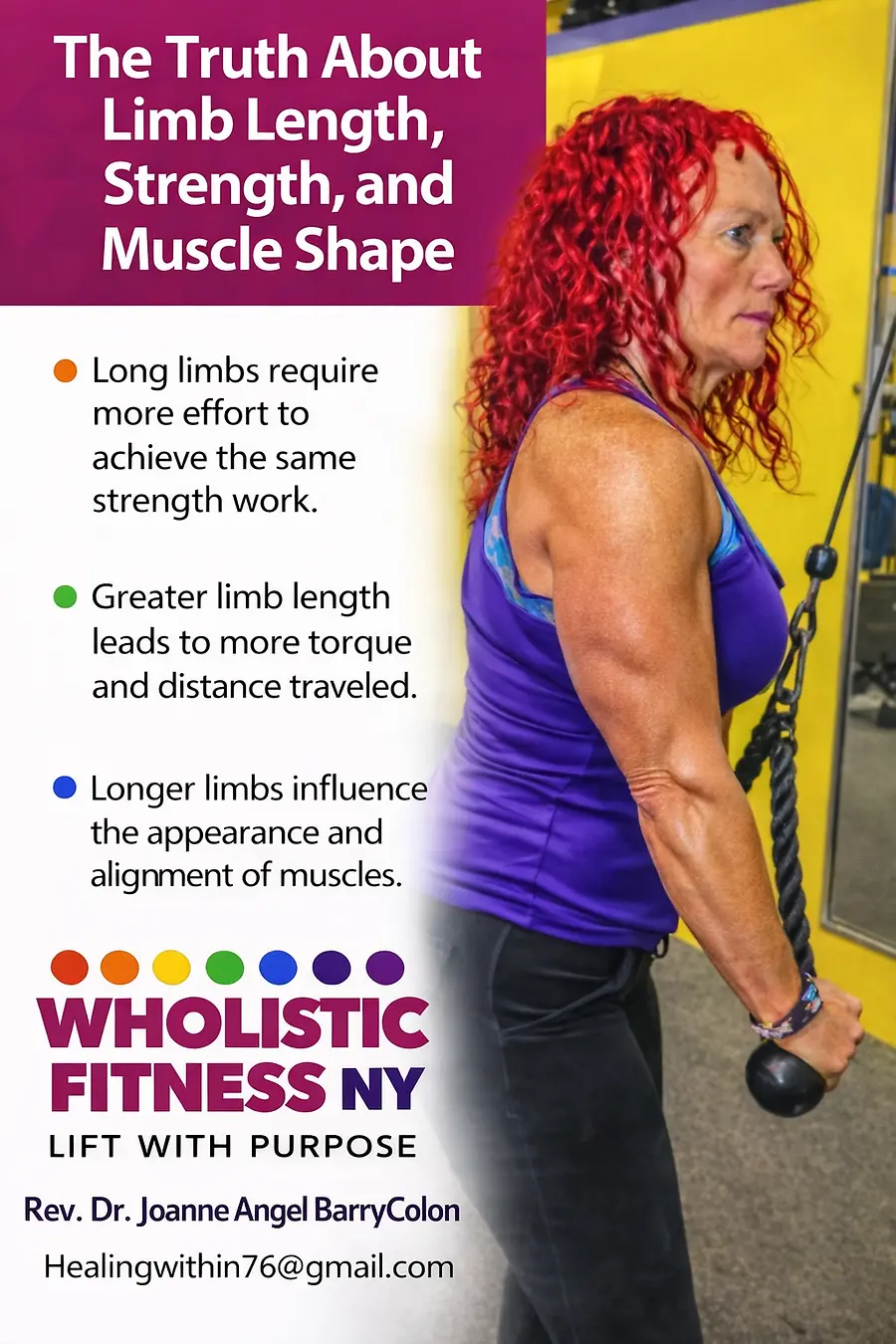
Why Longer Limbs Change the Way You Move, Build, and Experience Strength
When we step into the world of strength training, it is easy to assume that every body responds the same way to exercise. We are often taught the “correct” form, the “ideal” angle, and the “perfect” execution. Yet what is rarely discussed is how deeply our unique body structure—especially the length of our limbs—impacts the way we move, the way we build muscle, and the way we experience strength.
Let us begin with a simple movement: the bicep curl.
On the surface, it appears straightforward. Bend the elbow, bring the weight toward the shoulder, and return. Many are taught to aim for a 90-degree angle or slightly beyond. However, what is happening beneath the surface is far more complex, especially when we compare someone with longer arms to someone with shorter arms.
The body operates through a system of levers. Your bones act as levers, and your joints act as pivot points. When performing a bicep curl, the elbow becomes the pivot, and the forearm becomes the lever. Now here is where limb length becomes significant.
A person with longer arms has a longer lever.
This means the distance between the elbow and the weight in the hand is greater. As a result, the muscle must generate more force to move that weight through space. Even though both individuals may be moving from the same starting point to the same 90-degree angle, the person with longer limbs is moving the weight through a larger arc. More distance requires more work. More work requires more energy, more control, and more muscular engagement.
This is why, from a holistic perspective, strength is not just about how much weight you lift—it is about how your body interacts with that weight.
Now let us address the question: does it take longer for someone with longer limbs to move through a 90-degree angle?
The answer is both yes and no.
From a purely mechanical standpoint, both individuals can move through that angle in the same amount of time. However, when resistance is introduced, the body with longer limbs often requires more effort to stabilize and control the movement. This increased demand can naturally slow the movement down, especially when performed with intention and proper form.
In truth, it is not just about time—it is about tension.
Longer limbs create greater torque at the joint. Torque is the rotational force your muscles must overcome to move the weight. The longer the limb, the greater the torque, and the more the muscle must work to maintain control throughout the movement. This is why individuals with longer arms or legs may feel that exercises are more challenging, even when using the same weight as someone with shorter limbs.
This principle extends beyond the arms and into the lower body as well.
In movements such as squats and lunges, longer legs can change the mechanics of the exercise. The body may need to travel further, stabilize more deeply, and recruit additional muscle groups to maintain alignment. This does not mean one body type is better than another—it simply means each body moves through its own unique pathway of strength.
Now let us touch on muscle shape.
Limb length does not change where your muscles attach, but it does influence how they appear. Individuals with longer limbs often have muscles that look longer and more elongated.
Those with shorter limbs may appear to have fuller, more compact muscle bellies. This is not a reflection of effort or ability—it is simply anatomy expressing itself in form.
So what does this mean for your training?
It means we move away from comparison and into awareness.
Your body is not designed to mimic someone else’s movement exactly. It is designed to move in alignment with its own structure. When you honor your limb length, your leverage, and your natural mechanics, you begin to train with greater intelligence and less frustration.
You begin to understand that the journey is not about forcing the body into a standard—it is about working with the body you are in.
From this space, strength becomes more than physical. It becomes intuitive. It becomes intentional. It becomes holistic.
And that is where true transformation begins.


