The Women in My DNA: What We Inherit Beyond Blood
How the strength of generations before us shapes the choices we make and the voice we use today.

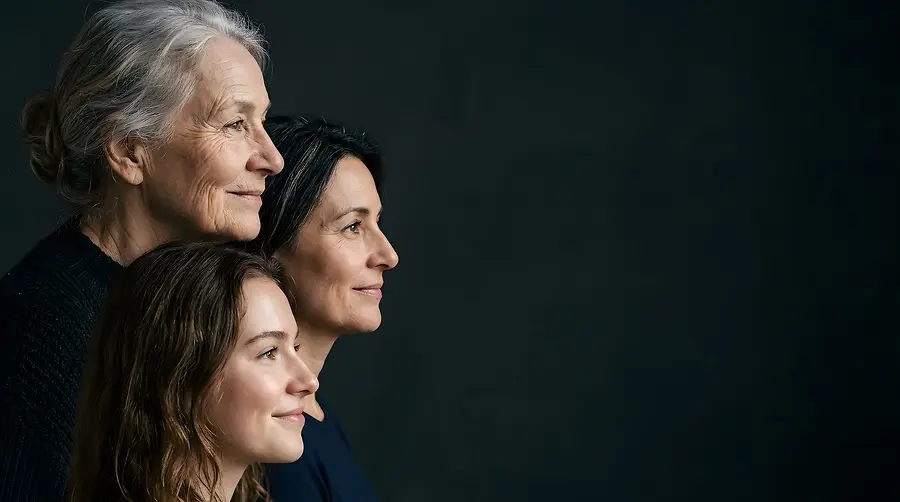
I come from strong women.
Not necessarily women whose names appeared on buildings, awards, or professional titles, but women who worked, endured, protected their families, and kept moving forward when life offered them very few choices.
Some had dreams they could not fully pursue. Some had opinions they could not always express freely. Some carried responsibilities they never chose.
Their strength was real.
But I have come to understand something important:
Strength and freedom are not the same thing.
I was born in Mexico and later built my life in the United States. Immigration gave me the opportunity to experience two cultures and made me deeply aware that what is possible for a woman can change dramatically depending on where she is born, when she is born, and what choices society allows her to make.
That awareness changed the way I see the women who came before me.
I am not the first strong woman in my family.
I may simply belong to a generation with more freedom to decide what to do with that strength.
When I was a child, my grandmother Stella wrote something for me.
Her message reflected the beliefs and language of her generation, but underneath it was something universal. She wanted me to remain grounded, to value hope, generosity, and character, and not become distracted by praise, wealth, or vanity.
I was too young to understand the depth of those words then.
Today, I see them differently.
I see a woman intentionally placing values into another woman’s life before that life had even unfolded.
And it makes me wonder how much of what we eventually call our own strength actually began long before us.
The women in my family did not only give me their blood. They gave me words.
They gave me standards. They gave me examples. They gave me resilience. They gave me an understanding that a meaningful life should be about more than what we accumulate.
Not everything we inherit can be identified in our DNA.
Some inheritances live in the way we think, in the courage we find when life becomes difficult, in the boundaries we learn to protect, in the way we care for others, and sometimes in words spoken to us decades before we finally understand them.
We often talk about finding our tribe as though it begins with the people we meet as adults.
I see it differently.
My tribe began before I was born.
It began with the women in my lineage whose strength reached me even when their opportunities did not.
Throughout my life, that tribe continued to grow.
Women taught me. Women challenged me. Women believed in me. Women opened doors.
Some of those relationships have lasted decades.
And I learned early that relationships should never be purely transactional.
The women who supported me mattered to me beyond what they could do for my career. I wanted to listen to them, learn from them, care for those relationships, and understand the human being behind the role.
Because influence is not simply about what we accomplish.
It is also about what remains in another person because we crossed their path.
We live in a world obsessed with speed.
We answer messages while doing something else. We collect connections, meetings, followers, and information. We are constantly encouraged to accomplish more in less time.
Efficiency matters.
But speed can also make us stop seeing one another.
I have always loved listening to people — their experiences, their perspectives, the stories that made them who they are.
And the older I become, the more I believe that people may forget many of the details of what we said, but they rarely forget how they felt in our presence.
Did they feel heard?
Did they feel respected?
Did they feel seen?
Sometimes the greatest influence we have on another person is not in what we teach them, but in the space we create for them to recognize something that was already inside themselves.
That kind of influence may never appear on a résumé.
But it can change the direction of a life.
Life also makes more sense looking backward than it does while we are living it.
A person enters our life.
A door closes.
An unexpected opportunity appears.
A difficult chapter changes our direction.
A few words written by a grandmother wait quietly for years before we are ready to understand them.
At the time, these moments can look completely unrelated.
Later, we sometimes realize they were shaping us all along.
Purpose is not always something we discover ahead of us. Sometimes we recognize it only by looking backward and realizing that the pieces were connected before we understood the picture.
Perhaps generations work the same way.
The women who came before me could not know what my life would become.
But something traveled forward.
Their values.
Their resilience.
Their sacrifices.
Their silences.
And perhaps even some of their unfinished possibilities.
That is where women’s awareness becomes more than empowerment to me.
It becomes responsibility.
If another woman taught me something, what will I do with that knowledge?
If someone believed in me, whose potential will I recognize?
If someone opened a door for me, will another woman find that door easier to walk through because I was there?
And this is also where TIK Radio was born.
It was never only about creating a podcast.
It was about creating a space for voices, stories, and perspectives to be heard.
A place where different generations, cultures, and experiences could meet.
A place where listening mattered as much as speaking.
In many ways, TIK Radio became an extension of something I had already been doing throughout my life — connecting people, creating space for conversation, and giving value to stories that might otherwise remain unheard.
The women before me did not always have a platform.
I do.
And that gives me a responsibility to use it with purpose.
I cannot return to previous generations and give them the choices they did not have.
But I can be conscious of what I do with mine.
I do not carry their silence so that I can remain silent. I carry their strength so that I can use my voice wisely — and create space for others to use theirs.
What I accomplish may belong to my lifetime.
But the strength behind it did not begin with me.
And if I use my voice with enough awareness, purpose, and intention,
it will not end with me either.


