The Wounded Child
How Montessori's Philosophy of Respect and Observation Can Guide Healing From Childhood Trauma

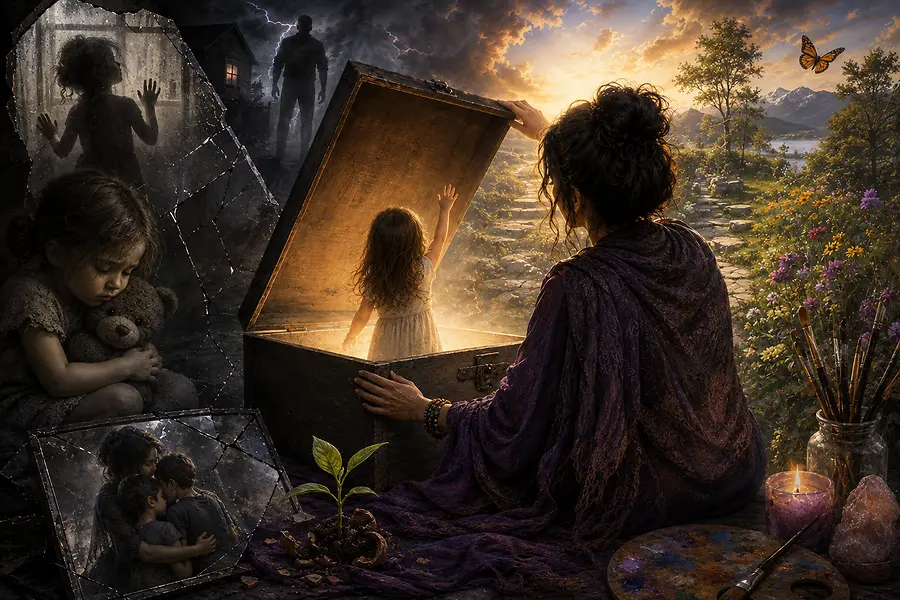
There is a child who lives inside many adults. Sometimes she is playful. Sometimes curious. Sometimes she remembers what it felt like to run barefoot, make something simply because it was beautiful, stare at the stars, or imagine an entire world no one else could see. And sometimes she is hiding. She learned a long time ago that being small did not necessarily mean being protected.
She learned to listen for footsteps. To notice changes in someone's voice. To read a room before entering it. To become quiet when quiet meant safety. Long before she had language for trauma, her body was learning its vocabulary. I know this child.
I once wrote about her:
Please don't hurt me, I am just a child.
I was born in this world innocent and free.
I may not be able to speak my mind,
But I am alive, and I feel the pain.
Those words contain a question that reaches far beyond childhood:
What happens to the developing human being when the environment that should nurture her becomes the place she must learn to survive?
Montessori Saw the Child Differently
Maria Montessori asked adults to reconsider something fundamental: What if the child is not an incomplete adult waiting for us to shape her, but a developing human being actively constructing herself? That distinction matters.
Montessori's educational philosophy placed enormous importance on observation, independence, dignity, freedom within appropriate boundaries, purposeful activity, and an environment designed around the developmental needs of the child.
Instead of constantly asking how adults could control children, Montessori invited adults to observe them.
What is this child trying to do? What does she need? What is developing here? What might become possible if we created an environment in which that development could unfold? Those questions belong in education. But perhaps they also belong in conversations about trauma. Because children don't develop separately from their environments. They develop within them.
What Happens When the Prepared Environment Is Unsafe?
Montessori education is well known for the concept of the prepared environment: surroundings intentionally organized to support the child's development, independence, exploration, and growing competence.
Now imagine the opposite. An unpredictable environment.
- Yelling.
- Violence.
- Loss.
- Fear.
- Neglect.
- Touch that violates rather than comforts.
- Adults whose behavior cannot be predicted.
A child in such an environment is still developing. She is still learning. But some of the lessons may become:
- Stay quiet.
- Watch carefully.
- Don't make anyone angry.
- Don't need too much.
- Be useful.
- Disappear.
- Survive.
The child adapts because adaptation is one of the remarkable capacities of human beings.
But an adaptation that helps a child survive one environment can follow her into places where she no longer needs it.
That is part of the wounded child many adults eventually meet.
Building the Box From Within
Years ago, I described my own experience through another poem, "The Box From Within."
The box begins with loss. A small child grieving her mother at only two years old. Another side appears as childhood itself begins disappearing. Then darkness. Fear. Violation. Silence. Later comes another chapter: a young woman disappearing into a life centered around her children while violence continues behind closed doors. Piece by piece, the box closes.
I wrote:
No one to hear the cries, no one to see the darkness
No one to tell the secrets to, no one to touch or hold.
That box became my metaphor for what happens when experiences we cannot understand, escape, or safely express become contained within us. But boxes aren't always obvious from the outside. A wounded child can grow into an extraordinarily capable adult. She can become educated.
- Raise children.
- Build careers.
- Take care of other people.
- Create.
- Teach.
- Lead.
- Laugh.
- Love.
And still carry a frightened child somewhere inside who learned that the world wasn't safe. That is why we should be careful about judging adults solely by the behaviors we can see. Sometimes we are looking at an adult response. Sometimes we are looking at an old survival strategy wearing adult clothes.
The Child Was Supposed to Explore
There is another part of my poem that feels especially important now:
I want to learn and be able to explore
All time and space and to grow big and strong.
And later:
I want to swim the oceans deep
To fly amongst the clouds in the sky
I want to hike the tallest mountain
And forge the lowest valley.
That is the child I don't want us to lose when discussing childhood trauma. The wounded child is not simply a collection of wounds.
There was someone there before the wounds.
- Curious.
- Imaginative.
- Adventurous.
- Creative.
- Hungry to experience the world.
- She had plans.
This is where Montessori's respect for the natural development of the child speaks so powerfully to me. Children possess an extraordinary drive toward discovery. Watch a young child who feels safe enough to explore. She touches. Builds. Moves. Asks questions. Repeats something until she understands it. Experiments. Makes mistakes. Tries again.
She is constructing a relationship with herself and the world. When trauma enters that world, some of that developmental energy may need to be redirected toward survival.
The question later becomes:
Can we help create conditions in which curiosity can safely return?
Perhaps Healing Requires a New Prepared Environment
This is where Montessori's philosophy gives me another way of thinking about adult healing.
What if the wounded child doesn't always need to be forced out of hiding? What if she needs a different environment?
- Safety.
- Choice.
- Consistency.
- Beauty.
- Nature.
- Creativity.
- Respect.
- Boundaries.
- People whose actions match their words.
- Space to explore without punishment.
- Permission to make mistakes.
- Permission to rest.
- Permission to say no.
- Permission to discover what she likes.
Perhaps healing sometimes means creating, as adults, some of the conditions our developing selves should have received in childhood.
Not because we can travel backward and rewrite what happened. We cannot. But we can change what surrounds us now.
Listen to the Child Instead of Silencing Her
Adults sometimes become frustrated with the parts of themselves that remain frightened, reactive, insecure, or sensitive.
- Why can't I get over this?
- Why does this still bother me?
- Why am I reacting this way?
But perhaps another question is more compassionate:
What is this reaction trying to tell me?
Montessori taught the importance of observing the child rather than constantly interfering with her. There may be wisdom in bringing that same curiosity inward.
- Observe.
- Listen.
- Don't immediately judge.
- What makes the wounded child retreat?
- What helps her emerge?
- What makes her feel safe?
- What brings curiosity back?
- What allows play?
- What awakens creativity?
- What lets her trust?
Instead of saying, There is something wrong with me, perhaps we can sometimes ask:
What happened here, and what do I need now?
Opening the Box
At the end of "The Box From Within," something changes. The woman speaks.
I will not be silenced any longer. I will be heard.
Where there once was darkness there is now light.
When I originally wrote those words, I imagined closing that box forever. Today, I understand healing somewhat differently. Maybe healing isn't sealing the box and pretending it never existed.
Maybe it is reaching a place where we can open it by choice.
Look inside. Understand what belongs to us and what never did. Comfort the child who once had no one to comfort her. Then decide what we want to carry forward.
Because autonomy matters here, too. The child who had no choice eventually becomes an adult who can begin making choices. And perhaps one of those choices can be:
I will create a different environment for myself now.
The Child Is Still There—But So Is Her Wonder
When we talk about the wounded child, I don't want the wound to become her identity. She is more than what happened to her.
Remember the little girl from my poem.
- She wanted oceans.
- Clouds.
- Mountains.
- Valleys.
- She wanted to learn.
- Explore.
- Grow.
- Live.
She had plans for her life.
Maybe healing isn't about getting rid of her. Maybe healing is finally taking her hand. Giving her the safety she should have had all along. And saying:
Come on.
There is still a world out there.
Let's go see it together.