
Title: The Nonlinear Phase: Why Rebuilding Feels Like Chaos Before It Feels Like Progress
How to Build Resilience When Life Falls Apart and Everything Feels Uncontrollable

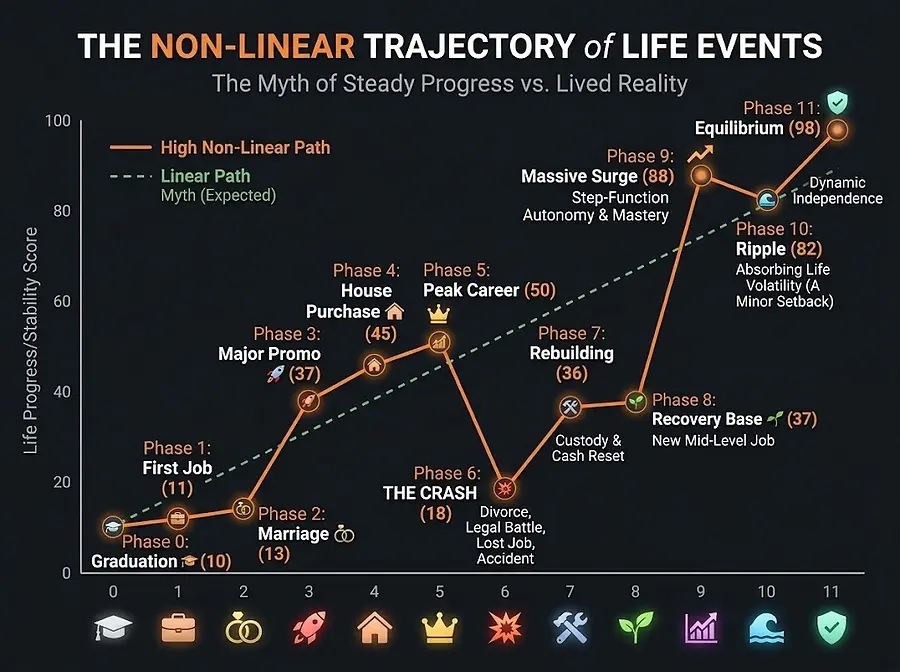
The Nonlinear Phase: Why Rebuilding Feels Like Chaos Before It Feels Like Progress
Most significant transformations do not begin with a calm decision or choice. They start with an abrupt disturbance—an unexpected event that invalidates the assumptions we used to navigate daily life.
A broken promise.
A relationship that turns volatile.
A sudden loss of a job.
A sudden collapse of health.
A series of serious legal proceedings.
A disruption to our sense of safety in our own home.
Suddenly, the routines that kept life steady yesterday no longer work today. The familiar rules are gone, and an uncomfortable phase begins.
The nonlinear phase.
The Compounding of the Shock
Disturbances rarely wait their turn in a polite sequence. They compound.
When a livelihood dissolves, it puts immediate strain on health. When domestic security fractures, legal battles often follow. This is the inflection point where people feel completely unmoored, not because they lack discipline or intellect, but because every operational pillar they leaned on has shifted at the exact same moment.
The mind desperately seeks a linear solution: If I just work harder, solve this one conflict, or fix this one person, everything will return to normal.
It will not. The old normal is gone.
The nonlinear phase is exhausting because you are forced to navigate unmapped territory while carrying the physical toll of high vigilance. You cannot predict the exact timeline of recovery, you cannot control external bad-faith actors, and you cannot force immediate clarity while the storm is active.
The Messy Middle
When life experiences a severe shock, it does not instantly settle back into peace. There is an unpredictable in-between period where emotions, circumstances, and daily reality swing wildly before reaching a steady rhythm.
This transition feels exhausting because:
- The environment feels volatile and unpredictable.
- Old habits no longer protect you, but new ones are not yet second nature.
- Energy is depleted from constantly being on guard.
- The future cannot be clearly mapped out.
The hardest part is not the disturbance itself. The hardest part is living through the uncertainty while the dust is still thick in the air.
Modern culture often sells the myth that resilient people navigate crises gracefully. We admire the polished outcome: the person who rebuilt their life, the calm professional, the restored household. But we rarely talk about the invisible strain of the messy middle—the nights spent questioning everything, the boundary lines drawn in exhaustion, and the silent discipline required just to get through the day.
A life in transition rarely looks composed while it is finding its footing.
Redefining Equilibrium
We often misunderstand equilibrium. We treat it as if it means complete stillness, a life where nothing ever shakes us, or an existence free from conflict.
That is an illusion.
True equilibrium is the resilience to handle life's sudden spikes in intensity. It is the capacity to absorb chaos and friction so deeply that life continues to move forward irrespective of the ups and downs.
Equilibrium does not mean life never gets disturbed. It means that when a disturbance hits:
- It may knock you off balance for an hour, a day, or a week.
- The shock may feel sharp and overwhelming in the moment.
- But the center holds. You do not collapse. You reset, steady your footing, and get right back on track.
It is not passive peace. It is the quiet, internal strength that says, "This disruption is happening around me, but my life, my work, and my direction continue regardless."
The Illusion of the Straight Line
When outside observers look at someone who has rebuilt their career, their minds play a retrospective trick. They see where the person began at the starting gate, they see where they stand today, and they draw a clean, uninterrupted line between the two points.
Society loves that picture. It creates the comfortable belief that progress is a smooth, continuous ladder where every month of hard work automatically adds another rung.
That straight line is a myth created by looking backward from the finish line.
The tidy picture erases the real story hidden in the middle:
- It erases the invisible foundation years when you put in relentless effort but receive almost zero external reward or recognition.
- It erases the false breakouts where an early surge collapses under unstable partnerships or fragile arrangements.
- It erases the catastrophic disruptions where a sudden external crisis knocks the floor out from under you, cutting your momentum in half overnight.
- It erases the quiet, unglamorous reset—the locked doors, the strict boundaries, and the daily discipline of rebuilding your footing when no one is watching.
The starting point and the ending point do not explain growth. The real transformation happens entirely in the messy, volatile space in between.
The Anatomy of Lived Progress
The scores above are illustrative, not a validated measurement. The author assigned each one based on the personal intensity of her own life events as a way to visualize the gap between the linear myth and the nonlinear reality—not as a scientific or universal scale.
Beyond the Rebound: The Five Pillars of Dynamic Equilibrium
The climb from the reset floor of Phase 8 up to Phase 11 is not driven by luck or market timing. It is driven by assets that only a nonlinear journey can forge:
Emotional and Social Maturity: The quiet power of total indifference to outside chaos. You no longer audition for approval or absorb the volatility of erratic people.
Radical Objectivity: The discipline to strip away wishful thinking, evaluate people strictly by their actions, and recognize that a temporary disturbance is just a passing ripple, not a collapse.
Hardened Persistence: The grit to execute with single-threaded focus, closing one loop at a time, working behind locked doors, and holding the line until the storm passes.
Compounded Skills: The reality that credentials, analytical mastery, and operational competence never disappear during a crisis. They wait quietly beneath the surface as latent equity.
Lived Experience: The un-Googleable authority of having faced catastrophic shocks, absorbed the blow, and redesigned the system on your own terms.
When these five pillars align, you achieve true dynamic equilibrium: you no longer ask life to be frictionless. You simply build a structure strong enough that your work, your focus, and your life continue moving forward regardless of the noise.
The Distortion of Face-Value Perception
When people evaluate another person's professional or family standing at face value, their minds run a flawed cognitive shortcut. They see a single snapshot of someone's peak and mistake it for their entire storyline.
Because the nonlinear path—the silent groundwork, catastrophic dips, and boundary-enforcing resets—is completely invisible from the outside, face-value perception generates intense psychological distortion:
Envy and Competition: Assuming growth is a neat, straight escalator where someone else's climb takes away your spot, ignoring that true autonomy is forged through unique personal endurance.
Resentment: Evaluating visible outputs without acknowledging the true cost of hidden inputs, wondering why someone else achieved recognition without seeing their Phase 6 crash.
Inadequacy and Depression: Comparing your own internal, chaotic reset phase against someone else's curated public highlight reel, concluding you are behind when your system is simply recalibrating.
Sustainable dynamic equilibrium cannot be evaluated from a surface snapshot. Real stability is forged by holding firm boundaries, operating behind locked doors when necessary, and knowing that your work and purpose continue moving forward regardless of who is watching or what noise surrounds you.
Hope, Reality, and Decisive Boundaries
Hope is a powerful instinct. It helps us endure prolonged difficulty, gives people second chances, and keeps us empathetic.
Yet ungrounded hope can also delay self-preservation.
When we expend our energy waiting for an erratic person or an unpredictable situation to magically change, we postpone securing the only things we actually control: our own space, our finances, and our focus.
Eventually, every difficult situation requires a clear choice:
Do we exhaust ourselves trying to patch up an unstable past?
Or do we draw a firm line and build a protected future?
Small Anchors in the Storm
When the external environment is chaotic, the remedy is not grand gestures. It is tightening the small things under your direct control:
- A locked door that guarantees quiet sleep.
- A clear boundary delivered without guilt or negotiation.
- A protected morning routine dedicated to your own work.
- Keeping common spaces neutral and refusing to get pulled into other people's storms.
Each small action acts as a stabilizing anchor. It absorbs the noise around you so your core priorities—your health, your livelihood, and your peace of mind—remain intact.
The Other Side of the Shock
Looking back, difficult chapters look different than they felt while we were enduring them.
In the heat of the moment, everything feels fragmented. But as the boundary holds, the pattern becomes clear. The disruption forced essential clarity. It showed you where the leaks were, taught you what you will never tolerate again, and compelled you to claim your own territory.
The goal was never to return to how things were before the shock occurred.
The real transformation happens when the old situation breaks down and you discover the quiet, steady resilience that keeps moving forward anyway.

She is a business strategist, researcher, and consultant with a strong interdisciplinary background spanning engineering, innovation, commercialization, federal funding, and entrepreneurship. She is the Founder of Xaiden Arts & Business Consulting, where she helps startups, nonprofits, small businesses, and innovation-driven organizations with business strategy, market research, commercialization, grant and proposal…





