Transpire to Transform
How organizational awareness becomes the catalyst for meaningful change and growth.

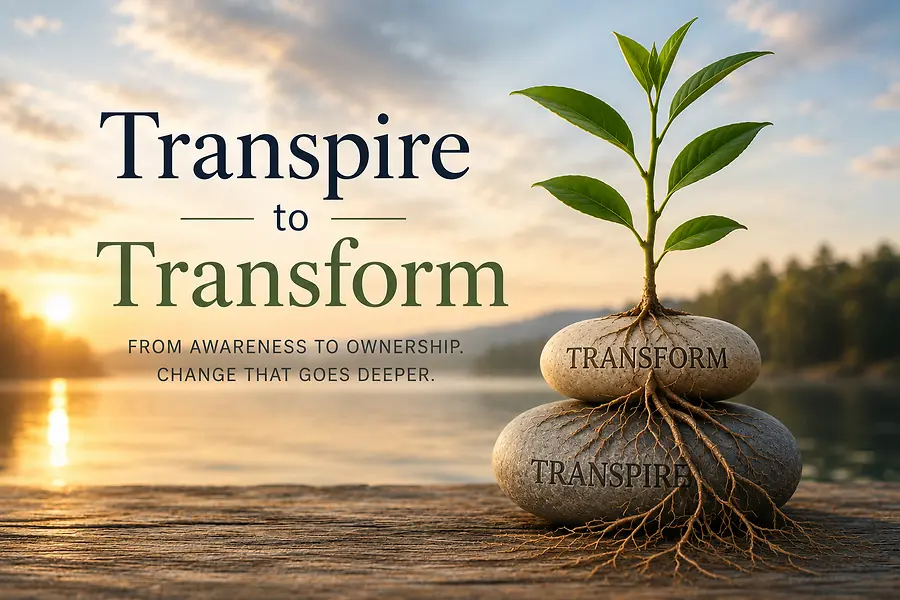
From Transpire to Transformation: Understanding the Real Beginning of Change
Where does real change begin? Is the need for change based on what we see, or what we know about what we see?
These are important questions that deserve deeper exploration. When considering the term transpire, it is often associated with negative connotations, although it is actually a neutral word. In this article, it is important to clarify that transpire simply means evidence of an occurrence or an awareness of something that has taken place. It matters to understand what we are observing and why it has occurred.
So, What Is the Issue?
In an organizational setting, many decisions are based on what is seen rather than what is known. Essentially, when situations transpire, they only indicate that something has occurred; they do not reveal why it has occurred.
Warren Bennis discusses the need for this mindset shift in the 2009 revision of On Becoming a Leader, where he highlights the difference between "seeing the world as it is and as it can be." This is where transformation becomes essential.
Transformation is an inside-out change that requires commitment to a continuous process. It is an intentional effort toward growth that does not occur by chance. With this intentionality, transformation is witnessed within an organization when its members offer themselves to be deployed into change rather than simply recruited into change (Bennis, 2009).
The connection is that transpire and transformation are not separate entities. Instead, they represent stages in the change process—from awareness to ownership.
Recognizing Symptoms Versus Addressing the Condition
In a corporate environment—whether in business, an office, or workplace culture—when situations transpire, employees, leaders, and direct reports alike are often responding only to what is visible. These occurrences can be understood as symptoms being treated while the underlying condition remains unresolved.
Gary Marx (2006) addresses this concept in Future-Focused Leadership by describing organizations that build their business around "fending off change." When there is a lack of willingness to address what has become misaligned, it often feels easier to remain comfortable and continue doing what comes naturally.
Does this sound familiar?
"If it ain't broke, don't fix it!"
So, What Is the Cure?
The cure is an inside-out understanding—a diagnosis of the current state—followed by meaningful transformation.
In my own experience as an I/O Psychologist, I have learned that I cannot be successful without continually evaluating who I am, where I am, and what areas require growth or improvement. Without consistent reflection, I risk failing the employees, leaders, and organizations that have trusted me to support their growth process. I also risk limiting my own development.
What remains true is that improvement is a continual process. I allow myself the opportunity to be challenged daily, to upskill, stretch my creativity, and expand my approaches without becoming trapped by familiar methods. Through this process, I strengthen my agility, flexibility, and adaptability so that I can respond effectively to changing needs.
A commitment to something simply because "it has always been done that way" can damage organizational culture, employee and customer retention, and overall business performance.
When we understand transformation as an organic process of growth, we can begin making intentional shifts.
Steps to Move From Transpire to Transformation
(For non-urgent scenarios only)
1. Retrain Your Senses: Sight, Hearing, Smell, Taste, and Touch
Hearing:
Instead of simply hearing a concern, listen with intention. Pay attention to what is being communicated and what may remain unsaid. Understanding the hidden areas can lead to better decision-making and more meaningful responses.
Listening:
Instead of immediately speaking or planning the next steps, listen again. Make listening your first response—not commenting, defending, or strategizing.
Sight:
Instead of focusing only on what is visible, put on corrective lenses that allow you to see beyond the immediate picture. Seek different perspectives because the situation is often larger than it appears, and the solution may be closer than expected.
Proactivity:
Instead of operating reactively, become more proactive. Proactive approaches come from using knowledge and awareness to strengthen systems, processes, and people.
Smell and Taste:
Instead of ignoring that unsettled feeling, metaphorically use your senses of smell and taste to explore deeper. Internal signals often remind us that we may not yet have all the information needed to fully understand a situation.
Touch:
Instead of relying on the status quo, use your sense of touch to engage more deeply. Explore through observations, reviewing artifacts, conducting interviews, completing investigations, researching, administering surveys, and hosting town halls. This creates an opportunity to intentionally pursue transformation through real-time human connection.
"Not everything that is faced can be changed, but nothing can be changed until it is faced."


