Trump’s War on the Endangerment Finding Is a War on Our Lungs, Our Wallets, and Our Futures
How Trump's Cancellation of the EPA's Endangerment Finding Threatens Climate, Health, and the Economy

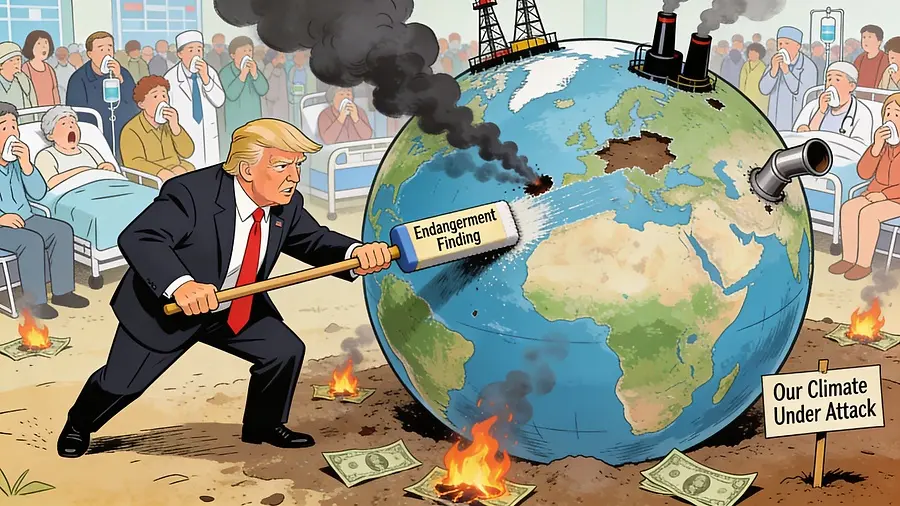
Donald Trump’s decision to cancel the EPA’s Endangerment Finding is not a minor regulatory adjustment; it is an attack on the legal and scientific foundation of climate protection in the United States, with consequences that will reverberate through global emissions, public health, and the economy for decades.
What the Endangerment Finding Is — And Why It Matters
In 2009, the EPA determined that greenhouse gases like carbon dioxide and methane “endanger public health and welfare,” triggering the agency’s duty under the Clean Air Act to regulate them. For 17 years, this finding has underpinned rules limiting emissions from vehicles, power plants, oil and gas facilities, and other major sources. It is the legal keystone that transforms climate science into actionable policy.
By revoking the Endangerment Finding, Trump’s EPA attempts to eliminate the legal basis for treating greenhouse gases as pollutants at all. Administration officials have called it “the most significant deregulatory measure in American history” and “the single largest deregulatory action in U.S. history.” If upheld in court, it would not just roll back individual rules—it would cripple any future administration’s ability to regulate climate pollution under existing law.
How Trump Is Dismantling Climate Protections
Trump frames this repeal as liberation from “disastrous” Obama-era climate rules and a boost to “American energy.” In reality, the policy moves tell a different story:
- Eliminating the Endangerment Finding itself, declaring that the Clean Air Act does not authorize the EPA to regulate greenhouse gases.
- Stripping away national vehicle greenhouse gas and fuel economy standards, while blocking states like California from enforcing stronger rules.
- Weakening or abandoning limits on climate pollution from power plants, industrial sources, and oil and gas operations that relied on the Finding.
- Retreating from international climate commitments, including exiting the Paris Agreement and reducing U.S. leadership in global climate diplomacy.
This is not administrative housekeeping; it is a deliberate, long-standing effort—championed by Project 2025 and fossil-fuel-funded think tanks—to lock in fossil fuel dependence and make meaningful climate regulation legally and politically more difficult.
Emissions and Climate: A Global Setback
The immediate, measurable impact is more climate pollution. Analyses suggest that rescinding the Endangerment Finding and associated vehicle rules alone will increase U.S. greenhouse gas emissions by roughly 10% over the next 30 years, adding billions of tons of CO₂ to the atmosphere. Transportation is the largest direct source of U.S. greenhouse gases; erasing these standards is not marginal.
Because greenhouse gases mix globally, additional U.S. emissions contribute to worldwide warming regardless of origin. As one of the largest historical emitters, U.S. backsliding has outsized effects on the global carbon budget and the remaining window to limit warming to internationally agreed targets. Weakening U.S. commitments also emboldens other countries to delay or dilute their own climate actions, undermining collective ambition at a moment when science demands steeper cuts.
Added emissions translate into more frequent and intense heatwaves, heavier downpours, worsening droughts, stronger hurricanes, accelerated sea-level rise, and faster loss of glaciers and snowpack. These are tangible shocks driving food insecurity, migration, and economic instability.
Health: More Pollution, More Disease, More Death
Trump has claimed the repeal has “nothing to do with public health.” Science and data say otherwise.
The Endangerment Finding was grounded in decades of evidence showing that greenhouse gas emissions—and the fossil fuel combustion that produces them—harm human health through hotter temperatures, dirtier air, and climate-amplified disasters. Repealing it frees major polluters to emit both greenhouse gases and co-pollutants like fine particulate matter and ozone precursors, which directly damage lungs and hearts.
Experts estimate that this rollback could result in tens of thousands of premature deaths and tens of millions more asthma attacks over the coming decades, disproportionately affecting children, the elderly, people with pre-existing conditions, and low-income communities near highways, refineries, and power plants. Climate-related health harms compound these direct impacts: extreme heat drives spikes in heatstroke and cardiovascular deaths, worsening wildfires choke regions in smoke, and shifting disease vectors expand tick- and mosquito-borne illnesses.
Economic Consequences: Short-Term Profits, Long-Term Costs
The administration presents the repeal as economic relief—cutting “red tape” and boosting growth. Fossil fuel companies clearly benefit from lower compliance costs, extended life for coal plants, and continued oil and gas demand.
But the long-term economic picture is different. Climate damages—crop failures, infrastructure destruction from storms and floods, wildfire losses, productivity declines, and pollution-related health costs—already impose hundreds of billions of dollars in global costs, with the U.S. bearing a major share. Increasing emissions by 10% over 30 years will significantly add to these damages.
Moreover, the policy undermines investment certainty for clean energy, electric vehicles, and efficiency. Companies making multi-decade capital decisions now see a federal government structurally biased toward fossil fuels, risking U.S. competitiveness as other nations accelerate low-carbon transitions.
EPA has also minimized or ignored the monetary value of lives saved, hospitalizations avoided, and illnesses prevented when calculating “costs” and “benefits.” By devaluing human life in policy calculations, almost any deregulatory step looks “cost-effective” on paper—a deeply flawed and ethically troubling approach.
Why This Moment Demands Action
Trump’s cancellation of the Endangerment Finding is a deliberate attempt to sever the link between climate science and climate law at a moment when that link is crucial. This move prioritizes short-term fossil fuel interests over the health, safety, and economic stability of Americans and the world.
If courts uphold this decision, future administrations that accept climate science will confront a twenty-first-century crisis with a gutted twentieth-century statute, forced either to persuade a polarized Congress or rebuild the legal foundation from scratch. Meanwhile, the atmosphere will not wait—every year of delay locks in more warming, more damage, and more preventable suffering.
The choice is stark: allow the repeal to stand as the moment the U.S. turned its back on its duty to protect people from well-understood harms—or use this moment to defend science, strengthen climate law, and accelerate the clean-energy transition already underway in communities, boardrooms, and capitals worldwide.
References
- Biesecker, M. “Trump’s EPA Revokes Scientific Finding that Underpinned US Fight Against Climate Change.” Associated Press, 12 February 2026.
- “EPA Repeals Legal Basis for Regulating Greenhouse Gases. What it Means for the US — and the World.” World Resources Institute, 11 February 2026.
- “President Trump Delivers Biggest Regulatory Relief in History.” The White House, 12 February 2026.
- “EPA Reverses Long-Standing Climate Change Finding, Stripping Its Power to Regulate Greenhouse Gases.” NBC News, 12 February 2026.
- “Trump Delivers a Deadly Blow to EPA’s Ability to Regulate Climate Pollution.” CNN, 12 February 2026.
- “Trump EPA Overturns Endangerment Finding.” Environmental Defense Fund, 12 February 2026.
- “How EPA ‘Endangerment Finding’ Repeal Could Impact Your Wallet.” CNBC, 12 February 2026.
- “EPA Strikes at the Roots of Federal GHG Regulations, Rescinds Endangerment Finding for Motor Vehicles.” Beveridge & Diamond PC Insight, 14 February 2026.
- “Trump Revokes EPA Finding on Greenhouse Gas Threat in Major Climate Policy Shift.” CNBC, 12 February 2026.
- “Why the US Endangerment Finding Matters.” Earth.Org, 11 February 2026.