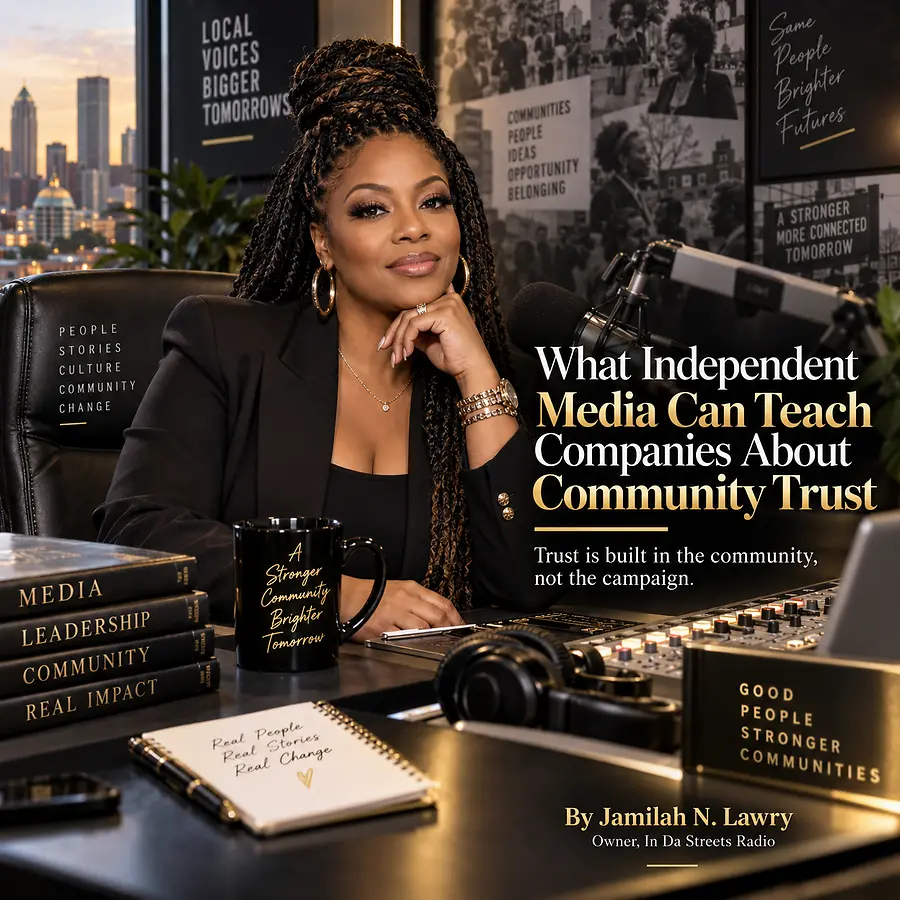
What Independent Media Can Teach Companies About Community Trust
What independent media knows about building trust that Corporate America is still struggling to learn.

There is something independent media understands about trust that a lot of companies are still trying to solve with another marketing campaign.
You cannot manufacture community.
You cannot automate authenticity.
And you definitely cannot parachute into a neighborhood, demographic, or cultural moment when it becomes profitable and expect people to suddenly believe you care.
As the owner of In Da Streets Radio, I have had a front-row seat to what community trust actually looks like. Independent media does not have the luxury of hiding behind massive advertising budgets, celebrity endorsements, or corporate language. We grow because people listen. People participate. People tell somebody else about us. Artists trust us with their music. Businesses trust us with their brands. Listeners trust us to understand what matters to them.
That relationship is everything.
And companies could learn a lot from it.
One of the biggest lessons is simple: people trust organizations that feel present.
Independent media lives in the community. We hear what people are talking about before it becomes a trend report. We know what artists are struggling with before the industry writes an article about it. We see the business owner trying to figure out how to survive before anybody calls them an “emerging entrepreneur.”
We are close enough to hear the real conversation.
A lot of companies are not.
They conduct surveys, analyze customer data, hire agencies, review dashboards, and then wonder why their audience still feels disconnected from them.
Sometimes the missing piece is not more data.
Sometimes you need proximity.
You need people around the table who actually understand the communities you are trying to reach.
And yes, this is where a little Black girl magic enters the conversation.
When you are a Black woman building an independent media company, you learn quickly how to listen between the lines. You learn how to recognize what is being said, what is not being said, and why somebody may not trust the institution asking the question in the first place.
That kind of cultural intelligence is not something you can always download into a presentation.
It comes from being in a relationship with people.
Another thing independent media gets right is responsiveness.
When your audience tells you something is not working, you cannot wait six months for a committee meeting.
You adjust.
You listen.
You communicate.
You make the change.
That creates a different kind of relationship because people see that their voice has an impact.
Companies say they want engaged customers, but engagement works both ways. If people speak and nothing changes, eventually they stop talking.
Trust starts breaking down when customers feel like they are being studied instead of heard.
Independent media also understands the power of representation.
People want to see themselves reflected accurately, not stereotyped, tokenized, or dragged out during heritage month and placed back on the shelf the following week.
Representation builds trust when it feels natural.
When the language sounds familiar.
When the stories feel real.
When people know they are not just being used as a target audience.
That matters more than many companies realize.
There is also something else independent media does extremely well: we humanize the brand.
People know there are real people behind independent platforms.
They know the personalities.
They know the hosts.
They know the struggles.
They know the wins.
That vulnerability creates connection.
Some companies have become so polished that nobody can feel them anymore.
Every statement sounds approved.
Every social media post sounds filtered.
Every response feels like it came from a legal department.
Professionalism is important, but professionalism without personality can create distance.
People do business with companies, but they build relationships with people.
That distinction matters.
At In Da Streets Radio, community is not a marketing department.
Community is the business model.
That means we have to continuously earn attention, loyalty, and trust. Nobody owes us a listen. Nobody owes us a follow. Nobody owes us support simply because we built something.
We have to create value.
We have to stay relevant.
We have to show up.
Corporate America could benefit from remembering that, too.
Customer loyalty is not guaranteed because your company has been around for 40 years.
Trust is not guaranteed because your logo is recognizable.
And community support is definitely not guaranteed because you sponsored one event.
Trust is earned through a pattern of behavior.
People are watching how you respond when something goes wrong.
They are watching who you partner with.
They are watching who gets leadership opportunities.
They are watching whether your community initiatives continue when nobody is taking pictures.
They are watching whether your promises match your actions.
Independent media survives under that kind of accountability every single day.
And maybe that is the lesson.
Companies that want stronger community trust should stop thinking like advertisers and start thinking like community members.
Listen before speaking.
Show up before selling.
Invest before asking.
Build relationships before launching campaigns.
And most importantly, understand that trust is not something you own.
It is something the community decides to give you.
And they can take it back just as quickly.
Independent media learned that lesson a long time ago.
Some of the smartest companies in the world are just now catching up.
By Jamilah N. Lawry
Founder & CEO, My Biz Consulting
Owner, In Da Streets Radio