When a Performance Problem Is Really a Communication Problem
How to distinguish between performance issues and communication breakdowns in the workplace.

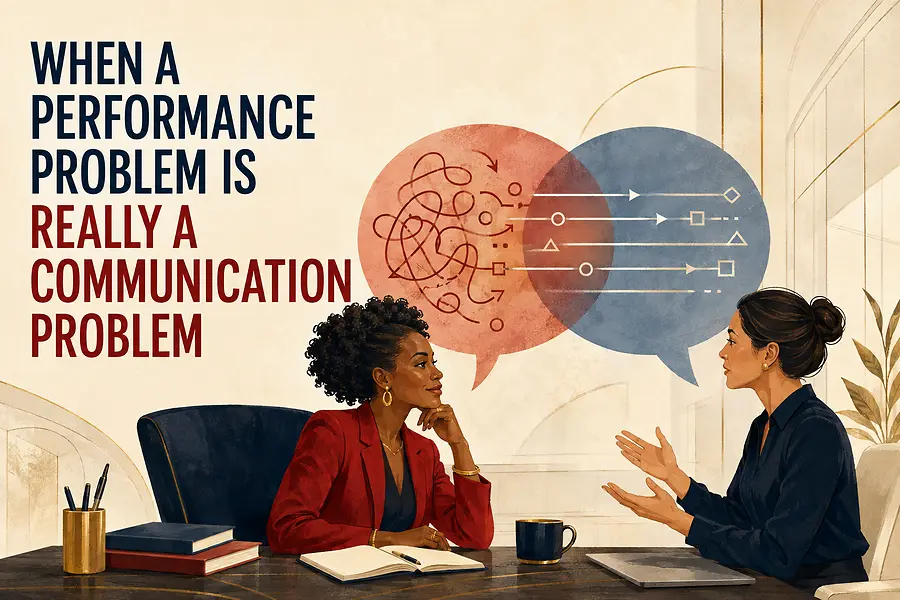
When a Performance Problem Is Really a Communication Problem
By Alana D. Tanner
When an employee is not meeting expectations, it is easy to label the situation a performance problem.
They are not taking enough initiative. They are missing the mark. They are not communicating. They do not seem committed. They should already know what to do.
Sometimes those conclusions are accurate.
But sometimes what looks like a performance issue is actually a communication issue.
As a Professional Certified Coach specializing in workplace and interpersonal dynamics, I have seen capable employees struggle not because they lack talent or motivation, but because they are working with unclear expectations, incomplete information, conflicting priorities, or feedback that arrives far too late.
The consequences can be significant.
Trust begins to erode. Frustration increases. The employee becomes defensive or disengaged. The leader grows increasingly convinced that the employee is the problem.
Eventually, an avoidable communication breakdown can become a genuine performance problem.
Expectations Aren't Clear Just Because They Were Stated
A leader may believe an expectation was communicated because it was mentioned in a meeting, included in an email, or briefly discussed during onboarding.
But stating an expectation is not the same as creating clarity.
Consider how often employees are told to:
“Take more ownership.”
“Be more strategic.”
“Communicate better.”
“Show greater leadership.”
Those phrases sound meaningful, but they can mean very different things to different people.
What does ownership actually look like in this role?
Which decisions can the employee make independently?
When should the leader be consulted?
What does successful communication look like?
How will it be measured?
Without specific answers, employees are left to interpret broad instructions through their own experiences and assumptions. When their interpretation differs from their leader's, the resulting gap can easily be labeled poor performance.
Before deciding that an employee failed to meet an expectation, leaders should ask:
Was the expectation clear enough that both of us would describe it the same way?
If not, the problem may not be performance yet.
It may be clarity.
Silence Is Often Mistaken for Understanding
Many leaders ask:
“Does everyone understand?”
No one raises a concern, so the meeting moves on.
But silence does not always mean understanding.
An employee may hesitate to ask questions because they do not want to appear unprepared. They may worry that asking for clarification will be interpreted as a lack of confidence or competence.
In some workplaces, previous questions may have been met with impatience, defensiveness, or dismissive responses.
The employee may also genuinely believe they understand the assignment while the leader assumes they understand something entirely different.
Instead of simply asking whether an employee understands, leaders can ask questions that reveal how the employee is interpreting the work:
- “What do you see as the most important outcome?”
- “What will you prioritize first?”
- “What obstacles do you anticipate?”
- “What support or information do you need from me?”
These questions are not about micromanaging.
They are about creating alignment before time, energy, and trust are lost.
Feedback Shouldn't Arrive as a Surprise
Another common communication failure occurs when leaders wait too long to address concerns.
Some leaders avoid difficult conversations because they want to preserve the relationship. Others hope the issue will correct itself.
Meanwhile, frustration quietly builds.
By the time the conversation finally happens, the leader may be discussing a pattern that has existed for months, while the employee is hearing about it for the first time.
That is not effective feedback.
It is accumulated frustration.
Effective feedback should be timely, specific, and focused on observable behavior.
Instead of saying:
“You need to be more professional.”
Explain what happened, why it mattered, and what needs to change.
For example:
“When the client asked for an update, you said you had not received the information you needed from the team. That may have been accurate, but discussing an internal breakdown in front of the client reduced their confidence in us. Next time, acknowledge the request, provide a realistic timeline, and bring the internal concern to me afterward.”
That conversation gives the employee something concrete to understand and change.
It also gives the leader an opportunity to coach rather than simply criticize.
Communication Is a Shared Responsibility
Recognizing a communication problem does not mean removing accountability from the employee.
Employees are responsible for asking questions, communicating obstacles, receiving feedback, following through, and taking ownership of their work.
Leaders are responsible for establishing clear expectations, providing necessary context, addressing concerns promptly, and creating an environment where employees can raise problems before they become crises.
Accountability and communication are not competing ideas.
Strong accountability depends on strong communication.
Leaders should not use communication as an excuse for ongoing poor performance.
But they also should not hold employees accountable for expectations that were never clearly established.
The goal is not to avoid difficult decisions.
The goal is to make better-informed ones.
Start With a Clarifying Conversation
Before labeling someone as a poor performer, begin with curiosity.
Ask:
- “What is getting in the way of the result we need?”
- “How are you understanding the expectations of your role?”
- “Where do you feel the priorities are unclear or competing?”
- “What feedback or information would help you perform more effectively?”
- “What part of this situation do you believe you own?”
These questions do not guarantee that the employee will improve.
They do, however, help reveal whether the underlying issue is a skill gap, lack of effort, insufficient resources, competing priorities, unclear expectations, or a breakdown in the working relationship.
Once the actual problem is identified, the leader can respond appropriately.
A skill gap may require training.
A resource problem may require additional support.
A lack of effort may require firmer accountability.
An expectation gap requires clarity.
And a communication breakdown requires honesty and a willingness from both people to change how they work together.
Don't Solve the Wrong Problem
Organizations lose capable people when they mistake confusion for incompetence, hesitation for disengagement, or unanswered questions for a lack of initiative.
They also lose valuable time when communication problems are allowed to grow until they affect morale, trust, productivity, and retention.
The most effective leaders do not avoid accountability.
They make accountability possible by creating clarity first.
Before concluding that someone cannot or will not perform, ask:
Do they truly understand what success requires?
And then ask yourself:
Have I given them a fair opportunity to succeed?
Sometimes the answer will be yes.
The employee knows what is expected, has the resources to succeed, has received clear feedback, and still chooses not to meet the standard.
That is a performance problem.
But sometimes the answer is no.
Sometimes the expectations were vague, priorities were competing, feedback came too late, or the employee was never given enough information to understand what success actually looked like.
That is a communication problem.
And if we diagnose the wrong problem, we will almost certainly choose the wrong solution.
Because before we ask an employee to perform better, we should make sure we have communicated what better actually means.


