When Leaders Become Rivals, Employees Become Pawns: The Human Cost of Leadership Infighting
How leadership conflict fractures organizations and the cost of internal power struggles on employees and institutional trust.

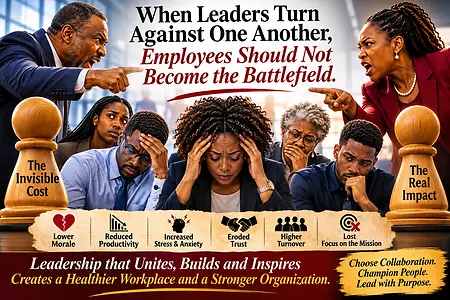
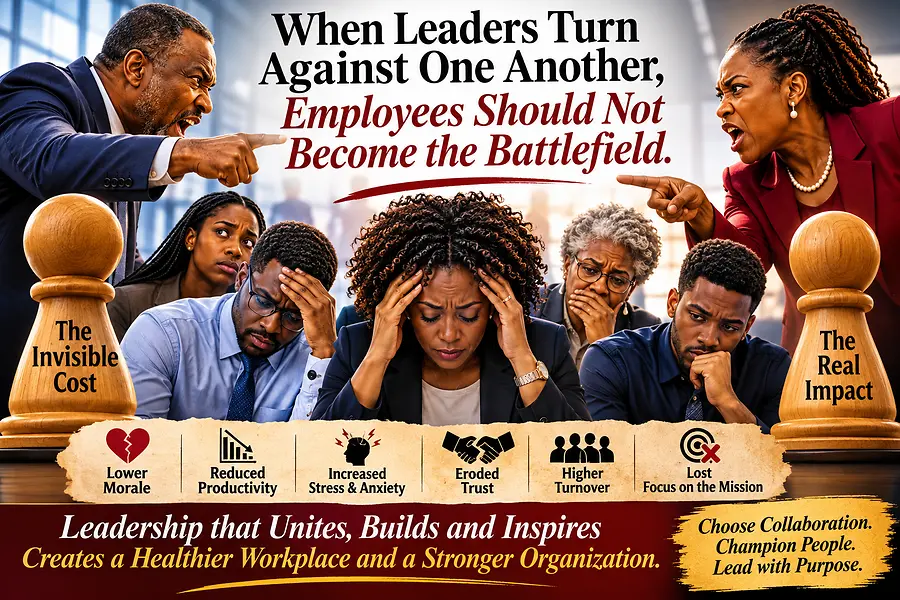
Leadership conflict rarely stays between the leaders involved. When professional disagreement becomes a power struggle, it can fracture working relationships, erode trust, and leave employees fighting battles they never chose.
Leadership carries responsibility for people, resources, and organizational direction. It should create stability and bring people together around a shared purpose. Healthy disagreement supports that work: different perspectives challenge assumptions, strengthen decisions, and encourage innovation.
The problem begins when disagreement becomes a contest for dominance, loyalty, recognition, or control. Employees then risk becoming unwilling participants in a conflict that has little to do with their responsibilities.
The Unspoken Politics of Choosing Sides
One of the most damaging consequences of leadership infighting is the creation of organizational camps.
Employees who once worked collaboratively may find that ordinary conversations, professional relationships, and routine decisions are interpreted as declarations of allegiance. Communicating with one leader may be perceived as disloyalty to another. Receiving recognition may associate an employee with a faction they never joined.
Employees should not have to demonstrate loyalty to competing leaders to establish their credibility or secure their place within an organization. They should not have to calculate whom to speak to, whose instructions to follow, or whether doing their jobs will be seen as taking sides.
Yet leadership rivalry can make those calculations part of daily work.
Employees may be asked to carry messages, validate a leader's position, reinforce competing narratives, or undermine a colleague's credibility. These pressures can be explicit, but they also emerge through selective communication, exclusion, withheld information, conflicting instructions, and preferential treatment.
Gradually, employees redirect their attention. They manage perceptions, approach collaboration cautiously, and question the motives behind decisions. Accomplishing the mission becomes harder when navigating the politics becomes a condition of doing the work.
The Human Cost Behind the Performance Report
Organizations track productivity, retention, financial outcomes, and employee engagement. Those measures may reveal that something is wrong without fully capturing the experience of working through leadership conflict.
Consider the employee who worries that an innocent conversation will be misconstrued. The supervisor who receives incompatible instructions from two leaders. The capable professional whose contributions are repeatedly overshadowed by questions of allegiance.
These situations demand attention and emotional energy that employees need for their actual work. People may become guarded, lose motivation, or withdraw from conversations in which they once participated freely. Their caution can be mistaken for indifference when it reflects a growing need to protect themselves.
There is something deeply demoralizing about arriving at work ready to contribute and discovering that the day's greatest challenge is managing the fallout from someone else's conflict.
Over time, even dedicated employees may question whether remaining in the organization is worth that burden.
When Silence Replaces Trust
Leadership infighting also weakens the conditions that allow employees to speak honestly, ask questions, acknowledge mistakes, and offer different perspectives.
When expressing an opinion could damage a relationship with someone in authority, silence becomes a practical choice. When association with a colleague carries political consequences, collaboration narrows. When leaders issue competing instructions, employees can be held accountable for expectations they had no power to reconcile.
Trust deteriorates as employees begin questioning how decisions are made. Are assignments based on competence? Is recognition earned? Are opportunities distributed fairly? Will raising a concern affect someone's standing?
Leaders do not need to make every decision unanimously. They do need to establish a process employees can understand and trust.
Once that confidence is lost, a staff meeting, an inspirational message, or a revised organizational chart will accomplish little without consistent changes in conduct.
A Personal Victory Can Become an Organizational Loss
A leader may gain influence, discredit a colleague, or consolidate authority while leaving the organization weaker.
Experienced employees may leave, taking institutional knowledge with them. Others may remain but stop offering ideas or volunteering for responsibilities. Departments may protect information and resources instead of sharing them. Time that belongs to the organization is absorbed by managing tension and repairing relationships.
The loss extends beyond productivity. Organizations also depend on the goodwill of people who believe their contributions matter, and their leaders will act fairly. That goodwill is difficult to restore once employees feel it has been exploited.
A leader may win a battle for influence and still preside over a diminished organization.
That is an organizational cost disguised as a personal victory.
Accountability Must Be Concrete
Protecting employees requires more than asking leaders to get along. Organizations need clear decision-making authority, a defined process for resolving conflicting instructions, and credible channels for raising concerns without retaliation. When disputes arise, the responsible senior leader should establish who will resolve them, communicate the resulting decision, and follow up with affected employees. Conduct that draws staff into personal disputes-such as pressuring them to take sides, withholding information, or using assignments to reward allegiance-must be addressed directly. Leaders should be evaluated on how they achieve results, including their treatment of colleagues and employees.
The responsibility for this work rests first with those who hold the greatest authority. They must be willing to intervene even when a leader involved is influential or otherwise successful.
Employees can contribute to a respectful workplace, but they should not be expected to mediate disputes between their superiors or absorb conflicting demands indefinitely. Resolving leadership conflict is a leadership responsibility.
The Discipline Leadership Requires
Leadership requires the ability to place the organization's mission above personal interests, disagree without degrading others, and exercise authority with restraint.
That discipline becomes most visible when relationships are strained. Leaders demonstrate it by addressing concerns directly, keeping employees out of personal disputes, accepting decisions reached through legitimate processes, and acknowledging the effects of their own conduct.
Their behavior establishes expectations throughout the organization. Respect and accountability become credible when employees see leaders practice them under pressure.
The same is true of division. When rivalry repeatedly produces rewards and carries no consequences, employees learn what the organization actually tolerates, regardless of what its values statement says.
What Are We Losing?
Organizations depend on both the competence of their people and the conditions in which those people are expected to work. When leaders turn against one another, employees should not become the battlefield.
Authority brings an obligation to protect people's ability to contribute, including during disagreement. Leaders fulfill that obligation by making decisions fairly, resolving disputes responsibly, and refusing to use employees as instruments of influence.
The true measure of leadership includes how secure people feel in doing their work, how freely they can contribute, and how much confidence they retain in those entrusted to lead them.
Every leader caught in a struggle for influence should pause long enough to ask:
What are we losing as an organization while we are busy fighting it?

Dr. Arlene M. Garrick is a Professor and Director of Hospitality, Culinary, and Lodge Operations at Hocking College with 26+ years of academic experience. She developed innovative teaching frameworks including CREAM and LearnTertainment to enhance student learning. Dr. Garrick coordinates three programs, oversees a live learning laboratory, and is an author of three memoirs. Her career reflects commitment to student…
More from Our Leaders