When the Loudest Critic Lives Inside Your Own Mind
Transform Your Inner Critic Into Your Greatest Ally Through Self-Compassion

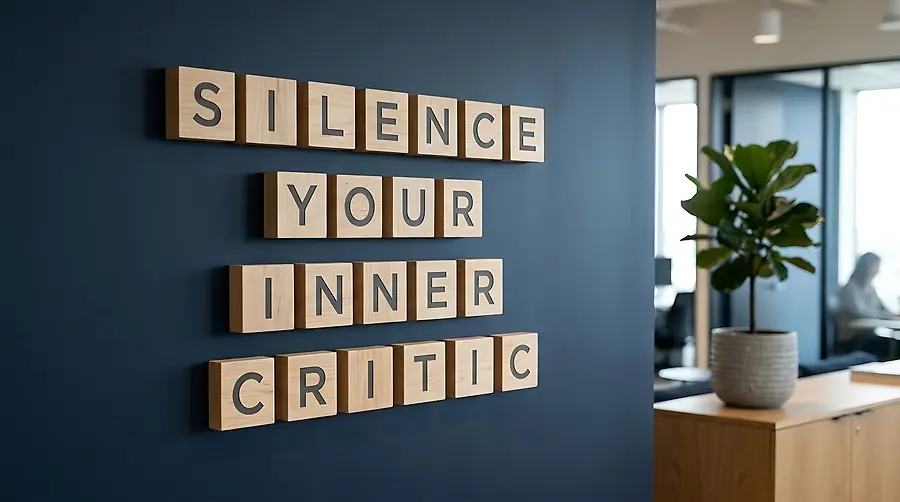
There Is One Voice We Hear More Than Any Other
There is one voice we hear more than any other throughout our lives: our own.
For many women, that voice has become less of a trusted companion and more of an unforgiving critic. It quietly questions every decision, magnifies every mistake, and convinces us that we should be doing more, achieving more, giving more, and somehow becoming "more" than we already are.
- "You should have handled that better."
- "You're falling behind."
- "Everyone else seems to have it figured out."
- "You're not enough."
Over time, these thoughts can become so familiar that we stop recognizing them as self-criticism. Instead, we mistake them for truth.
But here's something worth remembering:
Just because you think something doesn't make it true.
Our inner dialogue is shaped by years of experiences, childhood messages, painful relationships, unrealistic expectations, comparison, perfectionism, disappointments, and even trauma. The stories we tell ourselves are often written by moments that wounded us, not by moments that accurately define us.
The beautiful news is this:
Just as those stories were learned, they can also be rewritten.
Self-compassion is often misunderstood
Self-compassion is often misunderstood. Many people believe it means making excuses, lowering expectations, or pretending everything is okay. In reality, self-compassion is the courage to acknowledge our imperfections without allowing them to determine our worth.
Imagine speaking to a close friend who is struggling. Chances are, you would never say:
- "You're a failure."
- "You'll never get it right."
- "What's wrong with you?"
Instead, you would offer understanding, encouragement, and hope.
So why do we believe we deserve less kindness than the people we love?
The relationship you have with yourself sets the foundation for every other relationship in your life. When your inner voice is rooted in compassion rather than criticism, you begin making decisions from confidence instead of fear. You become more resilient after setbacks because mistakes become opportunities for growth rather than evidence of inadequacy.
Would I say this to someone I deeply love?
One of the simplest yet most powerful exercises I encourage is to pause whenever you notice a self-critical thought and ask yourself:
Would I say this to someone I deeply love?
If the answer is no, gently replace the thought with one that is both truthful and compassionate.
Instead of saying:
"I failed."
Try:
"That didn't go the way I hoped, but I can learn from this experience."
Instead of saying:
"I'm not good enough."
Try:
"I am still growing, and growth takes time."
Instead of saying:
"I always mess things up."
Try:
"One difficult moment does not define who I am."
These are not empty affirmations. They are balanced, realistic reminders that honor both your humanity and your potential.
Remember, healing doesn't happen because we become perfect.
Healing happens when we begin treating ourselves with the same grace we have always deserved.
The next time your inner critic begins to speak, pause before believing every word it says.
Ask yourself whose voice you're really hearing.
Then choose to answer with your own-one that speaks with wisdom, compassion, and hope.
Because the most important conversation you will ever have is the one you have with yourself.
Make it one that helps you grow instead of one that convinces you that you cannot.
Closing Reflection
"You have survived every difficult chapter that once convinced you that you wouldn't. Perhaps it's time your inner voice started giving you credit for the strength you've carried all along."