Who Holds the Leader? A Woman's Journey Through Loss, Leadership & Identity
When the person everyone depends on must learn to depend on others, what happens to leadership, identity, and organizational support?

For much of my life, I believed my strength came from being the person everyone else could depend on. I built my career leading teams, solving problems, and showing up no matter what. Then, in a single afternoon, the life I had carefully built changed forever, and with it, much of the identity I had attached to it.
Before That Day
Before that day, I knew exactly who I was. I was a high-performing leader in the hospitality industry - a regional general manager responsible for multiple Rhode Island hotels, teams, and a portfolio valued at more than $100 million. My days started early and ended late. I moved between properties, solved problems in real time, and made decisions that impacted approximately two hundred employees during peak season. I led teams that relied on me to be steady, decisive, and present, bringing charismatic, servant, and transformational leadership approaches to my work.
That leadership approach delivered meaningful results. I led one of my hotels to Hotel of the Year out of more than 100 properties and was recognized as General Manager of the Year. My teams were engaged. My properties were profitable. Like many women, I balanced multiple roles with pride: leader, wife, mentor, colleague, friend, while rarely stopping to consider how deeply those roles had become intertwined with my sense of self.
I didn't just show up. I delivered. I built teams. I developed leaders. I created results that mattered. I was the one others relied on; and I loved what I was doing. And then, on a Saturday, February 22, 2025, everything changed.
That Morning
That morning felt ordinary in the way the most sacred moments often do. I was getting ready, as I was scheduled to work at one of my hotels. My husband, Steven, was in bed, sipping his coffee, working through a Sudoku puzzle. As I walked out of the bathroom, ready to face the day, I noticed the beautiful sunlight streaming through the window, warming the room as he looked up at me and smiled.
"Ahhh… my beautiful wife. I love you so."
I looked at him, returning the endearment, "I love you too, sweetheart." Steven had a way of making me feel like the most beautiful woman in the room - valued, cared for, and deeply loved.
Before I left, Steven reminded me about meeting his son and family later and asked if I could come home first so that we could go together. I told him I would. I kissed him, what would be our last kiss, and said goodbye.
I Arrived Home Around 2:00 p.m.
I wish I could remember every detail, but shock makes memories blur at the edges. I arrived home around 2:00 p.m. The house was quiet. I dropped my bag at the entrance - 2:03 p.m. The mudroom door clicked shut. I called out for Steven, expecting his calm voice in return. Silence. I walked through the sunroom. His newspaper was untouched.
A chill swept through me, an instinctive sense that something was wrong. I opened the door to the fitness room and saw him on the floor. My world began to spin.
I dropped beside him. He wasn't breathing. His skin was cool to the touch. I called 911, though I barely remember what I said. The words came out as broken fragments between sobs. I don't know how long it took for them to arrive. Time had stopped making sense.
The house was filled with people - paramedics, officers, voices I didn't recognize. I remember the sound of shuffling feet, low murmurs, voices blending with the faint rhythm of the tide outside. There was a coolness in the air that had nothing to do with the weather.
There are moments in life when time breaks. That was one of them. Everything after - the 911 call, the people in the house, the voices - felt distant, like it was happening to someone else. But what I remember most clearly is the silence inside me: a hollow space where certainty, identity, and the life I thought I knew had suddenly disappeared.
The World Didn't Stop
And then, almost immediately, another reality set in. The world didn't stop. The business didn't stop. My teams still needed leadership. Decisions still needed to be made. And I, someone who had built her identity on being strong, capable, and dependable, felt the unspoken expectation to continue.
So, I did what I had always done. I performed. Within a day of Steven's death, I was working remotely. I returned quickly. I told myself I was fine because that is what leaders do. We push through. We show up. We hold it together.
But grief doesn't respond to performance. It doesn't respect titles, responsibilities, or timelines. It follows you into every meeting, every decision, and every conversation. What once felt urgent suddenly loses its perspective. Focus fractures. Sleep disappears. Even the simplest decisions become exhausting. And still, the expectation to lead remains.
And still, the expectation to lead remains. To show up. To decide. To carry others when you are barely holding yourself together.
Seven Weeks Later
Seven weeks later, I found myself sitting in our Florida home - the one Steven and I had just purchased together. Our next chapter. We had closed on it just two weeks before he died. We had walked through the rooms together, imagining the future - family visits, quiet evenings, a life we believed we had time to live.
Now I sat there alone. Unraveling. No Chapter Two. No Steven.
Still, I told people I was okay.
Until I realized what I was trying to do was impossible: pretending I was unchanged, when I had been fundamentally altered.
I was on the phone with one of my team members. He told me they missed me. That they were concerned. Then he said something that stopped me cold.
"We miss the force to be reckoned with."
That version of me. The leader who was everywhere, checking in, showing up at all hours, making sure everyone was okay. Consistently present, engaged, and strong.
I hung up the phone and sat in silence. His words echoed in my mind because I knew they were true. I wasn't simply grieving my husband. I was grieving the loss of the woman I had been before that day. For the first time, I found myself asking:
Who am I now?
Unmoored
Steven wasn't just the man I loved. He was my confidant. My sounding board. My partner in every sense of the word. He was the person I processed everything with - decisions, strategy, people, challenges. He helped me think clearly. He helped me lead better. And without him, I wasn't just heartbroken.
I was unmoored.
When I made the difficult decision to take time to grieve, I knew there was risk - not because I doubted my value, but because I wasn't sure the system knew how to hold someone like me in that moment.
I was told I was valued. That I mattered. Yet I was also told that if I took the time I needed, I would not return to my hotels or my teams. Instead, I would be placed elsewhere, in a role yet to be determined. In that moment, I realized the position that had defined so much of my professional identity was no longer certain.
That loss came quietly, but it cut deeply. My hotels were never just buildings. My teams were never simply employees. Together, we had built trust, stability, and performance. Losing that - not because of failure, but because I needed time to grieve - fundamentally changed the way I viewed organizational support.
A Gap Between What Organizations Say and What They Support
Intellectually, I understood the business reality: operations must continue, and leadership must be present. But what I experienced was not a thoughtful transition. It revealed a gap between what organizations say they value and what they are prepared to support. Because here is the truth: most organizations are not built to support leaders through profound human disruption. While my experience involved grief, disruption can take many forms, and every organization will eventually face it.
We have systems for performance, accountability, and growth. But when disruption enters, and it will, many organizations have no comparable system to support the leader. In hospitality, where leaders shape culture, influence the guest experience, and drive operational performance every day, the effects extend far beyond the individual. When leaders lose stability, teams lose consistency. They lose clarity. They lose trust. And when a leader is removed or repositioned without a thoughtful plan, the consequences ripple throughout the organization. This is not simply a human issue. It is a business issue.
Looking back, I no longer believe what happened was inevitable. I believe it was structural. In trying to make sense of my experience, I began to see what was missing - a way to lead through loss with intention. There is a better way: a way to support the leader, protect the team, and strengthen the organization.
The CARE Model©
I call it the CARE Model©.
- C - Communicate with clarity and compassion. Acknowledge what is happening openly and honestly.
- A - Align expectations. Define what is realistic in the moment.
- R - Redistribute responsibility. Support the team without stripping the leader of identity.
- E - Empower re-entry. Create a clear, supported path forward.
To be clear, supporting leaders through disruption is not about expecting them to process their emotions in hallways, break down in front of their teams, or abandon their responsibilities. In fact, many high-performing leaders are deeply committed to protecting their teams from having to carry the weight of their personal struggles. The support I am describing is intentional and structural: clear communication, realistic expectations, temporary redistribution of responsibilities, and a thoughtful path forward that allows leaders to navigate disruption without sacrificing dignity, identity, or organizational performance.
This is not about lowering standards. It is about recognizing that supporting leaders through disruption and maintaining high expectations are not competing priorities. When done well, they strengthen one another. It is about leading differently when it matters most. Had this existed in my world, the outcome could have been different, not easier, because grief is never easy. But more humane, more stable, and more effective.
I Did Come Back
I did come back - not as the same woman, but as a different leader. Loss changed me, but it also changed how I think about leadership. Strength is not about holding everything together. It is about telling the truth when things fall apart.
When organizations build systems that support both people and performance, everyone benefits. Leaders remain engaged. Teams remain stable. Trust deepens. Performance is sustained. Organizations don't have to choose between compassion and accountability. They can, and should, expect both.
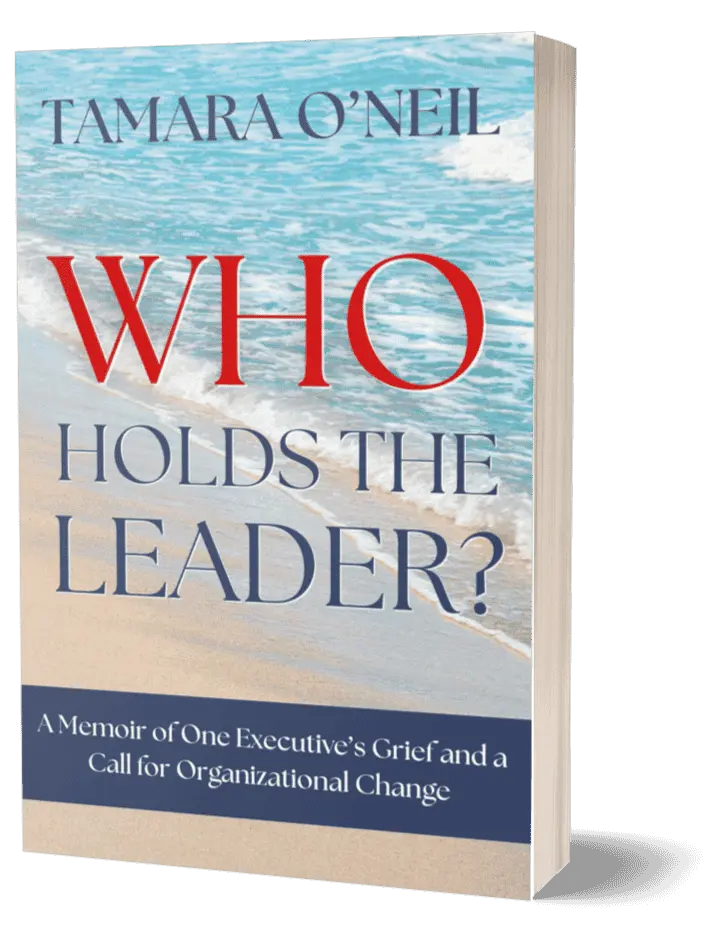
My experience inspired me to write Who Holds the Leader?, a deeper exploration of what happens when leadership and life's inevitable disruptions collide - and how organizations can respond with clarity, courage, and structure. Because this story is not unique to me. It is unfolding every day in organizations around the world.
Who holds the leader?
Every organization will answer that question eventually. The only choice is whether the answer is intentional.


