Women's Month Feature: Alison McCarty
From Prosecutor to Judge: Nearly Four Decades of Integrity, Compassion, and Service to Justice
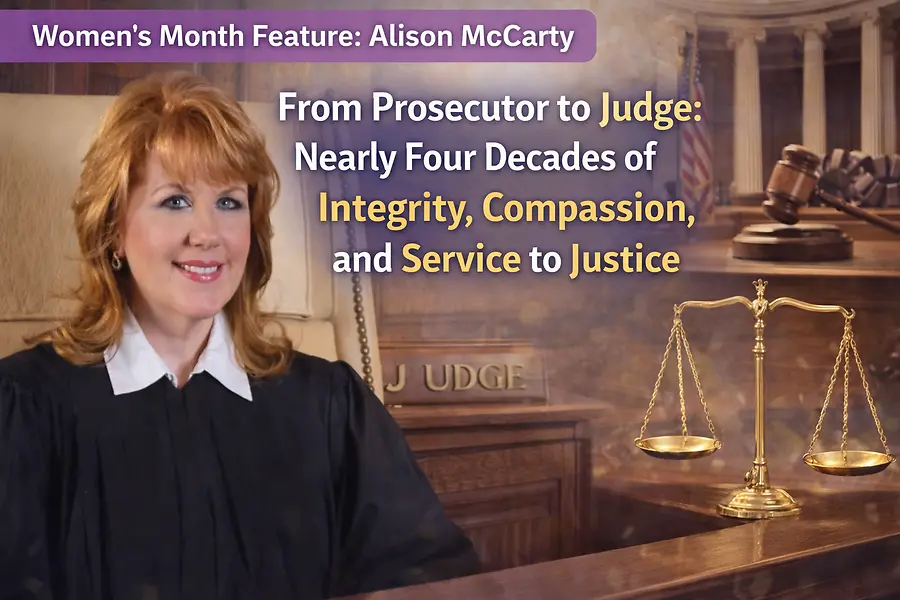
When Alison McCarty first entered the legal profession nearly four decades ago, she made a choice that would define her entire career: to dedicate her work to protecting the vulnerable, advocating for those who cannot advocate for themselves, and upholding the principle that justice isn't just about punishment—it's about rehabilitation, healing, and hope. Today, as Administrative Judge of the Summit County Court of Common Pleas in Akron, Ohio, she stands as a testament to what a career built on integrity, compassion, and relentless commitment to service can accomplish.
Answering a Calling: Building a Career in Service to the Vulnerable
Alison's path to the bench reflects a career of strategic growth and meaningful impact. She began as a judicial attorney for an appellate judge, providing the foundation for her deep understanding of law and judicial process. But she didn't stay in that safe, comfortable role. She moved into the Summit County Prosecutor's Office, where she spent a decade prosecuting some of the most difficult cases the legal system handles: felony cases involving child physical and sexual abuse, sexual assault, and violent crimes. This wasn't easy work. It required not just legal expertise but emotional resilience, the ability to hear terrible truths and still fight for justice day after day.
From Prosecutor to Judge: Leading with Accountability and Compassion
Her work in the prosecutor's office earned her recognition on high-profile cases, including the landmark State of Ohio v. Douglas Prade (1998)—a case that represented the kind of complex, consequential criminal prosecution that would come to define her career focus. But more than the accolades, what stands out is her unwavering dedication to victims and at-risk children. This wasn't a professional obligation to Alison; it was a calling. It's a commitment that has never wavered, even as her role evolved from prosecutor to judge.
Redefining Justice: Rehabilitation, Reentry, and Real Change
Now, with over 17 years on the bench, Alison presides over a wide range of felony criminal and civil cases, but her approach is distinctive. She emphasizes not just judgment, but rehabilitation-focused programs designed to reduce recidivism and transform lives. This is the difference between a judge who simply applies the law and a judge who understands that the legal system is fundamentally about people—people who have made mistakes, people who have been harmed, people who deserve the chance to rebuild their lives. Alison's work with the ReEntry Court, for which she's Ohio Supreme Court Certified as Presiding Judge, exemplifies this philosophy. These programs recognize that punishment alone doesn't solve the underlying problems that lead to crime; education, mental health support, job training, and accountability do.
Her leadership extends far beyond her courtroom. As Administrative Judge, she oversees court operations and manages the complex logistics of docket management and court administration. She serves on multiple committees addressing child welfare and domestic violence. She's been deeply involved in professional organizations—the Akron Bar Association, Ohio State Bar Association, Christian Legal Society, the Child Fatality Review Committee, and the Ohio and Summit County Sexual Assault Coalitions. For 15 years, she ran the Ohio High School Students Mock Trial Competition, introducing young people to the law and inspiring the next generation of legal professionals.
What's particularly remarkable about Alison is her willingness to challenge her own limitations. When asked what advice she'd give to young women entering the legal field, she's refreshingly honest: 'Don't limit yourself by what you think you're capable of.' She describes herself as an introvert—someone who, by nature, might have avoided the spotlight and the courtroom advocacy that her career has demanded. But instead of accepting that limitation, she taught herself. She developed the skill set of public speaking, case building, and courtroom advocacy. People laugh now when she tells them she's an introvert because her professional presence is so commanding. The lesson is powerful: your perceived limitations don't have to define your reality. Skills can be learned. Comfort zones can be expanded.
Resilience on the Bench: Leadership, Self‑Care, and Lasting Impact
The challenges Alison faces in her work today reflect the crisis of violence in American communities. She sees the devastating impact of interpersonal violence in families and the senseless gun violence that fills her courtroom. What troubles her most is not the violence itself, but what it reveals about our society: young people who lack the coping mechanisms, the communication skills, the mental health support to resolve conflicts without turning to lethal force. They move from verbal confrontation to weapons with terrifying speed. This is the human crisis beneath the legal cases—a crisis of emotional regulation, mental health, and community support systems that have failed too many people.
Yet even in the face of this darkness, Alison has learned what many judges discover too late, if at all: the necessity of compartmentalization, of self-care, of protection. The courtroom is filled with human misery. The cases are heartbreaking. The outcomes aren't always just. If a judge carries all of this home, it will destroy them. Alison has learned to put work aside when she leaves the courthouse, to focus on her family, to make exercise a non-negotiable priority because it's essential to her mental health. This isn't escapism; it's survival. It's recognizing that to be an effective advocate for justice, she has to protect herself.
Her accolades—the University of Akron Urban Light Award, the Committee Chair of the Year Award (twice), the Leadership Award, and joint recognition from the Akron Police Department and Children's Services Board for her advocacy—acknowledge her contributions. But they don't fully capture what Alison has accomplished. Nearly four decades of dedicated service to the law, to vulnerable populations, to justice, to rehabilitation, to hope. A career that began with a choice to serve others and has never wavered from that commitment. A judge who leads with integrity, who makes decisions with compassion, and who understands that the legal system is ultimately about human beings deserving the chance to become better versions of themselves.
Alison McCarty's career is a masterclass in integrity, resilience, and the profound impact of choosing service over comfort. She stands as a role model not just for young women entering law, but for anyone who believes that one person's commitment to justice can change a community. That's worth celebrating.