Women’s Safety in Social Circles: The Power and Price of Being Noticed
The unseen cost of visibility—why being admired attracts opportunity, envy, and predators, and how influential women protect their power, set boundaries, and exit unsafe spaces with clarity and control.

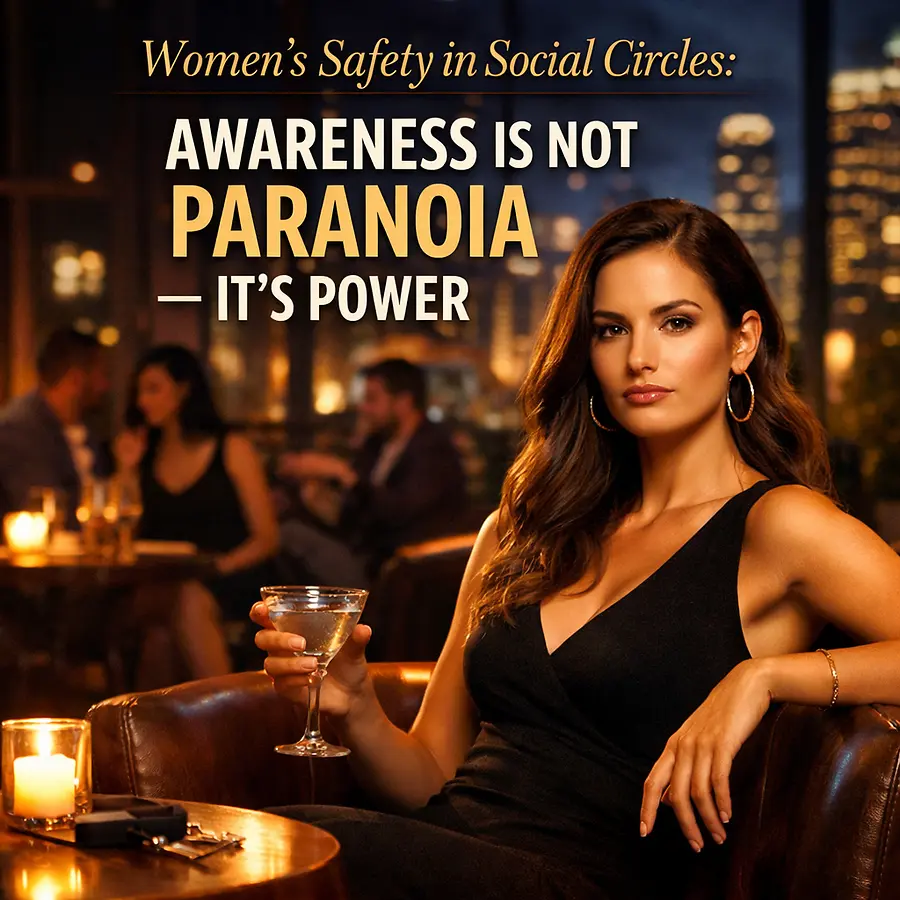
In modern society, women are encouraged to be visible.
To network.
To attend events.
To cultivate presence.
To shine.
Visibility is framed as empowerment — and it is.
But what is rarely discussed is this:
Being noticed carries both power and risk.
For ambitious, articulate, attractive, or socially magnetic women, attention is not neutral. It is currency. It opens doors — and it attracts predators. It builds influence — and it triggers insecurity. It creates opportunity — and it exposes vulnerability.
Understanding this duality is not paranoia. It is strategic intelligence.
The Advantages of Being Noticed
Let’s begin with the truth: presence is power.
When you are noticed in social spaces, you gain:
- Expanded professional opportunities
- Access to influential networks
- Social leverage
- Romantic options
- Increased visibility for your ideas
- Elevated status within circles
A woman who commands attention can shape rooms. She can influence conversations. She can build alliances. She can shift dynamics simply by entering a space.
Visibility builds capital — social, professional, and cultural.
But power always attracts resistance.
The Disadvantages of Visibility
Attention is not always admiration. Sometimes, it is surveillance.
When you stand out, you may encounter:
- Jealousy disguised as friendship
- Competition disguised as sisterhood
- Entitlement disguised as romance
- Curiosity disguised as concern
- Access disguised as opportunity
Predators do not pursue invisibility.
They pursue visibility.
They study the woman who is noticed — the one who draws attention, who commands energy.
Influence and vulnerability often coexist.
Being seen means being evaluated — and sometimes targeted.
How Manipulative Behavior Often Operates
Those who intend harm rarely present as obvious threats. They blend into professional networks, social gatherings, religious communities, and high-status environments.
They observe before they approach.
They look for:
- Women who are admired
- Women who appear isolated within groups
- Women who are newly visible
- Women who hesitate to assert boundaries
- Women who avoid confrontation
They understand social dynamics.
They understand ego.
They understand pressure.
Harm rarely begins dramatically. It begins incrementally:
Boundary testing.
Subtle manipulation.
Isolation.
Secrecy.
Patterns matter.
When Alcohol Changes the Dynamic
In social settings, alcohol is often positioned as harmless bonding.
But alcohol alters power dynamics.
After a few drinks, you may notice:
- Increased physical proximity
- Sudden boldness
- Suggestive language framed as humor
- Pressure masked as playfulness
Lowered inhibition can blur judgment — for everyone involved. What feels playful in one moment may feel unsafe in the next.
Your responsibility is not to manage another adult’s impulses.
Your responsibility is to protect your clarity.
Clarity is protection.
When Harm Is Socially Facilitated
One of the more uncomfortable truths is that harmful dynamics are sometimes normalized by others in the room.
In extreme cases, history has shown how individuals like Ghislaine Maxwell enabled exploitation alongside Jeffrey Epstein.
In everyday life, this can appear in subtler ways:
- Encouraging proximity to powerful but inappropriate individuals
- Minimizing red flags
- Framing discomfort as “overreacting”
- Positioning access as advancement
False sisterhood weakens boundaries.
True sisterhood reinforces them.
Red Flags Worth Respecting
Whether male or female, manipulative personalities often share patterns. Pay attention to individuals who:
- Repeatedly test small boundaries
- Encourage secrecy
- Attempt to isolate you
- Escalate intimacy quickly
- Use guilt when you resist
- Minimize your intuition
Apologies can be rehearsed.
Patterns are revealing.
The Art of Detachment
One of the most powerful skills a visible woman can develop is detachment.
Detachment is not coldness.
It is clarity.
You do not need to justify your exit.
You do not need to defend your boundaries.
You do not need consensus to leave.
Detachment looks like:
- Quietly reducing access
- Limiting oversharing
- Avoiding emotional entanglement
- Maintaining independent transportation
- Preserving financial autonomy
- Leaving when the energy shifts
The strongest exit is often silent.
Exiting Gracefully
Knowing how to leave is a leadership skill.
If an environment feels unsafe:
Stand up calmly.
Make brief eye contact.
Say, “I’m heading out.”
Do not debate.
Do not justify.
Do not linger.
If pressured:
Repeat yourself calmly.
Use short responses.
Create physical distance.
Exit with posture.
Exit with pace.
Exit without apology.
Protecting Your Environment
Not every room deserves your presence.
Protect your peace by:
- Vetting invitations
- Observing dynamics before engaging
- Limiting time in environments centered on intoxication
- Choosing circles aligned with your values
- Prioritizing purpose over popularity
Proximity shapes perception.
Environment shapes outcome.
If a room requires you to shrink, blur boundaries, or compromise integrity, it is not your room.
The Strength of Selectivity
Selectivity is often misinterpreted as arrogance.
It is not.
It is discernment refined by experience.
You are allowed to:
- Leave early
- Decline invitations
- Change circles
- Block access
- Withdraw without explanation
Not everyone deserves front-row access to your life.
Final Reflection: Power with Protection
Being noticed is a gift.
It allows you to lead.
To influence.
To inspire.
But visibility must be paired with vigilance.
Influence without boundaries invites exploitation.
Charm without caution invites risk.
The most powerful women are not reckless.
They are observant.
They are strategic.
They are self-governing.
Your safety is not an inconvenience.
It is an investment.
Guard your presence.
Curate your circles.
Exit when necessary.
And remember:
Awareness is not paranoia.
It is power.