
You Were Never Meant to Spend Your Whole Life Surviving
From Survival to Becoming: Discovering Who You Are Beyond Crisis
There comes a point in healing when survival is no longer enough.
That sentence may sound strange.
Survival is extraordinary.
When someone has lived through trauma, violence, loss, instability, grief, poverty, displacement, or years of simply trying to hold everything together, survival should never be dismissed.
Sometimes getting through the day is the victory.
Sometimes getting out of bed is the victory.
Sometimes leaving is the victory.
Sometimes staying alive is the victory.
But eventually, another question may begin whispering underneath all the work of surviving:
Now what?
Not:
What happened to me?
We may already know what happened.
Not:
Why wasn't I stronger?
Strength was never the problem.
But:
Who am I becoming now that survival no longer has to make every decision for me?
I believe that may be one of the most important questions we can ask.
Survival Is a Brilliant Teacher
The human ability to adapt is remarkable.
When our environment becomes unsafe, we learn.
- We watch faces.
- Listen to voices.
- Anticipate moods.
- Avoid conflict.
- Stay quiet.
- Become useful.
- Take care of everyone.
- Prepare for what might happen next.
Sometimes these adaptations become so deeply embedded that we stop recognizing them as adaptations.
They simply become:
Who I am.
But are they?
Perhaps some of what we call personality began as protection.
The person who never asks for help may once have learned that help wasn't coming.
The person who apologizes constantly may have learned that keeping others happy created safety.
The person who needs everything under control may have experienced what happened when life became uncontrollable.
The person who takes care of everyone else may have learned very young that their value came from being needed.
These behaviors aren't evidence that someone is broken.
They may be evidence of how intelligently that person adapted to the environment they were given.
The difficulty comes when the environment changes but the survival pattern remains.
Healing Is More Than Removing Pain
We often talk about healing as though its purpose is to eliminate symptoms.
- Stop feeling anxious.
- Stop remembering.
- Stop grieving.
- Stop reacting.
- Stop hurting.
Certainly, relief matters.
But I think healing asks something larger of us.
What are we making room for?
If fear becomes quieter, what would you like to hear instead?
If survival stops occupying every corner of your life, what would you like to put in that space?
- Joy?
- Curiosity?
- Friendship?
- Art?
- Education?
- Travel?
- Gardening?
- Love?
- Rest?
- Purpose?
- Play?
Perhaps healing isn't simply about becoming less wounded.
Perhaps it is also about becoming more alive.
You Are Allowed to Meet Yourself Again
One of the strangest experiences after long periods of survival can be discovering that you don't actually know what you like.
Someone asks:
"What do you want?"
And you don't know.
Not because you lack intelligence.
Not because you don't have preferences.
But because perhaps no one has asked you that question in years.
Maybe decades.
- What food do you enjoy?
- What colors make you happy?
- What do you want your home to feel like?
- What music do you play when nobody else is listening?
- What would you learn simply because it fascinates you?
- What would you create if it didn't need to become productive?
- What makes you laugh?
- Where does your body feel peaceful?
- Who are you when nobody needs anything from you?
These may seem like small questions.
They aren't.
They are questions of identity.
And for someone whose life has revolved around survival, caregiving, responsibility, or meeting other people's needs, answering them can become an act of reclamation.
Nature Understands Something We Have Forgotten
I keep returning to nature in my work because nature does not demand constant production.
A tree does not bloom twelve months a year.
The garden doesn't apologize for winter.
Seeds can remain beneath the soil long before anything visible appears.
- Leaves fall.
- Branches become bare.
- Roots deepen.
- Then something changes.
- Light returns.
- The soil warms.
- And what looked empty begins growing again.
We understand this when we look at the Earth.
Yet we rarely extend the same grace to ourselves.
We expect healing to be linear.
We want progress charts.
Milestones.
Completion dates.
We become frustrated when an old grief returns or something we thought we had resolved rises again.
But perhaps healing behaves more like a spiral than a straight road.
We encounter familiar places again - but we don't encounter them as the same person.
Each time around the Wheel, we may understand something differently.
Creativity Gives Us Another Language
Not everything inside us arrives in sentences.
- Some things arrive as color.
- Movement.
- Music.
- Food.
- Gardens.
- Stories.
- Texture.
- Images.
- Dreams.
Sometimes our hands understand something before our minds can explain it.
This is one reason creativity matters so much in the work I am developing.
You don't need to be an artist.
You don't need to paint something beautiful.
You don't need to show anyone.
Creativity isn't about producing a masterpiece.
It is about giving yourself permission to explore.
- Make something.
- Destroy it.
- Try again.
- Cook.
- Write.
- Plant.
- Dance.
- Sing badly.
- Paint outside the lines.
There is tremendous freedom in doing something that doesn't require perfection.
For people whose survival once depended upon getting things exactly right, that freedom can be profound.
Healing Needs Community Too
There is another myth I would like us to reconsider:
That healing is something we accomplish alone.
We praise independence so much that needing other people can begin to feel like failure.
But humans are relational beings.
We have always gathered.
- Around fires.
- Around tables.
- During harvests.
- During births.
- During deaths.
- During celebrations.
- During disasters.
- We tell stories together.
- Prepare food together.
- Grieve together.
- Laugh together.
- Teach one another.
- Remember together.
Sometimes healing doesn't happen because someone gave us the perfect advice.
Sometimes it happens because someone sat beside us long enough for us to realize:
I don't have to carry this particular thing alone anymore.
Education Can Be Part of Healing
I am an educator.
That distinction matters to me.
I am not interested in telling another person how their healing journey should look.
I am interested in creating educational environments where people can explore themselves differently.
- Where research can meet lived experience.
- Where nature can meet creativity.
- Where reflection can meet community.
- Where food can become connection.
- Where questions can be more important than answers.
Because perhaps the role of an educator isn't always to stand in front of someone and say:
"Here is what you need to know."
Sometimes it is to create an environment rich enough for someone to discover:
"Here is something I didn't know about myself."
That is a very different kind of learning.
Walking the Wheel
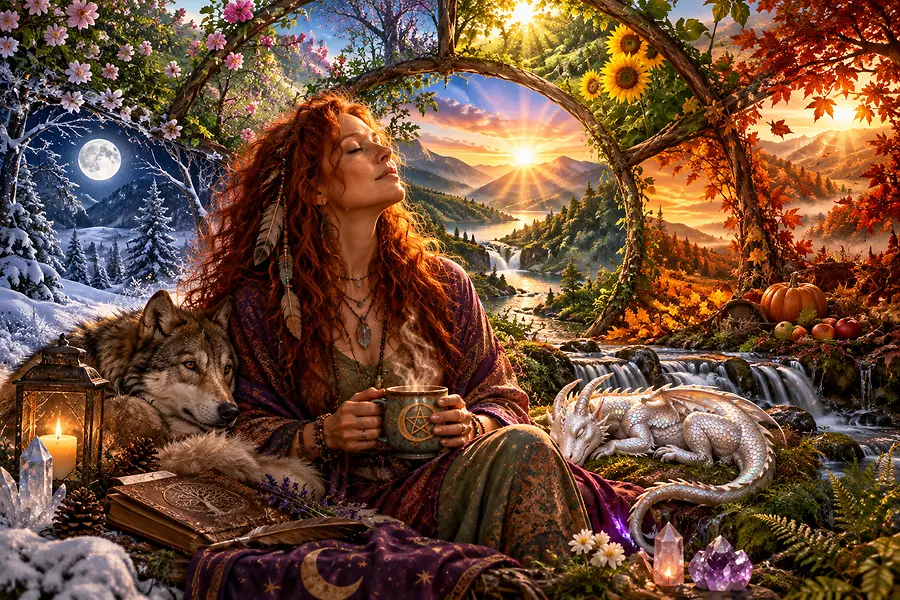
These ideas eventually became the foundation for something I call Rainbow Weaver: Walking the Wheel of the Seasons.
It didn't begin as a product.
It began as a way of thinking about healing.
What if we stopped forcing ourselves through a straight line?
What if we allowed the rhythms of nature to become invitations for reflection?
- Winter could ask us to rest.
- Spring could ask what wants to emerge.
- Summer could invite expansion.
- Autumn could ask what we are ready to release.
And then the Wheel turns again.
Not because we failed to finish.
Because life continues.
We continue.
Each return gives us another opportunity to meet ourselves where we are now.
You Were Never Broken
There is one idea underneath everything I am building that matters deeply to me:
You were never broken.
- You may have been wounded.
- You may have adapted.
- You may have survived circumstances no human being should have experienced.
- You may have pieces of yourself that still need tenderness.
But broken?
No.
A wound and a defect are not the same thing.
That distinction changes the question.
Instead of:
"How do I fix myself?"
we can begin asking:
"What does this part of me need?"
- Maybe rest.
- Maybe boundaries.
- Maybe knowledge.
- Maybe community.
- Maybe professional support.
- Maybe laughter.
- Maybe a garden.
- Maybe a paintbrush.
- Maybe a bowl of soup shared with someone who listens.
- Maybe permission to begin again.
Becoming the Weaver
I chose the image of the Rainbow Weaver deliberately.
Because eventually we begin gathering the pieces.
Not only the beautiful ones.
All of them.
- The grief.
- The joy.
- The childhood.
- The mistakes.
- The people we loved.
- The people we lost.
- The things we survived.
- The things we learned.
- The dreams that disappeared.
- The dreams that returned.
- The person we were.
- The person we are.
- The person we are still becoming.
We don't have to pretend the darker threads never existed.
We weave them too.
Because the darkness doesn't diminish the colors.
Sometimes it helps us finally see them.
And perhaps that is what transformation really is.
Not erasing our story.
Not pretending the painful chapters didn't happen.
Not becoming some perfectly healed version of ourselves.
But learning how to take everything life has placed in our hands and say:
This belongs to me now.
I decide what I create from it.
The Wheel continues to turn.
The seasons change.
The light disappears and returns.
And somewhere along the way, survival begins becoming something else.
Life.
Not the life someone else prescribed.
Not the life trauma dictated.
Yours.
And perhaps the question is no longer:
"How did I survive all of that?"
Perhaps now we get to ask:
"What am I going to create with the life I fought so hard to keep?"
Mylee Star Hawk, MAED, founded Mama Star's Healing Circle to support healing through education, art, and community. With 25+ years in education and community support, Star specializes in addressing generational trauma through creative expression, culinary arts, and spiritual practices. An ordained minister and master chef pursuing a doctorate in Transpersonal Psychology, she integrates education, creativity, and…





