Your Team Is a Mirror: What Leaders Must See Before They Can Change Anything
How your leadership presence shapes every aspect of your team's behavior, trust, and performance.

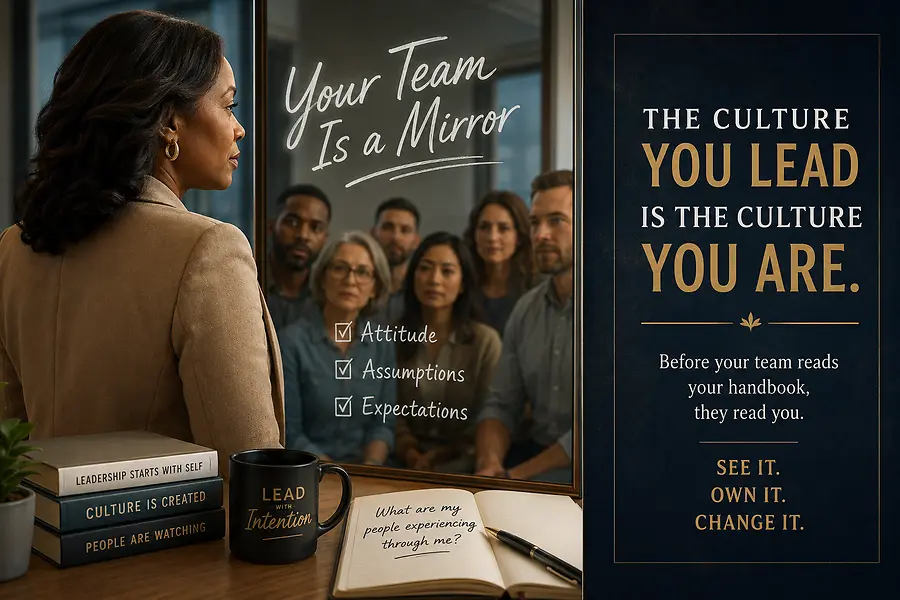
Your Team Is a Mirror: Why Every Culture Change Begins with the Leader
I have walked into a lot of broken cultures: schools suffocating under dysfunction, organizations paralyzed by distrust, and teams that had quietly stopped believing things could change.
In every single case, people were looking for the same thing—a different strategy, a better system, a new initiative that would finally move the needle.
And in every single case, what actually needed to change first was the leader.
This is the truth no one wants to say out loud: your team is a mirror of your leadership. If they are anxious, look at the anxiety you are carrying. If they are disengaged, examine what you have communicated—or failed to communicate—about purpose. If they avoid accountability, ask yourself when you last modeled what accountability looks like.
This is not blame. It is an invitation. Because if leadership creates culture, then leadership can also repair it.
Culture Is Not What You Post on the Wall
Too many organizations spend enormous energy crafting mission statements, printing values on lobby walls, and designing off-sites around culture-building. Then people walk back into the same emotional environment on Monday and wonder why nothing changes.
Culture is not what is declared. It is what is experienced.
Before your team reads your handbook, they read you. They sense the emotional temperature you bring into the room. They observe how you respond—or don't—when something goes wrong. They notice what you tolerate. They study what you celebrate. And they build their understanding of what is safe, what is expected, and what is truly valued from those signals—long before you ever hand them a policy document.
This is what I call the Culture Cascade™: the movement of a leader's internal world into the shared external environment. It is not dramatic or sudden. It happens in the small moments—the tone of an email, the response to a mistake, the pause before addressing a conflict that should have been addressed weeks ago.
Culture does not form through announcements. It forms through accumulation.
The Three Forces Shaping Culture Right Now
Whether leaders recognize it or not, three forces are constantly shaping the environments they lead: attitude, assumptions, and expectations.
Attitude is the emotional climate you carry. It is not your mood—it is your default orientation toward your work, your people, and the challenges in front of you. Your team absorbs it before you speak. When leaders demonstrate openness, curiosity, and steadiness, those qualities become the emotional baseline. When leaders project frustration, impatience, or contempt, those qualities become the baseline as well.
Assumptions are the invisible filters through which we interpret people's behavior, intentions, and capabilities. When left unexamined, assumptions quietly become verdicts. When leaders make decisions based on those assumptions, they create environments where people feel judged before they are known—and where trust never fully forms.
Expectations—especially unspoken ones—may be the most damaging force of all. When leaders believe people "should just know" what is expected without clearly communicating it, they create chronic tension that no one can fully name or resolve. People begin to feel they are failing at rules they were never given.
Together, these three forces move through every interaction, every decision, and every silence. Every leader produces all three—whether intentionally or not.
What Leaders Don't Say Teaches Just as Powerfully as What They Do
Early in my leadership of an adult education program, I encountered a culture shaped by years of accumulated silence. Previous leaders had avoided difficult conversations, and the staff had learned—through observation, not instruction—that certain things simply were not addressed.
When I arrived, I did something many leaders hesitate to do: I named what I saw, including my own expectations. I told the staff I wasn't going to enforce rigid punctuality the way some previous leaders had because our program didn't serve youth who required supervision. What I did care deeply about was professional commitment and mission alignment. I said it clearly, out loud, and on purpose.
The response was immediate relief. People had been guessing. Clarity gave them something to stand on.
But this is where it gets important: clarity without follow-through becomes just another form of silence.
When one staff member began treating that grace as permission—arriving consistently late and becoming progressively more casual about it—I had a choice. I could avoid the conversation to preserve harmony, or I could address it directly, honoring both my stated values and the relational trust I was trying to build.
I addressed it. The behavior changed.
But more important than the correction was what the rest of the team saw: what I said I valued was actually what I acted on. There was no gap between my stated culture and my lived culture.
That gap—between what leaders say and what they do—is where trust goes to die.
Silence Is Never Neutral
Leaders often believe that staying quiet is neutral. It is not.
When conflict arises and is left unaddressed, silence teaches that conflict is not safe to name. When poor behavior goes unchallenged, silence teaches that it is acceptable. When frustration is visible within a team and a leader walks past it, silence teaches that emotional honesty is not welcome.
Teams do not experience silence as the absence of information. They experience it as information. They fill the void with their own interpretations—and those interpretations are rarely more generous than what a direct conversation would have created.
This is not about becoming a different kind of leader. I recognize that every leader has a natural style. For years, I have used tools like the DISC assessment to understand behavioral tendencies, and I know my own profile well: high in both conscientiousness and influence, meaning I am both relationship-oriented and driven by accuracy. But knowing your style does not excuse you from examining its impact.
A leader who avoids conflict in the name of being "relational" may unintentionally teach their team that hard conversations are unsafe. A leader who delays decisions in the name of "thoroughness" may model that uncertainty is something to live with indefinitely. Style explains tendency. It does not justify impact.
Awareness is where the work begins.
The Question Every Leader Should Ask Before Asking Anything of Their Team
Most leadership training asks leaders to evaluate their teams: What are they producing? Where are they falling short? What needs to change?
I want to propose a different first question—one that changed the trajectory of my own leadership:
What are my people experiencing through me?
Not what I intend for them to experience. Not what I hope they feel. But what they actually receive through my presence, my consistency, my silence, and my choices.
When leaders ask that question with genuine curiosity and humility, culture begins to shift. Because the real work of leadership is not managing people—it is becoming someone worth following.
Your team is watching, not to judge you, but to understand what is safe, what is valued, and how to succeed in the environment you are creating.
The culture you lead is the culture you create.
And the extraordinary news is this: you can always choose to become more intentional about what you transmit.
Dr. Moni Kay is the author of Leaders, You Are the Culture: How CEOs, Executives, Managers, Coaches, and Heads of Household Shape Environments, Improve Performance, and Set the Tone for Their Teams. She is a leadership consultant, organizational culture specialist, and educator with decades of experience across school systems, nonprofits, and international education programs. Her proprietary Culture Cascade™ framework helps leaders at every level understand and transform the cultures they shape every day.
Book release: September 2026.


