Her Story
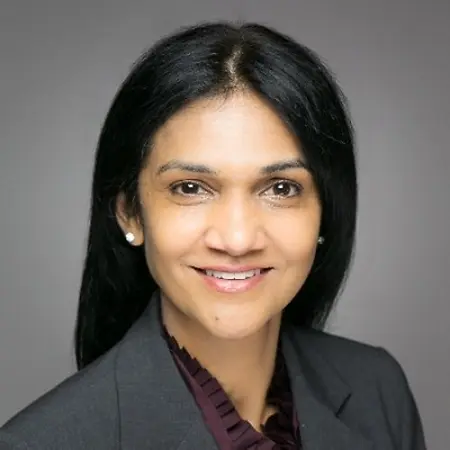
About Alpa
I currently serve as Senior Managing Director at AIG, where I report directly to the CFO and Chief Investment Officer, leading transformational initiatives across the organization. My work focuses on strategic projects that impact the CEO office, including leading one of the biggest IPOs that separated the property and casualty business from life and retirement about a year and a half ago. I also led a $1 billion expense management initiative that we completed in two and a half years during the COVID timeframe, ahead of the original three-year schedule. Currently, I'm focused on digitalization and exploring how we can leverage AI in insurance, particularly in underwriting and claims processing. I manage a global team that oversees any strategic initiatives impacting the firm, and recently led the movement of $200 billion in assets to BlackRock and Blackstone. Before joining AIG, I worked at Bank of New York Mellon where I developed strategy for their asset servicing business, their biggest division, creating a target operating model to serve clients over $200 million and building white glove service for Platinum clients. Earlier in my career, I worked at Goldman Sachs as chief of staff for Reagan Tax Operations, where I managed over 1,000 people globally and analyzed the impact of Dodd-Frank and FATCA on the financial industry. I've been in the industry for 28 years total, with my first 10 years in aerospace and defense before transitioning to financial services and insurance 18 years ago. Beyond my corporate roles, I'm deeply committed to helping others succeed. I founded Women Helping Women in Finance about 12 years ago because as a woman of color in a predominantly male industry, I didn't have many mentors or sponsors early in my career. Through this program, we visit Tier 1 and Tier 2 schools to help women succeed in financial services. I also founded Take-Two in 2004, a program that helps women and men return to the workforce after taking time off for personal reasons like caring for children or parents. I had to restart my own career after taking three years off from 2004 to 2008 when my daughter had health issues, and it took me 16 years to reach my current Senior Managing Director position. I'm passionate about ensuring others don't face the same penalties for career breaks. For the past 14 years, I've implemented this program at every organization I've joined to help build talent pipelines. I also sit on two advisory boards, one focused on cybersecurity and another on AI that I just joined a week ago.
Her Interview
Ten minutes with Alpa
01What do you attribute your success to?
I attribute my success to the mentors and sponsors who pushed me out of my comfort zone and supported me in taking risky assignments and senior role opportunities. I don't think I would be in the position I am today if it wasn't for those mentors. In my early career, I predominantly had male mentors because there weren't many female CEOs and CFOs in the financial industry at that time. In the last 10 to 12 years, I've had more female mentors. I still stay in touch with three or four key mentors who have guided me throughout my career, and I consult them when making significant decisions like changing companies or getting on boards. I've learned that mentors are of significant importance in my career, both personally and professionally. Beyond mentorship, I've learned to take risks and believe in myself. I wish I had known earlier in my career to have confidence in my inner voice, because if you have that confidence, nobody can stop you. I found that much more in my 40s and 50s, whereas earlier I would hesitate to apply for roles because I didn't meet all the criteria or worried about not succeeding. Meanwhile, my male colleagues who met maybe 40% of the job description would still apply and think they deserved it. Over time, I learned that you have to have your voice be heard and believe that you can do anything, but you need to be able to support it through your experiences.
02What advice would you give to young women entering your industry?
I would say take risk. Believe in yourself, because if you have the confidence and your inner voice, I think nobody can stop you. We've all been taught, especially as women, that we don't take a lot of risk. We've been taught that we need to do 100% of the role that we have to apply for before we think about it. I wish I knew that earlier in my career. I found that much more in my 40s and 50s, because I was hesitant, thinking I couldn't do a job because I didn't meet all the criteria, or what if I didn't succeed. Whereas my colleagues who were predominantly male, who probably met maybe 40% of the job description, still applied and thought they should deserve it. These are things I learned over time. You have to have your voice be heard. You need to be able to believe that you can do anything, but you need to be able to support it through your experiences. I think it's very important to be heard and be able to speak what you believe in.
03What values are most important to you in your work and personal life?
Education is a key core principle for me. I'm extremely grateful that I've had the opportunity to do my MBA and undergrad, and I'm passionate about supporting others through academia or experiences to really change their day-to-day lives. I've sat on many non-profit boards focused on education, including Pratham, which provides education to third world countries like India, Africa, and China in villages. I co-founded Global Risk for Leadership to provide cybersecurity certification to underprivileged children who might not have the opportunity to attend college, so they can get certified in high school and start working. We wanted to help not just people who go through colleges, but people who might not be able to meet traditional criteria, yet still be able to change their lives and the generations coming after them. Beyond education, helping women and men succeed is extremely important to me. I founded Women Helping Women in Finance because as a woman of color in a predominantly male financial industry, I didn't have a lot of mentors and sponsors. I also founded Take-Two because I believe society shouldn't penalize people for taking time off for personal reasons like helping a child or parents. When I had to restart my career after taking three years off for my daughter's health issues, it took me 16 years to reach my current position, and I'm extremely passionate about helping others avoid that struggle. For the past 14 years, I've made sure every organization I join brings in programs to help build talent pipelines. I want people to see themselves where I am and understand that they can aspire to these roles, especially women of color who may not see leaders who look like them.
Join Influential Women and start making an impact. Register now.