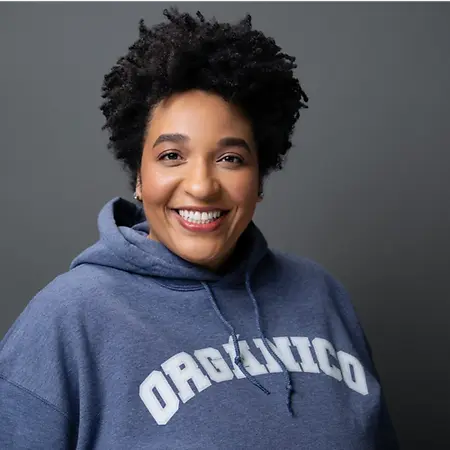
Her Story
About Ana
My journey into SEO was completely unexpected. I started as a performing arts major studying film and TV at City College of New York, dreaming of becoming a local short film artist. I even did a study abroad program where I filmed my first documentary. After graduation, I worked in radio for Univision for about 2 years, which exposed me to the world of entertainment and helped me understand marketing as a whole, especially working with marketing teams to promote shows and personalities. But when the transition to streaming made it difficult for traditional media to survive, I couldn't find steady work in my field. Life threw me a curveball, so I decided to try marketing. Since I already had an eye for creativity and content creation, SEO felt like a perfect fit. I love that SEO offers so many insights to creative teams, and I'm passionate about talking to them about what can benefit their target audience or users. Now, 8 years into my SEO career, I'm a generalist who dabbles in everything, but my true expertise is in content strategy and YouTube optimization. I work extensively with content writers and copywriters, helping brands audit and understand their YouTube channels. What I'm most proud of is that over the past 3 years, despite having no technical background, I've taught myself to build scripts, workflows, and pipelines, diving deep into AI, machine learning, and natural language processing. My ability to think outside the box and create internal systems that help complete tasks faster has been one of my biggest achievements, and clients have responded incredibly positively to this work. I'm currently a SEO-lead at chartists.io, and I'm also reconnecting with my creative roots by hosting a podcast on YouTube called Screen Opti, where I talk to local artists about balancing their artistic and professional lives.
Her Interview
Ten minutes with Ana
01What do you attribute your success to?
If I'm honest, I think it's easy to want to credit resilience alone, but the truth is I had help. SEO wasn't an easy field to find mentors in, especially when I was starting out, and it's still volatile today, more search surfaces, more apps for people to research brands and products, more change to keep up with. In an environment like that, you have to be adaptable just to stay standing. But I didn't figure that out on my own. I met people along the way who were genuinely great and supportive, even though they came and went. I've learned to see that as its own kind of gift, people come into your life for a reason, teach you what they can, and then move on, the way we probably all should. But what they left behind stuck with me. They trained me well and helped me transition into this field, and a lot of what I know today, I owe to them. So if I had to name what actually got me here, it's less "I was resilient" and more that I was lucky enough to be shaped by people who were generous with their time and knowledge, at a moment when I needed it most.
02What’s the best career advice you’ve ever received?
The best career advice I ever received came from someone at NBCUniversal. She told me: no one really cares about your feelings. They matter, but no one really cares. You have to learn to adapt, lead, and focus on your own personal goals. That advice has helped me so much, because there are moments where all you want to do is complain, or scream and shout, and that can cloud your own judgment. When you're transitioning into a role and trying to prove you're good at your job, you can't let those emotions take control of you. You have to take control of them, because people will only see you as "that kind of person," and that's not your intention. Your intention is to bring awareness to issues, but you can't do that if you haven't earned people's trust. At the time, I was transitioning and really emotional. I felt like I was being treated unfairly, but honestly, it depends. A lot of the time, it's really the work being reviewed, not you as a person. I didn't know what I was doing, and I was scared to take on new opportunities. She told me: stop focusing on your emotions, because no one's going to care about those. Sure, you can bring them up, say you feel fear, but you can't rely on them. People will say "aww," but they're not going to really care. You need to prove yourself, push yourself. You're capable of anything if you get out of your own way. It can be harsh advice to hear, especially when you're in it, but I think it's the best I ever got, because imposter syndrome is real. She basically said, "No one's going to care, girl. You gotta just do it. If this is what you want."
03What are the biggest challenges or opportunities in your field right now?
Right now, SEO is going through a transition, expanding into AI and AI search skills that didn't really exist in this field a few years ago. It's a volatile time, honestly, with more search surfaces and more apps for people to research a brand, product, or service than ever before. Keeping up with that has meant learning a lot, often in real time. Over the past three years, I've been lucky to have the space to focus on automation, building scripts, workflows, and internal systems that help our team move faster. I wouldn't say it came from some natural ability to think outside the box so much as a willingness to sit with things I didn't understand yet, machine learning, natural language processing, parts of the computer science and engineering world that were completely new to me, and slowly figure out how they could actually make our work better, not just more technical for technical's sake. I'm still learning most of this as I go. What I've built so far works, but I think of it less as expertise and more as an ongoing experiment I get to keep refining.
Join Influential Women and start making an impact. Register now.