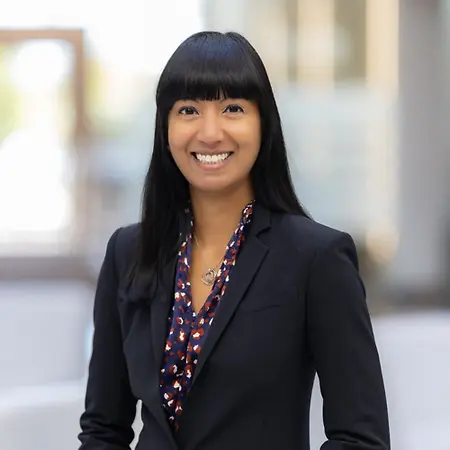
Her Story
About Anindita
Anindita Sinha is a senior pharmaceutical executive and Vice President of Commercial Operations at Shionogi Inc. (U.S.), based in New York. She is an accomplished commercial leader with approximately 15–17 years of experience in the healthcare and life sciences industry, specializing in commercial strategy, operational excellence, insights and analytics, market access, and data-driven decision-making. In her current role, she leads a multifunctional commercial operations organization spanning insights and analytics, data management, market research, field operations, incentive compensation, training and development, and meeting planning, with a focus on enabling launch readiness and organizational performance.
Throughout her career, Anindita has held senior leadership roles across major pharmaceutical and biotech organizations, including Intercept Pharmaceuticals, Optinose, Boehringer Ingelheim, Pfizer, Celgene, and Bayer, as well as earlier consulting experience. Her work has centered on driving growth strategy, improving commercial effectiveness, and leading complex transformations across global and U.S. markets. She has extensive experience in product launches across specialty therapeutic areas such as oncology, immunology, dermatology, and rare diseases, and has played a key role in pricing, market access strategy, M&A integration, and cross-functional executive alignment. Known for her analytical rigor, she has consistently leveraged data and business intelligence to optimize performance, improve operational efficiency, and support patient access initiatives.
Anindita holds a Bachelor of Arts in Biochemistry from Columbia University and a Master of Philosophy in Microbiology from Yale University, where she also pursued doctoral-level research as part of a PhD program (ABD). Beyond her corporate leadership roles, she is actively engaged in industry organizations and nonprofit initiatives, including board and advisory contributions focused on healthcare, leadership development, and community impact. Fluent in English and Bengali, and conversational in Hindi, she is also a mentor and advocate for developing future leaders in the life sciences industry, with a professional focus on building high-performing, data-driven, and collaborative commercial organizations.
Her Interview
Ten minutes with Anindita
01What do you attribute your success to?
I attribute my success to three main things. First, I've had a wonderful support system, both personally and professionally. I really do credit the fact that I've been able to build, and also people are willing to build with me, really strong relationships, such that I have people that I can ask advice of, I can count on, but who also reciprocate and count on me as well. I can trace back certain relationships or certain individuals to every successful point that I can point to in my trajectory. Second is definitely my personal drive. I am extremely driven. I do not settle for anything, really, and I think that's a big part of why I am successful, because I will never be satisfied with good enough. I'm always looking to see how can things be made better, how can things be made more optimal, how can we get faster, more efficient, more economical, more strategic. That really, for better or for worse, layers into my personal life as well, so there's always a level of drive and just, like, what can we do better that keeps me going. Third, I will say is my curiosity. I'm always asking questions. I'm always looking to learn. The moment I feel like I am the smartest person in the room is the moment I realize I'm in the wrong room.
02What’s the best career advice you’ve ever received?
The best career advice I’ve ever received is to stay curious, continue learning, and never underestimate the importance of building strong relationships. I believe growth happens when I remain open to change, innovation, and new opportunities.
03What advice would you give to young women entering your industry?
The first thing I would say is be unafraid. Walk into a room like you belong to be there. One of the biggest lessons I learned early on in my career was the reason people weren't asking me to speak, even though I was often the one with the answers, was because someone told me very honestly that I didn't have executive presence. They said I walked into a room and looked like a child, so nobody was going to pay attention to me or take me seriously until I started to open my mouth, but if I wasn't given the invitation to open my mouth, I was never going to speak. That was a big wake-up call for me, and I realized I needed to start walking into a room like I belong to be there, like I am entitled to be there. And again, that comes with respect and knowledge. You can't walk into a room elbows out if you don't have anything to provide. You might do that once or twice, and then you will be disinvited from the room. So you have to bring the goods in order to be sustained, but it changes my mindset. I would tell young women today, make sure you know your stuff. That's a given. If you don't know your stuff, everything I'm going to say is moot. But if you do know your stuff, and you're confident in it, fake it till you make it. Be confident. Do not wait to be asked.
04What are the biggest challenges or opportunities in your field right now?
I think one of the biggest challenges in our field, in healthcare and pharma in general, is that unfortunately our reputation is again starting to suffer. During the pandemic, I think people started to look at pharma as the savior, like we need pharma to develop drugs, develop vaccines, help us get through this, and our reputation and the true value of pharma was focused on. Unfortunately, now, in the last three years, with different political forces and social forces, I think our reputation is again kind of sinking, where people focus on pharma as the expensive drug maker, as opposed to focusing on the innovation that we bring and the investment that we make. When I tell people I work in pharma, it's a 50-50 chance that I'm gonna get someone saying something not so friendly to me. More specifically, in terms of challenges I have, I think probably the biggest challenge I see today is just keeping up with the pace of innovation. I know that sounds like an opportunity, but it is really a challenge because what often ends up happening is that digital transformation, or any sort of data transformation, information transformation, is triggered by someone in senior leadership saying, hey, I saw this one thing in this one random channel, and I want you, as my team, to do it, make it happen. I think what I am trying to really impress upon my team is that we have the ability to also push back and be thoughtful and very choiceful in how we do things. I would prefer for us to be very deliberate in how we introduce innovation of different kinds into our day-to-day. Because innovation for innovation's sake is not useful. You want to innovate because you have a problem you're trying to solve for, and you're finding the most efficient solution. On the flip side, I think everything I've mentioned is ideally an opportunity. If people are interested in coming into commercial operations or even just analytics in general, if you're a curious individual, if you're someone who wants to learn more and wants to find ways to help patients, this is a great place to be. You can use your coding and your analytics capabilities, and all you have to do is really learn the business, which if you're a smart person, that's not hard to do. It's a question of what do you do with that learning, and how do you then make it sing for all of the stakeholders that we serve on a day-to-day basis.
05What values are most important to you in your work and personal life?
Having a sense of accountability is extremely important to me. I get very frustrated with people who do not take accountability for their own actions or their own lives, really, and that's personal and professional. It's like, no, be accountable, take ownership. You own your own destiny. You cannot blame others for that. So accountability is a big one for me. The second one is integrity. I very much hold that in high regard. You have to be honest and upfront and upright in what you're doing. That's really important quality and value that I hold dear. And I think the third one is transparency. For me, being a team lead now, I value and I also take into consideration how I've been treated in the past, and what I liked and what I didn't like, and what I never liked is when a boss or a team lead kept me in the dark, because they felt like they knew more than I did, and I didn't need to be bothered with that information. I've approached it very differently, where I obviously have to also be mindful as a leader. You can't divulge everything to everyone all the time. You have to have some level of filter. But I have some trusted team members who directly report to me. My leadership team are trusted, hardworking, and very thorough professionals. And so I've committed to them. I'm like, look, when I know things, you guys will be the first to know. I will not keep you in the dark. And I think that level of transparency engenders automatically a level of trust that is so critical in a team.
Join Influential Women and start making an impact. Register now.