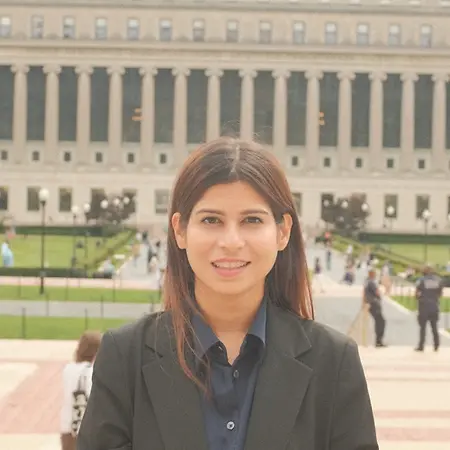
Her Story
About Ansha
Working on impact-based projects has always been something I've resonated heavily with. During my law school days after my BBA, I interned with various NGOs, juvenile justice centers, and trial courts fighting cases against sexual harassment and marital or domestic violence against women. I discovered the intersectionality of environment and gender disparity, and wage gaps, especially in my country India, which made me really interested in sustainability fields and making women join the workforce. Instead of working with law firms, I chose to work with a niche startup doing wonderful work in water resources management, where we worked with underprivileged and water-scarce communities in India on river basin planning, dam management, and other water resource management projects. I was responsible as their legal head for all the contracts, risk assessment, and negotiations. While working there, I got to do consultation with partners across the world and worked on projects in Africa and Zambia, where I was negotiating with government officials everyday. My interest in impact-based work grew, and I thought I could probably influence better and create more impact-based things at a bigger scale by working with the government in my country rather than a company. I got impaneled as a consultant for the government of a state in India for about 3 years, representing them for any cases that came across the legislative body. I also got impaneled at two other government bodies, one was a bank and the other was a cooperative organization. During my work with the government in this underprivileged state of India, I got to work on an election campaign in a very severely underdeveloped area with no roads, no water, or electricity infrastructure. Seeing these conditions firsthand and walking those roads gave me more of a realization about moving towards public service. That's when I decided to pivot to public policy and moved to the US. I'm currently pursuing my public administration master's from Columbia SIPA and am due to graduate next month. The person I campaigned for is now a Member of Parliament with 100% successful outcomes. In the last year, I've done graduate consulting work with NYSERDA in New York for grid planning, especially with respect to AI data centers, and worked with Sustainable Investments to see how institutional investors would want to put their investments across the U.S., especially with respect to systemic destabilizers and climate risks.
Her Interview
Ten minutes with Ansha
01What do you attribute your success to?
I've been very blessed to have both examples of women working in my family for the last 3-4 generations in education and academia, which gave me a lot more insights than I understand anybody else would have, given the social realities of India and especially participation of women in the workforce. I have been supported financially and otherwise at least through my undergraduate by my family and male members, so I have been lucky that way, that both genders in my family and my friends have supported me. My grandmother as a teacher, my mom as a teacher, and now my elder sister who is a very successful businesswoman, and now me - I do have great examples in my family that inspired me early on to pay more credit or more worth on what your merits are or what your accomplishments are, rather than what is perhaps decided either by society or in general depending on gender. I have also had mentors who were nice throughout my law career and my political consulting. I have been the person who dared to go into spaces where women were less in numbers, especially in my country, and thankfully, while it was a very calculated risk seeing all sides of potential outcomes, I have been very lucky with respect to the mentors who I got to work with, and they also understood both my limitations and the bravery of it. They were very supportive, and that does help build the morale a little bit. That did motivate me to come to Columbia and move from being born in a very underdeveloped part of my country to living in New York. These beliefs and the morale boosting and the attitudes of positive people around you do help people to move forward in life, rather than being very skeptical or trying to poke. That's perhaps way more important.
02What advice would you give to young women entering your industry?
What I suggest might be a little bit in the context of the social reality of India, but especially if you're a first-gen lawyer, I got a lot of advice to stick to corporate or compliance or more of the safer sides of the law within the office environment, which makes total sense reasonably. But to get the right mentors and to get the right opportunities, I think it's totally fine for women to venture more into those defense peripheries of law, especially for women. We need to have women-centric lawyers, like we need women-centric doctors, because a lot of nuances can get lost without that understanding of the interpersonal dynamics. That would be one of my advice. Second would definitely be to not be very scared of pivoting whenever you feel like there's something else you would want to do more than what you're doing. There are always opportunities for degrees and work experience. When I decided that I wanted to move to something that has more exponential or more large-based impact, I started working more with government advisories and less with firms. My focus shifted more towards the industry that I was going to pivot to. So from any industry, even from law to policy, or law to tech, or tech to law, or business to law, my message is if you would want to pivot, there are many ways through internships or just changing your workplace or moving as a consultant route. Pivoting at any point in your life should not be something that you feel scared of. And definitely, of course, just believe in yourselves, be confident, and keep moving forward.
03What values are most important to you in your work and personal life?
Integrity and honesty are definitely one of the key ones. Whatever you stand for, you should be clear about it. I am very respectful of that. I don't debate the substance - that is, of course, the second part of it - but initially, whatever you stand for, as long as you can justify and you're clear in the morality and why and how of it, I think that's very important, both for yourself and your own conscience and clarity, and also for the society and people around you. If you are clear is when you can articulate it better, and then, of course, people could understand and help you modify or make it better. But the first step, I think, is knowing yourself and knowing what you want to stand for, what you want to do.
Join Influential Women and start making an impact. Register now.