
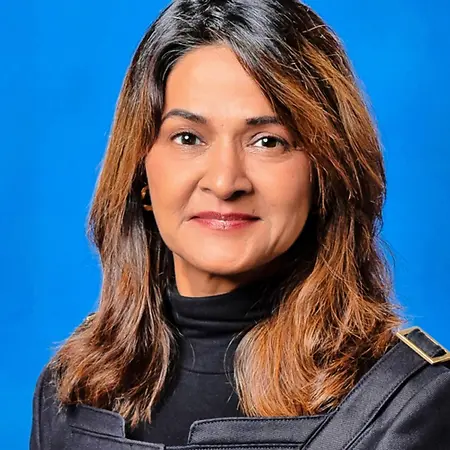
Influential Woman · Life Sciences, Medical Devices, IVD, AI in Healthcare
Aparna Ahuja M.D.
MD, MBBS
CEO and FOUNDER, AJA LIFE SCIENCES ADVISORY LLC
Glenview, IL 60026
Her Story
About Aparna
Aparna Ahuja, MD believes the hardest part of healthcare innovation isn’t creating breakthrough science, it’s turning evidence into adoption and meaningful patient impact.
A global physician executive and healthcare strategist, Aparna brings more than three decades of leadership across diagnostics, MedTech, medical and clinical affairs, clinical strategy, and healthcare innovation. She has held senior leadership roles at Abbott, BD, and T2 Biosystems, leading global medical, clinical, and scientific organizations and partnering across R&D, regulatory, commercial, corporate development, and executive leadership teams.
Her expertise spans clinical and evidence strategy, real-world evidence, regulatory and market access, AI in healthcare and responsible AI adoption, and investor and private equity diligence. She is particularly interested in how AI, data, and emerging technologies can be translated into clinically meaningful, evidence-based solutions while maintaining trust, governance, and patient-centeredness.
Through AJA Life Sciences Advisory LLC, Aparna advises life sciences leaders, boards, investors, and innovators at the intersection of science, strategy, leadership, and technology. She is also a passionate mentor and advocate for women in leadership, diversity, and inclusion, committed to creating opportunities for the next generation of women leaders to thrive.
Aparna is active in professional and global leadership organizations, including leadership roles with the Clinical and Laboratory Standards Institute (CLSI) and international initiatives focused on artificial intelligence and healthcare governance. She has been recognized with multiple honors, including the CLSI Service Award, BD Women’s Hero Award, CEO Excellence Award, and Marketing Excellence Award.
Her leadership is grounded in curiosity, purpose, courage, integrity, excellence, generosity, resilience, and humanity - values that guide how she leads, mentors others, navigates challenges, and creates impact for patients and people.
Throughout her career, Aparna has remained grounded in a simple principle: the true measure of leadership is the impact we make on patients and people. She believes that creating that impact requires advancing science and innovation, embracing responsible technology, building inclusive organizations, and developing leaders who lead with purpose.
Her Interview
Ten minutes with Aparna
01What do you attribute your success to?
I’ve never thought of success as a destination. For me, it has been the result of staying curious, staying grounded in purpose, and being willing to reinvent myself when the world around me changes.
Throughout my career, I have deliberately sought out moments that challenged me—whether that meant entering new areas of healthcare, embracing emerging technologies like AI, or taking on responsibilities that required me to lead through uncertainty. Those experiences taught me that growth rarely happens in the familiar.
I also believe success is deeply connected to the people around us. I have been fortunate to learn from extraordinary mentors, colleagues, and leaders who challenged my thinking, trusted my potential, and gave me opportunities to grow. Their influence has shaped my own commitment to mentoring others and creating opportunities for the next generation of leaders.
Ultimately, what has sustained me is purpose. In healthcare, innovation is only meaningful when it improves lives. That belief continues to guide how I lead, how I approach change, and how I define impact. For me, success is not simply what I achieve—it is the difference I make, the people I help grow, and what becomes possible because I was willing to step forward.
02What’s the best career advice you’ve ever received?
“Seek a seat at the table.” That advice changed how I approached my career.
I didn’t interpret it as simply asking to be included. I interpreted it as: step forward, make yourself valuable, and earn a voice in the decisions that matter. I have carried that mindset throughout my career and have never shied away from the table—or from a challenge.
I experienced this early in my leadership journey when a new president came in and Medical was initially left outside the core leadership circle. Rather than accept that position, I focused on demonstrating the value Medical and Clinical Affairs could bring to the business—connecting science, evidence, patients, regulatory strategy, and commercial decisions. Over time, Medical became an essential voice in the most important decisions. The conversation shifted from “Should Medical be at the table?” to “We wouldn’t make this decision without Medical at the table.”
That experience shaped how I lead. Don’t wait to be invited into important conversations. Step forward, bring value, build credibility, and earn your place. And once you have that seat, use it not just for yourself, but to create space for others.
03What advice would you give to young women entering your industry?
Stay strong. Use your voice. And if you walk into a room and there’s no seat at the table, pull up a chair.
There will be moments when you are underestimated, when your expertise is questioned, or when you are the only woman in the room. Don’t let those moments make you smaller. Know what you bring, speak with conviction, and stay true to what you believe is right. I’ve learned that having a voice is not about being the loudest person in the room. It is about having the courage to speak when your perspective matters—even when it may not be the easiest thing to say.
I also believe we have a responsibility to make the path easier for those coming behind us. Throughout my career, I have made mentoring and developing technical and medical leaders—particularly women—a priority. I want the next generation not only to have a seat at the table, but to feel confident knowing they belong there.
Take the seat. Use your voice. And when you get there, make room for someone else.
04What are the biggest challenges or opportunities in your field right now?
I believe we are at an extraordinary inflection point in healthcare. AI is not simply another technology wave—it has the potential to fundamentally change how we discover, diagnose, make decisions, and deliver care. The leadership challenge is making sure we change with it.
Throughout my leadership career across Medical and Clinical Affairs, I have worked at the intersection of science, evidence, patients, business strategy, and increasingly, technology. That experience has taught me that the hardest part of innovation is rarely the technology itself. It is creating the trust, evidence, organizational readiness, and cross-functional alignment required to turn innovation into meaningful impact.
What excites me most about AI is its potential to augment human expertise rather than replace it. Imagine being able to bring together vast amounts of clinical evidence, real-world data, diagnostics, and patient information to help clinicians make better decisions faster. But that promise comes with an equally important responsibility: we cannot allow the speed of AI to outpace the rigor of healthcare.
We need to ask not only “Can AI do this?” but “Should it? For whom? What evidence do we need? How do we know it is right? And how do we make sure patients and clinicians trust the answer?” Those are fundamentally leadership questions, not just technology questions.
Having led through significant change, I see an enormous opportunity for Medical and Clinical leaders to help shape this next chapter—to bring scientific rigor, patient perspective, ethical judgment, and a deep understanding of clinical reality into the development and adoption of AI.
The future I see is not AI replacing the human side of healthcare. It is AI giving humans the ability to do what they do best—understand, decide, innovate, and care—with far greater insight.
05What values are most important to you in your work and personal life?
If I had to distill my values into one word, it would be people. Patients and people are ultimately at the heart of why I do what I do.
Curiosity keeps me learning and evolving. I have never wanted to stand still—whether that means embracing new science, technology and AI, or being willing to rethink what I have always known.
Purpose reminds me that the work should matter. In healthcare, behind every technology, decision, or data point is a person whose life we have the opportunity to improve.
Courage has been important throughout my journey, particularly when I have stepped into unfamiliar territory or found myself in rooms where I was not necessarily expected to be. Integrity means doing what is right, especially when it is difficult. Excellence means holding myself and my teams to a high standard, while remembering that excellence is not perfection.
Generosity means sharing what I have learned and creating opportunities for others. Mentoring, particularly developing the next generation of medical and technical leaders, is something I consider both a privilege and a responsibility.
And resilience has been woven into my journey. As an immigrant, I learned early that you may have to navigate unfamiliar environments, adapt, and keep moving forward even when the path is not obvious.
But through all of these values, I come back to one thing: humanity. No matter how sophisticated healthcare becomes—with AI, advanced diagnostics, precision medicine and enormous amounts of data—we can never lose sight of the patients, families, colleagues, and people behind the work.
People are the purpose. Everything else is a means to serve them better.
Join Influential Women and start making an impact. Register now.