
Exploring the empathy gap between managers and employees, this article examines how workplace frustrations stem from misunderstanding rather than malice, advocating for partnership over opposition to build trust and organisational success.
Her Story
About Bamidele
My story actually started in Nigeria, where I was born and grew up in a community surrounded by doctors, nurses, and pharmacists. I always wanted to be a pharmacist because the pharmacy was the first place people would go to for help - they were the first line of defense. At age 13, my family moved me and my siblings to the UK, where I developed my love for science, specifically microbiology. But at age 18, I experienced my first major setback when I failed all four of my A-level science courses. A lecturer told me I didn't have what it takes to study science and should think about a different career path. That was the first of many obstacles I would encounter. I re-enrolled, went through clearing, and studied HND Applied Biology, where I excelled with distinctions. This led me straight into year 2 of my biomedical science degree, which I completed in 3 years. Since then, I've earned my MSc in clinical microbiology, specialist and higher specialist portfolios in virology, and become a Fellow of the Institute of Biomedical Science and the UK Academy for Healthcare Science. During COVID, I led the MPUV project, deploying mobile vans in eastern England and developing and training the workforce during the pandemic. Today, I lead teams, write policy, mentor and coach others, and have published three books including 'The Mentor's Journey from Learning to Leading.' I recently wrote a proposal on AI equity for the UK Parliamentary Group on STEM that was approved as a flagship government project. I'm also a mother, wife, author, minister in the church, youth leader, gospel artist who released an album in 2018, and someone who loves writing, speaking, storytelling, singing, traveling, and entertaining. No day is the same for me - I wear my scientific hat with systems thinking in everything I do, whether leading teams, influencing policy at governmental level, or using my voice and platform to advocate for voices in the shadow and work toward a more equitable society.
Her Interview
Ten minutes with Bamidele
01What do you attribute your success to?
I think it's impact for me. I know it's not even that I think. It's all about impact. It's about being the answer. You know, sometimes you say be the change that you want to see. That is success for me. When you see that, oh, I couldn't have this, I couldn't do this, and then you make it happen for others. Even when you climb up the ladder, not letting the ladder go, holding the ladder for others to come through as well. That is success to me. You know, obviously, I want a world where there is equity. We're not all the same, we're different, but there is so much space in the world for us all to have a bite of the cake. Think about the birds in the air - how many of them have enough space to fly. They're all flying, and they fly in unison. That's what I'm working toward.
02What’s the best career advice you’ve ever received?
Never limit yourself. That one came at a very later stage in my career. You know, I wish I had that one at that point in time, when that lecturer told me that I didn't have what it takes to study science. Don't limit myself. And that's what I have - I have a LinkedIn HubSpace that I tagged 'no ceiling, van space, no ceiling.' There's a reason why I said no ceiling - I'm not going to limit myself. No matter what people say, you have that belief in yourself that you can do whatever you put your mind to do. It's that no ceiling mentality. Yes, obstacles will come, but there's a way we can remove them, you know, walk around it to make sure that there's a path for us.
03What advice would you give to young women entering your industry?
I would say come in with an open mind. Be ready for the bashing - I purposefully use that word, because they're going to get that bashing. You know, be ready for it. Just have that no-ceiling mentality. And no matter what you encounter, you will pull through, as long as you believe in yourself. Surround yourself with people - support system is so key. At a very early age, it's very important to have a support system. Find your tribe, as I will call it. We are not for everybody, you understand? We're not for everybody. But for those that you are, you need to find them. You need to find your kind, and then be that what you've been destined to do. Like I said, when the world knocks you down, you get back up again. You only fail when you don't try again. That's it.
04What are the biggest challenges or opportunities in your field right now?
The challenge is that they're shutting the doors in the face of our upcoming young leaders. They're not even getting their foot in the door. I mean, as a mentor, I speak to a lot of students and early career professionals, and the story is the same. They can't even get in. It's a systemic issue, really. It starts from the school - the access to education, what comes after, job opportunities, training opportunities. There isn't that many. For every one job, there's about a thousand candidates for it. There's a lot of graduates every year, and you can tell the percentage of them that will actually end up having a job by the time they graduate - not many. I see many of them having to pivot into something else. Even a lot of our professionals now, they're retraining and reskilling to go into something different, because their profession is not serving them. There are opportunities in our communities, we just have to find it for ourselves, but if the system is not working against us, I think we will find our footing. Look at the economic crisis that we are in right now - cutting funding everywhere. I was complaining about my time, which is nearly 20 years ago when I entered the industry, and we're still seeing the same thing now.
05What values are most important to you in your work and personal life?
Empathy, genuineness, authenticity, resilience, and that can-do mentality are most important to me. Also, justice - I don't like when people are being treated unfairly, regardless of their race or socioeconomic background, and that is one of the reasons for what I do. I use my voice and my platform to speak for what I call the voices in the shadow. The reason being that some people go through so many things in life, but they can't speak, or they don't have the platform to. So as much as possible, I use my platform to advocate for a better society. Family is key to me - a very good support system, community. The list is endless.
Her Content Hub
Articles by Bamidele
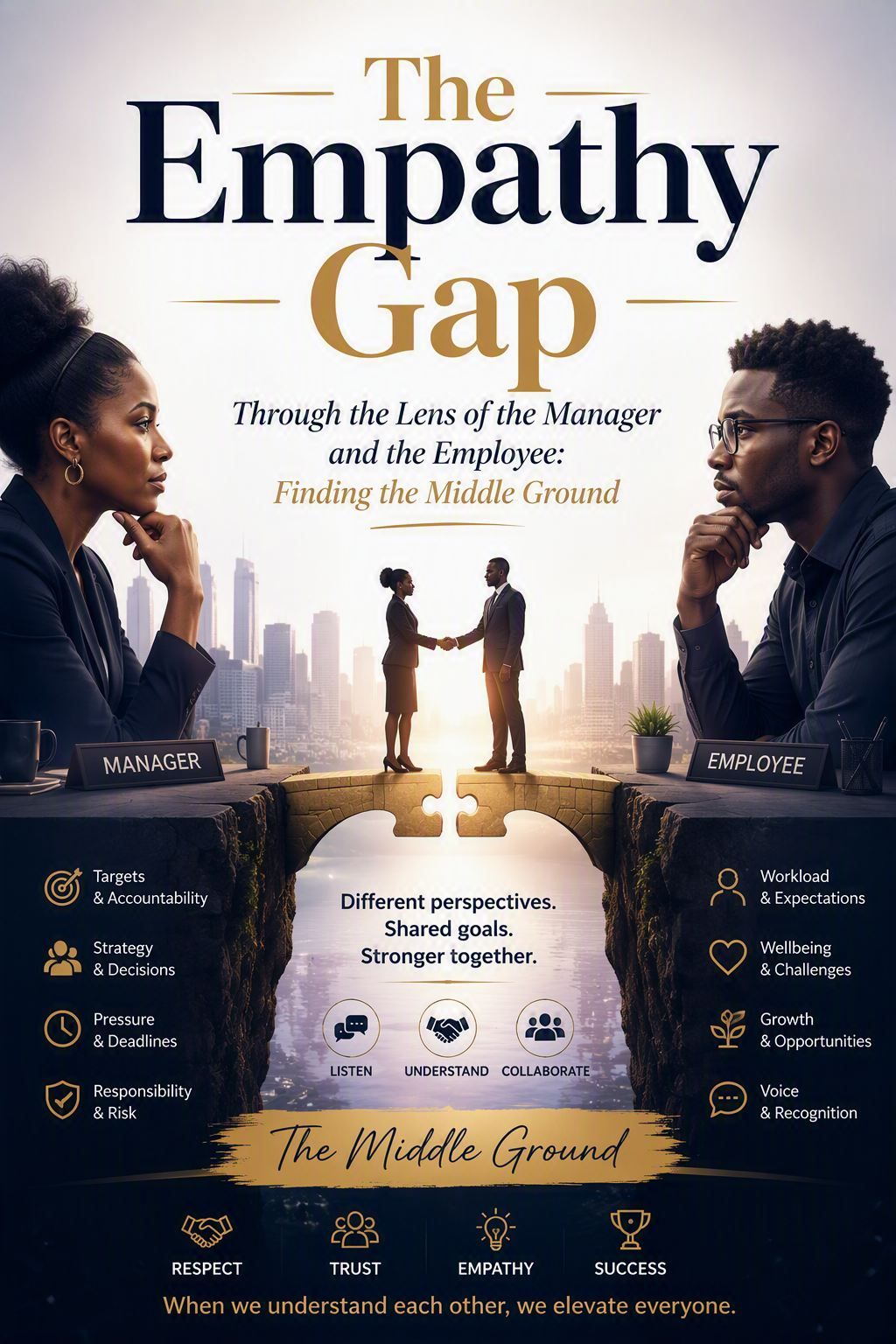
The Empathy Gap: Through the Lens of the Manager and the Employee.
Bridging the Gap Between Management and Staff Through Empathy and Understanding
There is a phrase I have heard countless times throughout my career:
"Management doesn't understand."
Interestingly, I have also heard the opposite:
"Staff don't understand."
The more years I spend in leadership, mentoring, training, and professional practice, the more I realise something important.
Both sides are often right. And both sides are often wrong.
The reality is that many workplace frustrations are not driven by bad intentions. They are driven by different perspectives, different pressures, and incomplete understanding.
I know this because I have stood on both sides.
- I have been the employee wondering why decisions were made without consultation.
- I have been the manager carrying the burden of decisions I could not fully explain.
- I have been the new starter trying to learn, prove myself, and gain confidence.
- I have been the experienced professional expected to know the answers.
- I have trained people.
- I have supervised people.
- I have advocated for people.
And through it all, one lesson remains consistent:
We achieve more when we stop viewing each other as opponents and start seeing each other as partners.
Through the Employee's Lens
Imagine being a member of staff. You arrive every day committed to doing a good job. You are managing deadlines, family responsibilities, financial pressures, career ambitions, and the everyday realities of life.
- You want your work to matter.
- You want your voice to be heard.
- You want fair recognition for your efforts.
- You want opportunities to grow.
Yet sometimes, decisions arrive without context.
- A new process is introduced.
- A project deadline moves unexpectedly.
- A request feels unreasonable.
- A promotion opportunity is missed.
- A workload increases.
- A policy changes.
From the employee's perspective, it can feel as though management is disconnected from reality. It can feel as though leaders only see targets and dashboards while staff are carrying the emotional and practical impact.
When communication is poor, assumptions quickly fill the gap. People begin to feel undervalued, overlooked, or unheard. And perhaps most importantly, when empathy is absent, trust begins to erode.
Through the Manager's Lens
Now imagine being the manager. Every decision carries consequences. You are responsible not only for your own work but also for the performance, development, well-being, and accountability of an entire team.
You are balancing budgets, organisational objectives, regulatory requirements, performance expectations, risk management, staffing challenges, and senior leadership demands. Some days, you are expected to deliver more with fewer resources. Other days, you must make difficult decisions knowing they may not be popular.
- There are situations where a manager cannot disclose everything they know.
- There are times when information must remain confidential.
- There are occasions when a decision is not their personal preference but an organisational requirement.
From the manager's perspective, it can feel as though employees only see a small part of the puzzle. Not because they are unwilling to understand, but because they may not have visibility of the bigger picture.
Managers often carry pressures their teams never see, just as employees frequently carry burdens their managers never fully appreciate.
The Empathy Gap
The real challenge is not necessarily workload. Nor is it hierarchy. The challenge is what I call the empathy gap.
The empathy gap occurs when we become so focused on our own pressures that we lose sight of the pressures facing others.
- Employees assume managers do not care.
- Managers assume employees do not understand.
- Both sides become frustrated.
- Both sides become defensive.
- Both sides feel unheard.
And before long, workplace relationships become transactional rather than collaborative.
The tragedy is that most people entered the workplace wanting the same things:
- To do meaningful work.
- To contribute positively.
- To be respected.
- To succeed.
- To help their organisations succeed.
The Managers We Need
Let us be honest. Not every workplace challenge can be explained by misunderstanding.
- Some managers genuinely lack empathy.
- Some lead through fear instead of trust.
- Some communicate poorly.
- Some forget what it felt like to be the newest person in the room.
Leadership is not simply about authority. It is about responsibility. People may forget what a manager said. They rarely forget how that manager made them feel.
The best leaders remember that people are human before they are employees.
- They listen.
- They communicate.
- They create psychological safety.
- They hold people accountable without diminishing their dignity.
- They understand that leadership is not measured by title, but by impact.
The Employees Organisations Need
Equally, employees have responsibilities too. No organisation can thrive if accountability exists only at the leadership level.
Professional growth requires ownership. It requires curiosity. It requires resilience. It requires a willingness to learn, adapt, and contribute.
Employees who seek to understand the wider organisational context often discover that decisions are more complex than they initially appeared.
They move from asking:
"Why is management doing this to us?"
to asking:
"How can we contribute to solving this challenge?"
That shift transforms workplace culture.
Finding the Middle Ground
The middle ground is not agreement on everything. It is mutual understanding.
- It is managers recognising that behind every job title is a human being with aspirations, challenges, and responsibilities.
- It is employees recognising that leadership often involves difficult decisions, competing priorities, and pressures that may not always be visible.
- It is creating environments where questions can be asked without fear.
- Where feedback flows both ways.
- Where respect is not dependent on hierarchy.
- Where accountability and compassion coexist.
Most importantly, it is recognising that success is shared.
- When employees succeed, managers succeed.
- When managers succeed, teams succeed.
- When teams succeed, organisations succeed.
These outcomes are not competing interests. They are interconnected.
A Final Reflection
Throughout my journey as a professional, trainer, mentor, employee, and leader, I have learned that workplaces function best when we replace assumptions with conversations.
Many conflicts stem not from malice but from misunderstanding. Many frustrations can be reduced when people feel genuinely heard. And many organisational challenges become easier when we stop focusing on who is right and start focusing on what is right.
The goal should never be management versus staff. The goal should be partnership. Because at the end of the day, we are all working towards the same destination.
The question is not whether managers and employees see things differently. They do. The question is whether we are willing to understand each other's views well enough to find the middle ground.
That is where trust is built. That is where people thrive.
And that is where organisations achieve their very best.
By Bamidele Farinre, CSci, FIBMS, Hon Fellow AHCS
Agile Practitioner | Author | Mentor | STEM Advocate
A powerful reflection on the invisible weight of representation and the emotional toll of being the first and only one in spaces where you're underrepresented. This article explores the burden, loneliness, and unexpected strength that comes with breaking barriers.
The Burden of Being the Only One Breaking barriers, carrying expectations, and creating pathways for those who follow.
The Hidden Weight of Being the First and What It Means to Create a Path for Others
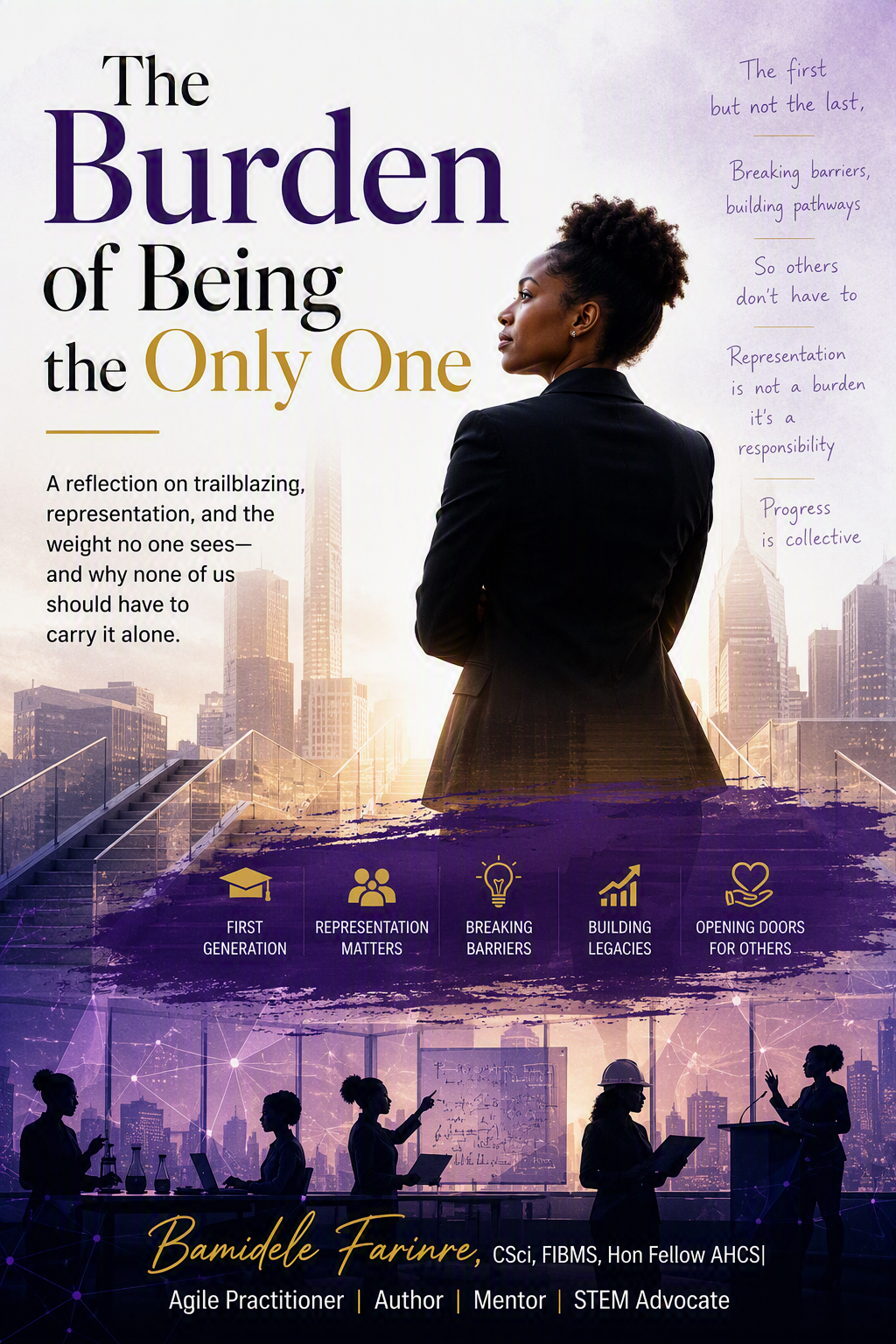
There is a weight that comes with being the only one.
It is a burden rarely discussed openly, yet many people carry it every day.
- You may be the only woman in the boardroom.
- The only Black professional in your department.
- The first person in your family to attend university.
- The first doctor, engineer, scientist, teacher, entrepreneur, lawyer, or leader your family has ever known.
- You may be the first to challenge expectations, break traditions, or enter spaces where nobody expected you to belong.
To the outside world, these achievements are often celebrated as milestones. To the person carrying them, they can sometimes feel like a responsibility so heavy that success comes hand in hand with exhaustion.
I know this feeling well.
As a Black woman in STEM, there have been moments throughout my career when I have walked into rooms and immediately known I was different. Not because I lacked qualifications, experience, or expertise, but because I was visibly underrepresented.
In those moments, I often felt an unspoken pressure. A pressure not only to succeed for myself but also to prove that people who looked like me belonged there too.
Many people who are "the only one" understand this burden instinctively.
We become representatives when we simply want to be individuals.
The Invisible Weight of Representation
When you are part of a majority, your mistakes are generally viewed as your own. When you are the only one, your mistakes often feel like they carry wider consequences. You worry that a single error may reinforce stereotypes. You feel pressure to outperform simply to be considered equal. You work harder because you know opportunities may not come as frequently. You become hyper-aware of how you speak, how you dress, how you lead, and how others may perceive you. Over time, carrying this weight can become exhausting.
Many first-generation professionals know this feeling. Many immigrants know this feeling. Many people from working-class backgrounds know this feeling. Many women in male-dominated industries know this feeling. Many individuals from underrepresented communities know this feeling. The details may differ, but the emotional experience is often strikingly similar.
You are not only building your own future. You feel as though you are carrying the hopes of everyone who comes after you.
The Loneliness Nobody Talks About
There is another side to being the only one: loneliness.
- The loneliness of being successful in places where there are few people who understand your journey.
- The loneliness of reaching milestones your family may be proud of but cannot fully relate to because they never had access to those opportunities themselves.
- The loneliness of navigating challenges without mentors who share your experience.
- The loneliness of constantly explaining why inclusion matters to people who have never had to think about it.
Sometimes, being the first means there is no blueprint. No roadmap. No guide. No inherited wisdom.
You are learning as you go. Building as you climb. Creating pathways while simultaneously walking them.
People often celebrate the outcome but rarely acknowledge the emotional cost.
The Strength Hidden Within the Burden
Yet there is another truth. While being the only one can feel heavy, it can also be transformative.
- Those who have experienced exclusion often become champions of inclusion.
- Those who lacked mentors often become mentors.
- Those who were overlooked become advocates.
- Those who had to fight for opportunities often dedicate themselves to creating opportunities for others.
This has certainly shaped my own journey. Some of the challenges I experienced as a Black woman in STEM became the very reason I became passionate about equity, mentorship, leadership development, and community building.
The barriers were real. The self-doubt was real. The isolation was real. But they also taught me the importance of creating spaces where others do not have to carry the same burden alone.
Because progress is not measured solely by how far we climb. It is measured by how many others can climb because we chose to reach back.
Being the First Should Never Mean Being Alone
One of the greatest misconceptions about trailblazers is that they are somehow fearless. The truth is that most pioneers carry uncertainty. We simply move forward anyway. We take the next step despite not knowing exactly where the path leads.
But no one should have to do this alone.
This is where communities matter. Mentors matter. Sponsors matter. Teachers matter. Parents matter. Leaders matter.
When we intentionally support those entering unfamiliar spaces, we reduce the burden of being the only one. When we create inclusive workplaces, we reduce the pressure of representation. When we actively develop diverse talent pipelines, we ensure fewer people have to stand alone.
The goal should never be to applaud people for surviving isolation. The goal should be to eliminate the isolation itself.
A Message to Those Carrying the Burden
If you are currently the only one in the room, I want you to know something.
Your presence matters. You do not need to be perfect. You do not need to carry an entire community on your shoulders. You do not need to prove your worth every single day.
You belong. Not because you are exceptional enough to overcome barriers. Not because you worked twice as hard. Not because others granted you permission. You belong because your voice, perspective, expertise, and experience have value.
And if you are the first, remember this:
Your journey is not just about opening doors. It is about making sure those doors remain open for others.
From "The Only One" to "One of Many"
My hope for future generations is simple.
- That fewer people will experience the burden of being the only one.
- That young girls entering STEM will see leaders who look like them.
- That first-generation students will find mentors who understand their journey.
- That professionals from every background will enter workplaces where inclusion is not an initiative but a reality.
- That representation becomes so commonplace that it is no longer remarkable.
The ultimate measure of progress is not that we continue to celebrate the first. It is that eventually, there are so many that being "the only one" becomes a thing of the past.
Until then, for everyone carrying that burden today, know this:
You are not alone. Many of us have walked that path. Many of us are still walking it. And together, we can ensure that those coming behind us inherit not the burden of being the only one, but the freedom of being one of many.
Explore the hidden costs of toxic workplace dynamics specifically for women leaders, from credibility loss to health impacts. Learn to recognize twelve destructive behaviour patterns and strategies to protect yourself in professionally hostile environments.
Name It, Navigate It, Leave It: What Toxic Workplace Dynamics Actually Cost Women Leaders.
How toxic workplace dynamics disproportionately undermine women leaders and what it truly costs them.
The Hidden Cost of Toxic Workplace Dynamics for Women Leaders
You have probably worked with at least one of them.
The person who takes credit for your idea in the meeting where you just presented it. The one who copies your manager into every critical email. The one who manages to make everything your fault without ever quite saying so directly.
You told yourself it was just the way things are. You adjusted. You worked around them. You stayed professional, stayed polite, and stayed quiet in the moments when staying quiet cost you something you cannot fully account for yet.
This article is not about those people.
It is about what their behaviour costs you-specifically as a woman, specifically as a leader, and specifically if you are also navigating the additional weight of being underrepresented in the spaces you occupy.
Because the cost is real. It is specific. And it is rarely named honestly enough.
"Toxic workplace dynamics are not personality clashes. They are power patterns. And they do not affect everyone in the room equally."
Why Women Pay More
The Same Behaviour, a Different Bill
When a man in a leadership role is undermined by a colleague, it is inconvenient and frustrating. When a woman in a leadership role is undermined, it can reinforce a narrative that may already exist about whether she is the right person for the role.
That asymmetry is not fair.
It is also not imaginary.
Women leaders are more likely to have their authority questioned when someone challenges them. They are more likely to be described as difficult when they respond assertively to behaviour that might be tolerated from a male colleague. They are also more likely to absorb the emotional labour of managing a toxic dynamic quietly rather than escalating it, because the cost of being perceived as someone who cannot handle the environment often feels higher than the cost of tolerating the environment itself.
That calculation is exhausting.
It takes up space that should be dedicated to the actual work. Over time, it contributes to burnout, causes women to step back from roles they have earned, and creates a quiet exodus from organisations that never fully understood what they were losing-or why.
Worth Saying Clearly
If you have been told that a toxic colleague is simply someone you need to learn to manage, that advice places responsibility in the wrong place.
Some workplace dynamics are genuinely manageable.
Others require systemic intervention.
Knowing the difference matters, and this article will help you recognize it.
The Specific Cost
Six Things Toxic Dynamics Take From Women Leaders
Credibility
Your authority gets quietly chipped away
Every time someone takes credit for your work, talks over you, or undermines you in front of others, a small deposit is made into a narrative about your competence.
Individually, each incident may feel minor. Cumulatively, they shape how you are perceived in the room.
Energy
Managing around people is a full-time, unpaid job
Anticipating the blame shifter. Preparing for the control freak. Protecting yourself from the underminer.
All of that cognitive labour happens before you have even started the work you were actually hired to do.
It is invisible.
And it is expensive.
Ambition
You start making yourself smaller to survive
When every time you step forward something pushes you back, the rational response can become to stop stepping forward.
Women in toxic environments often describe shrinking their ideas, their visibility, and their aspirations-not because they lack confidence, but because the environment has taught them that visibility comes with a cost.
Health
The body keeps the score the meeting minutes do not
Chronic stress from sustained toxic dynamics has physical consequences:
Sleep.
Appetite.
Concentration.
The body responds to environments that feel consistently unsafe.
Women who describe toxic workplaces often describe health impacts that began quietly and accumulated over time before they recognized their connection to the environment.
Trust
You stop believing organisations mean what they say
When you report a concern and nothing changes, when the values displayed on the wall do not match the behaviour happening in the workplace, trust erodes.
And once it disappears, it rarely fully returns.
Women who experience repeated organisational inaction often develop a reasonable scepticism that follows them.
Time
Years that should have been spent building get spent surviving
This is the one that weighs the heaviest.
The years spent in environments that drained rather than developed you. The opportunities missed because the environment made pursuing them feel too costly.
You cannot get that time back.
But you can decide what you do with the time ahead.
Name Them
Twelve Types, and What They Actually Cost Women
The following are not personality profiles designed to judge people. They are patterns of behaviour to recognize so that you can respond clearly rather than absorb them silently.
Based on widely recognized workplace dynamics, these patterns have been reframed through a leadership and gender lens.
The Spotlight Thief
Claims credit for your work, often publicly.
What it costs women specifically
For women already fighting to have their contributions recognized, having their work attributed to someone else is not a minor irritation. It directly affects the visibility that leads to advancement.
Document everything. Share progress in writing. Make your contributions visible before they can be reassigned.
The Bulldozer
Talks over people, dismisses perspectives, and dominates every room.
What it costs women specifically
Women are interrupted more frequently in professional settings than men. The bulldozer reinforces a pattern that already exists.
Being repeatedly talked over can diminish confidence and discourage women from continuing to speak.
Hold your ground calmly. Finish your sentence. Name the behaviour directly when necessary.
Join Influential Women and start making an impact. Register now.