Women, There Is an Elephant in the Room. Her Name Is Imposter Syndrome.
Breaking the silence on imposter syndrome: why high-achieving women feel like frauds and how to reclaim your rightful place at the table.

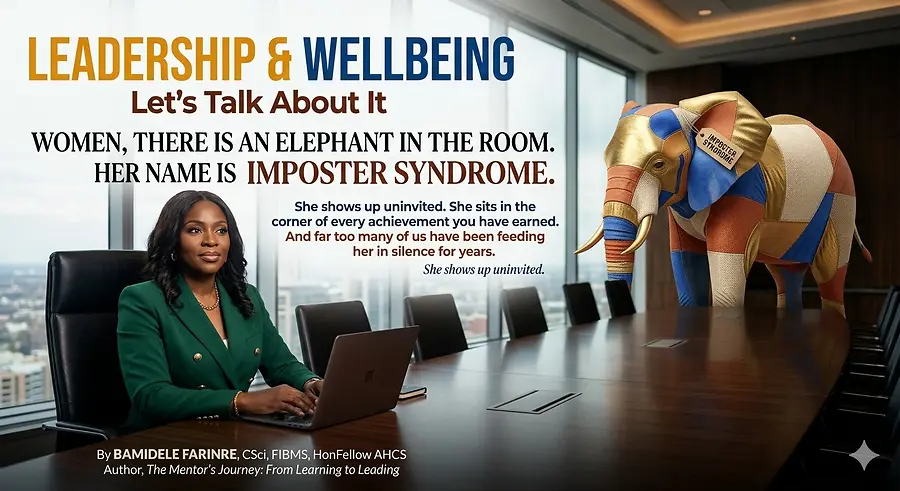
You got the job, the promotion, the seat at the table.
And the first thought that arrived, before the congratulations had even settled, was:
“What if they find out I am not as good as they think I am?”
If that sounds familiar, you are not alone. Not by a long stretch.
Imposter syndrome is one of those things women talk about in whispers, in corners, after a few drinks when the professional armour comes off slightly. We acknowledge it to each other privately and then walk back into the room and perform certainty we do not always feel. We have become very good at that particular act. And we pay for it in ways that are rarely named clearly.
I have experienced it. I still do, occasionally, even now—with years of experience, a published book, a career I have built deliberately, and a long list of evidence that I know what I am doing. The voice still shows up sometimes. The difference now is that I know what it is, I refuse to give it the steering wheel, and I want to talk about it honestly so other women can do the same.
“Imposter syndrome is not evidence that you do not belong. It is often evidence that you care deeply about doing the work well. The two things are not the same.”
What It Actually Is
Let us name the elephant properly
The term was first coined in 1978 by psychologists Pauline Clance and Suzanne Imes, who noticed it particularly in high-achieving women. They described it as a persistent internal experience of feeling like a fraud despite external evidence of competence and success—the belief that your achievements are largely due to luck, timing, or the fact that nobody has looked closely enough yet.
That is the core of it. Not low confidence across the board. Not a general lack of self-belief. A very specific conviction that the gap between how others perceive you and who you believe you are is wider than it should be—and that eventually, somehow, the gap will be exposed.
It is worth saying clearly: imposter syndrome is not a diagnosis. It is not a flaw in your character. It is a very human response to certain kinds of pressure. And it shows up in some of the most capable, accomplished, rigorous people in every field. The fact that you feel it is not proof that you do not belong. It is often proof of the opposite.
A personal note
“I remember sitting in a room full of senior professionals early in my career, feeling certain that everyone around me had a blueprint I had somehow missed—that there was a manual for belonging in this space and mine had not arrived. Years later, I realised that most of them felt something similar and had simply learned to keep moving anyway. Nobody gave me that information at the time. So I am giving it to you now.”
How It Shows Up
Six ways the elephant makes herself at home
The Overworker
Doing twice the work to feel half as secure
You prepare more than anyone else in the room because you are convinced that anyone who prepared less would be found out. The preparation is real. The need to do more than everyone else to feel legitimate is the imposter talking.
The Deflector
Crediting luck for everything you worked for
“I just got lucky.” “I was in the right place.” “Anyone could have done it.” You deflect every compliment because accepting it feels like agreeing to a lie. The truth is that luck and work usually coexist. The work was yours.
The Perfectionist
Never quite finished, never quite good enough
The project is done, but you are still revising. The presentation is ready, but you are rewriting the opening. Perfectionism and imposter syndrome often travel together. The fear is not failing—it is being seen to fail.
The Shrinker
Making yourself smaller so nobody looks too closely
Not raising your hand. Not sharing the idea. Waiting until you are certain before speaking, which often means not speaking at all. Shrinking is a protective strategy. It keeps the gap hidden. It also keeps you stuck.
The Comparer
Measuring your inside against everyone else’s outside
You see their confidence and assume it is complete. You see your own doubt and assume it is unique. The comparison is unfair because you have full access to your uncertainty and almost none to theirs.
The Denier
Refusing to let the feeling exist at all
Some women do not call it imposter syndrome. They call it being realistic, staying humble, keeping their feet on the ground. Sometimes that is true. But sometimes it is simply the elephant under a different name. Naming it honestly is the first step to not being ruled by it.
Why Women Carry More of This
This is not just personal. It is also structural.
Imposter syndrome does not visit everyone equally. It lands harder on women, and even more so on women from underrepresented groups. There are real reasons for that which have nothing to do with individual weakness.
When you are in a room where few people look like you, you have less external evidence that you belong. When systems were not designed with your full inclusion in mind, they can reinforce the internal voice that says you do not fit. When you have been told—explicitly or implicitly—that you are an exception rather than the expectation, that voice gains traction.
This matters because it means imposter syndrome is not only an individual issue. It is also an organisational one. A woman who feels like a fraud in a room where she is the only one of her kind may not be experiencing distortion—she may be accurately reading an environment that has not fully affirmed her belonging. Those are different problems and require different responses.
Both deserve attention.
How to Handle It and Thrive
Stampeding the elephant: seven things that actually help
01 — Name it out loud
Stop letting the elephant pretend it is not there. The moment you say, “I am feeling like a fraud, and I know that is the imposter talking,” you reduce its power. Silence strengthens it. Naming weakens it.
02 — Build your evidence file
Imposter syndrome forgets your wins and magnifies your doubts. Counter that deliberately. Keep a record of feedback, successes, outcomes, and moments of impact. Read it when the voice gets loud.
03 — Separate feeling from fact
Feeling like a fraud is not the same as being one. Ask: What is the actual evidence? Not what does it feel like.
04 — Talk to someone who will be honest
Not someone who will only reassure you, but someone who can give you a grounded view of your work. The goal is calibration, not comfort.
05 — Stop waiting until you are ready
“Ready” is a moving target. The voice will always add one more requirement. Step forward anyway.
06 — Find your people
Community dismantles the isolation imposter syndrome relies on. When you hear others say it out loud, it loses some of its grip.
07 — Let your work speak, then listen
Over time, patterns form. Results accumulate. You were not just lucky repeatedly. At some point, the evidence becomes harder to dismiss honestly.
The elephant does not get to drive.
I said at the start that I have experienced imposter syndrome. I still do sometimes. And my relationship with it has changed not because it went away, but because I stopped letting it have the final word. I learned to feel it, name it, and keep moving—not because I became fearless, but because I decided that waiting for fear to disappear before acting was a price too high to keep paying.
The elephant will always be somewhere in the room. That is not the problem. The problem is letting it decide your direction.
Move anyway.
Speak anyway.
Trust the evidence you have accumulated, even when the feeling says otherwise.
And talk about it—openly.
To younger women who think they are alone in it. To peers performing certainty at a cost. To institutions that still treat this as an individual problem rather than a structural signal.
You are not a fraud. You are a woman doing real work in spaces that were not always built for you. That is not the same thing. And it is time we stopped letting the confusion between those two facts hold us back.
Bamidele Farinre, CSci, FIBMS, HonFellow AHCS
Chartered Biomedical Scientist | Educator | Author | Global STEM Advocate
Bamidele Farinre is the author of The Mentor’s Journey: From Learning to Leading and a contributor to the APPG on Diversity and Inclusion in STEM’s AI equity inquiry. She writes and speaks on mentorship, leadership, identity, and the real experiences of women navigating professional life. The No Ceiling philosophy runs through everything she does: there is no limit on what you can learn, build, or become.
Influential Women | influentialwomen.com
© No Ceiling 2026 | Bamidele Farinre


