
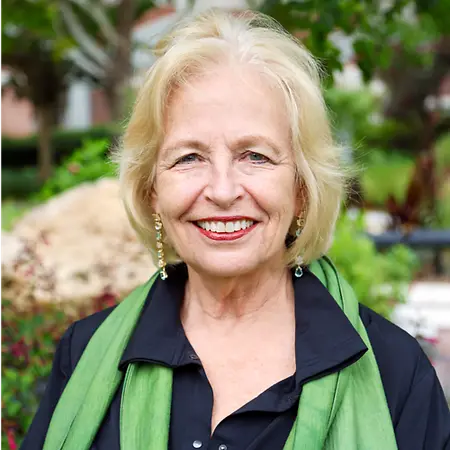
Her Story
About Bonnie
Bonnie Spring, PhD, serves as the Krafft Professor of Behavioral Sciences and Social Medicine at Florida State University College of Medicine and Director of the Florida Blue Center for Rural Health Research and Policy. An accomplished researcher and academic leader, she specializes in health behavior change, mobile health (mHealth), team science, and evidence-based practice. Her work focuses on technology-assisted behavioral interventions that address multiple health risks, including smoking, obesity, poor quality diet, and physical inactivity. She is also an expert in optimization methods designed to improve the effectiveness and efficiency of health interventions. In her current leadership role, she works to connect rural populations with healthcare and social services through technology, coordinated care, and closed-loop referral systems that help ensure individuals receive the support they need. Spring earned her Bachelor of Arts in Psychology from Bucknell University in 1971 and completed her PhD in Psychology at Harvard University in 1977, beginning her academic career that same year. Initially drawn to psychology after considering a career as a novelist, she studied abroad in England, and then earned a Woodrow Wilson Fellowship that supported her admission to Harvard. Her professional journey included early faculty positions at Harvard University and Texas Tech University, followed by research at the VA Medical Center in Hines, Illinois, and approximately seven years as a professor at the University of Illinois Chicago. She subsequently spent nearly 20 years at Northwestern University, where she served as a professor of preventive medicine, Director of the Center for Behavior and Health, and Director of Team Science. During her tenure, she also held leadership responsibilities in cancer prevention and contributed to interdisciplinary clinical and translational research initiatives. In November 2024, she joined Florida State University College of Medicine, where she continues to advance innovative approaches to behavioral science and rural health. Throughout her career, Spring has evolved from studying schizophrenia to developing behavioral interventions that help people make sustainable improvements to their health. She is committed to translating scientific evidence into practical solutions through interdisciplinary collaboration, technology-assisted coaching, and research that addresses barriers to care. Her current initiatives include improving rural health outcomes, addressing food insecurity and healthcare access, and exploring AI-assisted tools to expand access to personalized lifestyle coaching. Her contributions have earned recognition, including the Paula H. Stern Award for Outstanding Women in Science and Medicine from Northwestern University Feinberg School of Medicine in 2022, along with leadership roles in the Society of Behavioral Medicine and the American Psychological Association. Spring believes that professional growth and innovation depend on paying attention to emerging trends and questioning established practices rather than assuming there is only one correct approach. By remaining open to change and exploring alternatives, she encourages the discovery of new possibilities that others may not have considered.
Her Interview
Ten minutes with Bonnie
01What do you attribute your success to?
Curiosity, Outstanding Mentorship, Even Better Friendships, My Daughter and Granddaughter
02What’s the best career advice you’ve ever received?
The best career advice I’ve ever received is to pay attention to where trends are heading and to question the idea that there is only one right way to do things. It’s important to remain open-minded, challenge conventional thinking, and recognize that what works today may not be the best approach tomorrow. By embracing change and being willing to explore alternative methods, I’ve learned that opportunities often emerge from paths others may not have considered.
03What advice would you give to young women entering your industry?
Find activities or research questions that truly capture and sustain your interests and passions. A career is long and has ups and downs. Ideally, yours should have the capacity to grow, change, and transform along with you. Stay attuned to what gives your life meaning, purpose, and joy. Those go the distance and will help you do so too. Above all else, please enjoy the journey and be kind to those around you.
04What are the biggest challenges or opportunities in your field right now?
There are two main challenges. First, uncertainty about the stability of future research and educational funding have demoralized some junior investigators and deterred many others from pursuing academic or research careers. These same conditions challenge senior mentors to optimally balance providing usual scientific training, socioemotional support, and accurate insights about the likely socioeconomic conditions ahead. Second, an unprecedented level of opinion polarization in the country impedes constructive communication and collaboration across within-country cultural divides.
An important opportunity is that the U.S.'s difficulty with offering high-quality, affordable healthcare in the U.S. has become nonignorable. Having long provided the most expensive healthcare in the world but obtained disappointing and shrinking longevity, recent cuts to the safety net portend great hardship for a large portion of the population. Surprising consensus and coherent action has emerged across usually divergent political sectors about the urgent need to invest in deploying new technologies and care delivery models to prevent further rapid (and costly) declines in the health of our at risk older population.
05What values are most important to you in your work and personal life?
Continued growth, learning, development, and opportunity to have a positive impact on the people around me are what I value most in both work and personal life. At some midcareer point, I perceived less and less difference between the goals of mentoring trainees, providing therapy, and parenting. All three seemed to cohere around helping people figure out their needs/desires and then remove obstacles (sometimes self-inflicted) to attain their goals in constructive, fulfilling ways. A great benefit of this philosophy has been that I've learned a tremendous amount from those I've tried to help. I find it a real gift that differentiating mentor from mentee has become a near-impossible task.
Join Influential Women and start making an impact. Register now.