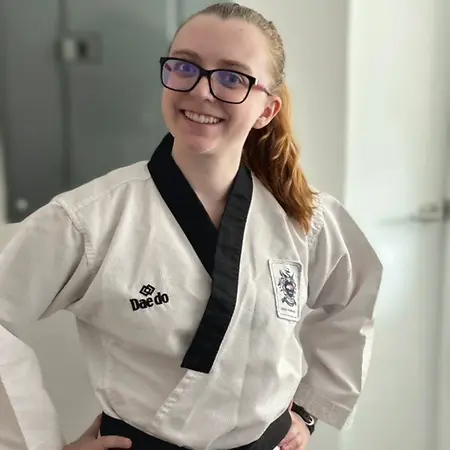
Her Story
About Camille
Camille McClaren is currently a psychology student at St. Francis College in New York City and a lifelong martial artist whose work bridges cognitive science, social-emotional education, and sport performance. She began practicing taekwondo at age five and has earned her Kukkiwon-certified 4th Dan black belt, founding Pure Taekwondo NYC, a women-run, inclusive, and science-informed martial arts school as a teenager. Her coaching approach emphasizes motor learning, embodied cognition, and adaptive teaching methods, developed through years of working with students of all ages, abilities, and learning needs. She is also involved in academic research exploring the relationship between movement, language, and learning, with interests in metacognition, cognitive science, and educational equity. As an instructor and mentor, Camille has built a reputation for innovative, student-centered teaching that prioritizes understanding over rote technique. She has coached athletes to competitive success in sport poomsae at state, national, and international levels, while also creating programs for beginner students, youth learners, and specialized populations. Her teaching philosophy integrates discipline, creativity, and critical thinking, often introducing concepts like “concept stripping” to help students transfer knowledge across contexts and deepen comprehension. Through Pure Taekwondo NYC, she has also expanded access to martial arts training, originally serving Orthodox Jewish girls and now welcoming a broader, diverse community. Beyond athletics, Camille is academically ambitious and actively engaged in research and leadership roles. She has contributed to interdisciplinary projects at Long Island University. She is also an advocate for mental health awareness, disability equity, and inclusive education, and frequently uses her platform to discuss developmental psychology, learning systems, and youth empowerment. Across all of her work, she is driven by a commitment to helping others build confidence, critical thinking skills, and ownership of both mind and body.
Her Interview
Ten minutes with Camille
01What do you attribute your success to?
I started doing Taekwondo when I was five, and when I was seven, I decided this was what I wanted to do with my life. I told my first Taekwondo master, "I want to be a Taekwondo master just like you and have my own school". He looked at me and laughed and said, "You will never be a master; no one will ever bow to you", because I'm a girl. That lit me on fire, and I started my school when I was a teenager, initially focusing on Orthodox Jewish girls who are very conservative religiously and need to be taught by a woman. I expanded it to include high-level young black belt athletes who competed nationally and internationally, and I coached them to medal stands in multiple levels of competition. As an adult, I mainly teach privately right now. It's really important that you understand that my school does things differently. It is woman-run, whereas most of the field is male-dominated, and it will be feminist-oriented and science-informed in all of the methodology that I use. I'm currently in college gathering more and more knowledge about how to shape my methodology so that it really follows cognitive science and motor learning information, so that we're doing things differently. Cognition and motor learning have a profound crossover, making sports good for your mind and body; the difference is that I want to do it on purpose, very intentionally. We're not just making up stuff.
That same Master, three years after telling me that, gave me my first black belt, which I earned. At that point, I was already one of the top six athletes in my division in the US in poomsae competition. He announced to the whole taekwondo school that I had surpassed him and that he could no longer teach me. His specialty was fighting; mine was poomsae. He didn't want to learn more about poomsae so he could keep being my Master and coach, and he turned down people who offered to help him do so. Well, in my 10-year-old mind, I was being abandoned as an athlete, and I took it personally. So I didn't quit. The word "quit" never entered my mind. I was at the top in New York for years in each of my divisions, and at the time, no coach in New York City was at my caliber. I had to travel to different states to occasionally work with some of the top poomsae coaches in the US, which was financially difficult while I was also a full-time student. Instead of taking three taekwondo classes a day as I did as a kid, I specialized my training in poomsae only, and I trained myself. For years, my first Master made me pay to use his dojang after hours, which was located in a professional bodybuilding gym. One day I showed up to practice on my own after hours, and the taekwondo mats were gone. He moved to another location and took the mats, leaving me without them - without telling me. So, I used my competition status to get in the door of different dojangs around the city after hours, from 8 pm to 11 pm, every day, getting home at 12 am. During my teenage years, I worked with top coaches on occasion, but each of them abandoned me for athletes who were able to pay them more money. I've had coaches say they were going to coach me at tournaments who stabbed me in the back and never showed up. Despite being at the top nationally and internationally, consistently, I was always an underdog when I competed. As an athlete, from a young age, I would practice for hours every day and compete in tournaments at various levels of competition. I won most of the time, but win or lose, I would always step off the mat and start practicing at the tournament. It would confuse my fellow competitors. They didn't understand why I did that. I always worked my belt off to be better than my talent, and no one witnessed it. I never had what other athletes have the luxury of having: a consistent coach who cared enough as an adult authority figure and role model to stay. I had to become as knowledgeable and talented as these top coaches about poomsae so that I could train myself and stay at the top of my divisions nationally and internationally. And I did.
Unfortunately, when I stopped competing, I found out the hard way that the taekwondo world has a strong out-of-sight, out-of-mind culture. When I earned my fourth Dan after years of having no one to promote me and became a Master, I quickly found out that I was surrounded by a culture of men that would not accept and respect me as an equal in mastery. I realized that all the loneliness of educating and training myself for about 18 years since the age of 10 was not going to be rewarded with the respect I felt I deserved as a fellow master in the sport. This has led me to go after my college education. Again, right now, I'm a college student, and I'm gathering more information so I can shape my methodology correctly. I'm very academically driven, so I plan on earning degrees in psychology, cognitive science, and motor learning to help with my credibility with people who don't realize that Taekwondo masters- the only qualification you really need is to know Taekwondo. I've been doing Taekwondo for 23 years, and there is much room for educational research and applications of therapeutic use. I'm looking to change the culture to a more feminist-oriented culture in my own Dojang and raise awareness and educate through conversation about gender-related issues in martial arts, as well as explore and expand the understanding of it as a multi-sensory, cognitive, and motor enrichment learning education model through my biggest contributive goal of creating an interactive textbook on the cognitive science of teaching and learning sport poomsae. This goal is for me to show myself that I can surpass everyone who doesn't treat me with respect in knowledge, skill, attitude, and tenacity. As an adult and master in the sport, I am no longer afraid of retaliation from male masters for speaking up about my experiences.
I do taekwondo for me. I love and am fascinated by the movement of sport poomsae. When I watch it, it breaks into one thousand tiny pieces to study. I've always approached it in an interdisciplinary way; learning Kinesiology, Exercise Science, Psychology, and Cognitive Science in school only enhances my understanding. I don't owe or attribute my success as an athlete to any of the masters I've worked with - I'm 90% self-taught. I attribute my success as a person to my drive and fight, and will that are unstoppable against the unending adversity these men have created in my life. Because of them, I know who I don't want to be to my students, and that is a blessing.
02What’s the best career advice you’ve ever received?
Do what you're passionate about.
03What advice would you give to young women entering your industry?
Learn about various forms of violence and really ask yourself if not just what you teach in your dojang or dojo but how you teach it qualifies as functional self defense for real life attacks, as opposed to the applications of rule-based and point-based sport martial arts. Ask yourself what narratives you are instilling in your students and where and who they truly come from in your male-dominated industry.
As a lifelong female martial artist who advocates for disrupting sexism and other gender-related issues in martial arts I have done much reflecting on this topic... in my personal experiences as a survivor, I've noticed that I am often expected by men to be invincible and as abled as a Hollywood action hero to the point where he believes he is freely allowed to physically challenge me just because I have a black belt. To some men there is a victorious success in physically challenging and "dominating" a female martial artist without consent to touch their bodies in an effort to feel manly and achieve the narrative that "men are and must be dominant". This idea that female martial artists are invincible because they took a self-defense class is perpetuated by a male-dominated industry. This narrative is then taught to women who don't realize that real life attacks don't come with the safety rules a martial arts class is required to have. That invincibility narrative is also based on the false assumption that an attack is or can be purely physical when the reality is violence against women is much more complicated outside of the safety of a dojang or dojo. That is why I support separating what qualifies as sport from actual functional self-defense preparation, both in methodology and outcome.
04What are the biggest challenges or opportunities in your field right now?
One ongoing challenge women face in American professional culture is navigating gender bias and sexism—and the martial arts industry is not immune to those problems.
As a feminist, I believe in speaking openly about these issues. But I have learned that speaking louder does not always make difficult conversations easier. Sometimes, it makes people more determined to avoid them.
I have been told directly by male counterparts that gender-related problems in the sport are not real, that they are “all in my head,” or that I simply have “a chip on my shoulder.”
But have you ever stopped to consider what that phrase actually implies?
When someone has experienced real harm within a culture and then speaks about the conditions that contributed to it, dismissing them as “having a chip on their shoulder” shifts the focus away from the culture and back onto the person who was affected by it. It can turn a conversation about sexism into a judgment about a woman's attitude. It can reduce legitimate criticism to the stereotype of the “angry woman.”
I am not interested in pretending that difficult experiences did not happen simply because acknowledging them makes other people uncomfortable.
My experience growing up in martial arts was not the inspirational sports movie where a coach recognizes an athlete's potential and invests in them—not merely for medals or the coach's reputation, but because they genuinely care about the athlete's development, well-being, and journey.
There were lessons I learned about competition, discipline, and perseverance. There were also lessons about power, gender, boundaries, and what happens when empathy is absent.
I have spent years reflecting on those experiences. I do not want to be defined by them, but neither do I believe I should have to silence myself to make other people comfortable.
And perhaps that is the most liberating part: I don't have to.
I can love martial arts and still challenge its culture.
I can be grateful for what the sport has given me and honest about where it has failed me.
I can be a feminist, a teacher, a martial artist, and a woman who refuses to apologize for recognizing patterns that deserve to be examined.
Speaking about sexism isn't bitterness.
Asking for accountability isn't having an attitude.
And refusing to stay silent isn't anger.
Sometimes, it is simply choosing to make the culture better for the people who come after us.
I'm a fighter. Most people: all you have to do is make it hard for them, and they'll stop. I say, bring it on.
05What values are most important to you in your work and personal life?
Mental health awareness and advocacy are very important to me and my business, as well as disability awareness and advocacy in all environments. In athletic spaces, more and more athletes are speaking up about mental health, and as I've gotten older, the emphasis on the mental aspects of sport has only grown because of these leaders. However, in martial arts, because of the patriarchal history and identity and mindsets that come with the historical "tough-guy" mentality and masculine norms, the industry is further behind compared to how other sports are evolving.
Join Influential Women and start making an impact. Register now.