Explore how leaders can acknowledge and navigate transition grief—the emotional response to organizational loss—using the GRACE™ Framework to help employees process change while moving forward with compassion and clarity.
Her Story
About Chameka
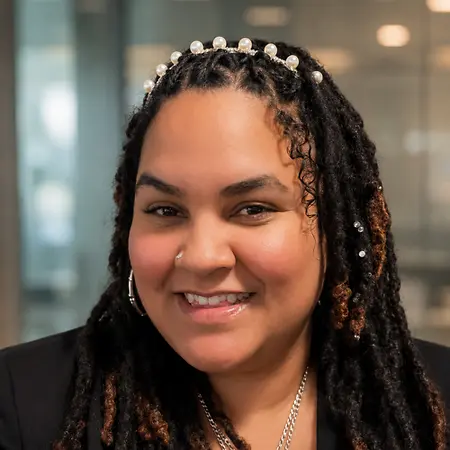
Chameka Necole Crawford-Valenzuela is a life coach, leadership coach, consultant, facilitator, and published author dedicated to helping leaders and individuals navigate growth, change, and personal transformation. She specializes in coaching leaders and teams to enhance efficiency, strengthen collaboration, improve effectiveness, and lead with authenticity. With approximately 20 years of experience in K–12 expanded learning and education, Chameka has built a career centered on developing people, strengthening organizations, and helping individuals discover their potential.
Throughout her career, Chameka has supported leaders and organizations through leadership development, organizational effectiveness, coaching, and change management initiatives. She previously served as an Organizational Development Specialist, where she designed and facilitated learning experiences, supported team development, and helped organizations create stronger cultures. In 2020, she founded Evolving Foundations Life Coaching, providing coaching services that empower individuals and leaders to achieve personal and professional growth while embracing their authentic selves.
Chameka earned her Bachelor’s degree in Educational Studies, Master’s degree in Psychology with an emphasis in Life Coaching, and Graduate Certificate in Mental Health and Wellness with an emphasis in Grief and Bereavement from Grand Canyon University. She attributes her success to God, the strong work ethic and confidence cultivated through her faith, and her commitment to serving others. Her advice to young women entering the field is to step forward with confidence, meet people where they are, and embrace their authentic selves without fear. Through her coaching, consulting, and leadership work, Chameka continues to inspire meaningful change and help others build lives and organizations rooted in purpose, growth, and resilience.
Her Interview
Ten minutes with Chameka
01What do you attribute your success to?
I truly attribute it all to God. He’s the one who gave me the vision, the confidence, and the gifts that I carry. Whenever I begin to question myself, He’s the one who reminds me that there’s something unique within me because He placed it there for a reason.
I also believe the work ethic I have and the courage to keep stepping into new spaces come from Him. Every opportunity I’ve pursued has required faith, and I’ve learned that I don’t have to become someone else to succeed. I simply have to be who God created me to be. That has given me the confidence to show up authentically, trust the process, and continue saying yes to the opportunities He places in front of me.
02What’s the best career advice you’ve ever received?
The best career advice I’ve ever received was simple: Be yourself.
Early in my career, I thought I had to fit a certain mold to be successful. Over time, I realized that the qualities I once questioned—my curiosity, empathy, authenticity, and willingness to have meaningful conversations—were actually my greatest strengths.
I’ve learned that people don’t connect with perfection; they connect with authenticity. The more I’ve embraced who I am, the more opportunities have opened up. My advice to others is to stop trying to become who you think people want you to be and start becoming more of who you already are. The right opportunities will recognize your value, and the right people will appreciate what only you can bring.
03What advice would you give to young women entering your industry?
Don’t be afraid to step into the spaces you’re called to enter. Meet people where they are, lead with compassion, and never feel like you have to become someone else to belong.
Be authentically yourself and trust that if you’ve been given the opportunity to sit at the table, you’re there for a reason. You have something meaningful to contribute because God created you with unique gifts, purpose, and perspective. Walk in with confidence, embrace who you are, and don’t let comparison or self-doubt convince you otherwise. The world doesn’t need another version of someone else—it needs the person you were created to be.
04What are the biggest challenges or opportunities in your field right now?
One of the biggest challenges I see is that so many people struggle with self-doubt. Social media has created a constant stream of comparison, where we’re measuring our beginnings against someone else’s highlight reel. At the same time, the coaching industry has grown rapidly, with so many people marketing similar services that it can be difficult to know who to trust.
At the same time, I see tremendous opportunity. More people are beginning to understand that coaching is not therapy, and it’s not mentoring. It’s a collaborative partnership that helps people uncover their own strengths, gain clarity, and move forward with intention. As that understanding grows, I believe more people will seek coaches who meet them where they are—with empathy, curiosity, and a genuine desire to help them become who they were created to be.
05What values are most important to you in your work and personal life?
The values that guide both my work and my personal life are faith, authenticity, compassion, curiosity, and service.
My faith is my foundation. It shapes how I lead, how I treat people, and how I navigate challenges. I believe every person has inherent worth and untapped potential, and I strive to reflect that in every interaction.
Authenticity is equally important to me. I don’t believe we were created to fit into someone else’s mold. Whether I’m coaching a client, working with leaders, or spending time with my family, I want people to experience the same genuine version of me.
I also value compassion and curiosity. Before I try to solve a problem, I want to understand the person behind it. Everyone has a story, and I believe meaningful change begins when people feel seen, heard, and understood.
Finally, I value service. Success has never been about titles or recognition for me. It’s about leaving people better than I found them—helping them gain confidence, navigate change, and discover what’s already within them. If I’ve made someone’s path a little lighter or helped them believe in themselves again, then I’ve done meaningful work.
Her Content Hub
Articles by Chameka
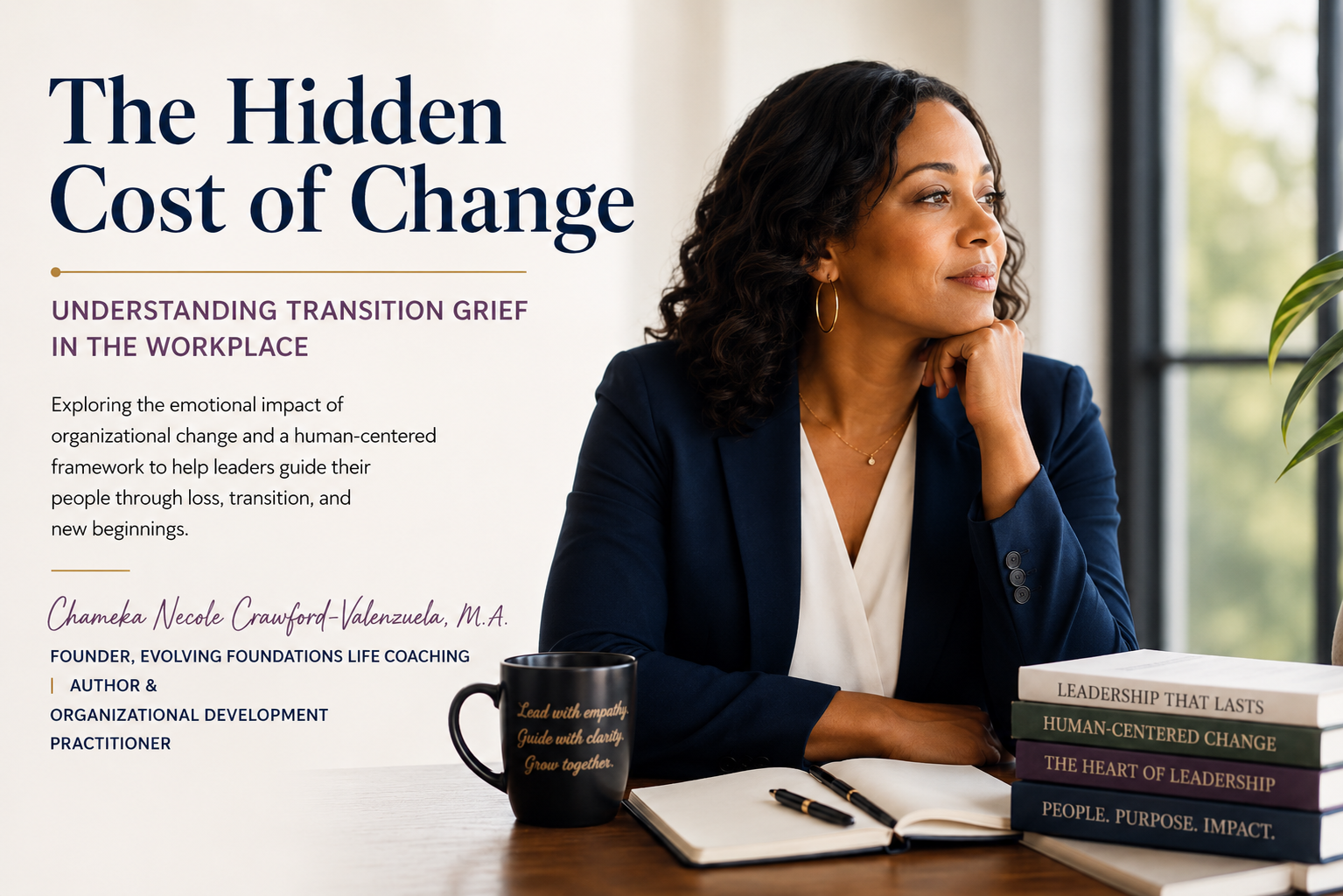
The Hidden Cost of Change
Understanding and Supporting the Hidden Emotional Impact of Organizational Change Through the GRACE™ Framework
Unseen. Unspoken. Unprocessed.
The deepest workplace losses are often the ones no one thinks to acknowledge.
No one sends flowers after a reorganization.
No one brings casseroles when a department is dissolved.
There is no bereavement leave when a trusted leader resigns, when a role you've poured years into disappears, or when the team that once felt like family is scattered across an organizational chart.
Yet people grieve these losses every day.
Organizational change is often measured in milestones, budgets, communication plans, and implementation timelines. Leaders celebrate successful launches, completed restructures, and new strategic directions. But beneath every organizational chart is a human story that is far more difficult to measure.
Every merger, restructuring, acquisition, leadership transition, technology implementation, or workforce reduction asks people to let go of something that mattered. Sometimes what is lost is obvious-a job, a title, or a familiar workspace. More often, the losses are invisible: a sense of identity, trusted relationships, confidence, routine, influence, or the certainty of what tomorrow will look like.
Because these losses are not traditionally recognized as grief, employees are often expected to move forward almost immediately. They attend kickoff meetings for the future while quietly mourning what has been left behind. They are encouraged to embrace change while still trying to make sense of what was lost.
When those emotions surface, they are frequently labeled as resistance, disengagement, negativity, or poor performance.
But what if we have been calling grief by the wrong name?
In my work, I define transition grief as the emotional and psychological response to meaningful organizational loss. It is the experience of navigating change that alters a person's identity, relationships, routines, or sense of purpose at work. Although often invisible, transition grief influences engagement, trust, collaboration, performance, and well-being. When left unacknowledged, it is frequently mistaken for resistance rather than recognized as a natural response to loss.
This distinction matters because organizations spend enormous energy planning operational change while giving comparatively little attention to the human transition accompanying it. Change can happen overnight. Transition rarely does.
Psychologist Elisabeth Kübler-Ross helped us understand that grief is a natural response to loss, while William Bridges reminded us that organizational change and psychological transition are not the same experience. Together, their work provides a foundation for understanding why employees may struggle even when they fully support the organization's direction. ¹ They are not necessarily resisting the future-they may simply be trying to process what they have left behind.
People don't resist change nearly as often as they struggle to process what they've lost.
That single idea has shaped my understanding of organizational change. In my experience as an organizational development practitioner, I've watched leaders work tirelessly to create thoughtful communication plans, training experiences, and implementation strategies. Yet even the most carefully managed change initiatives can falter when the emotional experience of employees goes unseen.
The hidden cost of change is not found only in turnover, lost productivity, or delayed implementation. It is also found in the silent emotional labor employees perform while trying to adapt to a new reality.
And that cost deserves our attention.
The Psychology of Transition Grief
For many leaders, organizational change is viewed as a strategic necessity. Markets evolve, budgets shift, technologies emerge, and organizations must adapt to remain effective. These realities are undeniable. Yet while leaders often focus on the mechanics of change, employees experience something entirely different.
What employees experience isn't simply change. They experience transition.
Change is an event. Transition is the internal psychological journey people take as they make sense of a new reality. One happens on an organizational chart. The other happens in the human heart.
This distinction was articulated by transition expert William Bridges, who argued that change and transition are not synonymous. Change can occur overnight with a new reporting structure or a revised strategy. Transition unfolds over time as people release the old, navigate uncertainty, and gradually embrace a new beginning.
Understanding this distinction changes the questions leaders ask. Rather than asking, 'Why are people resisting?' we begin asking, 'What might people still be grieving?'
Research in organizational psychology consistently shows that uncertainty affects more than morale. It influences trust, decision-making, collaboration, and engagement. ² Employees who have experienced significant organizational disruption often report lower psychological safety, heightened anxiety, and concerns about their future, even when their own positions remain secure.
These reactions are not signs of weakness. They are predictable human responses to uncertainty and loss.
One of the least discussed experiences following restructuring is what researchers often call survivor syndrome. ³ Employees who remain after layoffs or major organizational shifts may feel relief, guilt, sadness, increased workload, or fear that additional changes are still ahead. Outwardly they may appear resilient. Inwardly they are trying to reconcile competing emotions while continuing to perform.
Without language for those experiences, many simply push them aside.
Organizations excel at planning operational change. Far fewer intentionally plan for the emotional transition people must navigate.
That observation sits at the heart of this article. We have become increasingly sophisticated at managing projects, yet we often underestimate the human work required to let go of what once felt familiar.
This is where leaders have an extraordinary opportunity. Rather than viewing emotions as obstacles to productivity, they can recognize them as valuable information. Emotions reveal what mattered. They tell us where identity, purpose, and connection once lived. When acknowledged with compassion, they become a bridge toward engagement rather than a barrier to it.
The question is no longer whether transition grief exists.
The question becomes: How can leaders respond in ways that help people move forward without asking them to ignore what they've lost?
The answer begins with GRACE™.
Introducing the GRACE™ Framework
As I worked alongside leaders and teams navigating change, I noticed a recurring pattern. Most leaders genuinely cared about their people. They communicated frequently, explained the reasons for change, and invested countless hours preparing implementation plans. Yet many still felt frustrated when employees seemed hesitant, distracted, or emotionally exhausted.
The problem was rarely a lack of leadership effort. More often, it was the absence of a practical way to acknowledge the emotional side of transition.
Existing change models helped explain what people were experiencing, and for years, I relied on them to guide my work as an organizational development practitioner. My focus was helping leaders navigate change through learning experiences, coaching conversations, and strategies that supported organizational transformation.
Then, unexpectedly, I found myself navigating organizational transition from the other side.
Suddenly, the theories I had taught became deeply personal.
I understood, in a way I hadn't before, what it felt like to lose familiarity, routine, identity, and certainty while still being expected to move forward.
That experience didn't change my belief in the importance of workplace change.
It deepened my understanding of the people experiencing it.
It reminded me that behind every restructuring, every new organizational chart, and every strategic initiatives is a human being trying to make sense of what has been left behind.
I realized I wasn't searching for another change management model. I was searching for a way to help leaders respond to the emotional reality they were already witnessing but didn't always have language to describe.
The GRACE™ Framework grew from that realization.
The GRACE™ Framework
G - Give Permission to Grieve
Every meaningful change involves some form of loss. Leaders cannot eliminate grief, but they can normalize it. Simple statements such as 'It's understandable to miss the way things were' create psychological safety and remind employees that their reactions are human.
R - Recognize What Has Changed
People are not only grieving positions or processes. They may be grieving identity, confidence, relationships, routines, influence, or a sense of belonging. Ask, 'What feels different for you?' before assuming you know the answer.
A - Acknowledge the Human Experience
Listening without rushing to solve communicates respect. Validation does not mean agreement with every concern-it means recognizing that emotions are real and worthy of attention.
C - Create Space for Conversation
Healthy transition requires intentional conversations. Reflection questions, coaching conversations, team check-ins, and one-on-one meetings allow employees to process change together instead of carrying it alone.
E - Empower New Beginnings
Eventually every transition invites people to build a new identity. Leaders help by reconnecting people to purpose, celebrating progress, clarifying expectations, and reinforcing hope.
Reflection Questions for Leaders
Consider these questions before your next one-on-one or team conversation.
- What might members of my team still be grieving that has not been acknowledged?
- Where have I focused more on implementation than on transition?
- How am I creating psychological safety for honest conversations?
- What can I celebrate to help people begin seeing a hopeful future?
Change is an organizational event. Transition is a human experience. The leaders who understand the difference create workplaces where people can heal, adapt, and thrive.
The future of organizational evolution will not be defined solely by better technology, stronger communication plans, or faster implementation timelines. It will be shaped by leaders who understand that every transformation has a human story.
When organizations make room for both accountability and compassion, performance and humanity no longer compete-they strengthen one another. The organizations that flourish will be those that lead with clarity, courage, and GRACE™.
Leading with GRACE™: Five Conversations Every Leader Should Have During Change
Leading with GRACE™: Five Conversations Every Leader Should Have During Change
Frameworks are only valuable if they influence behavior. The GRACE™ Framework comes to life through intentional conversations that help people process transition while continuing to move forward together. These conversations are not scripts to follow-they are invitations to listen with curiosity, empathy, and courage.
Conversation 1: What are you finding hardest to let go of?
Rather than assuming you know what an employee has lost, ask. Some people miss former teammates. Others miss confidence, routines, or a sense of purpose. Naming the loss is often the first step toward healing.
Conversation 2: What do you need most from me right now?
Employees rarely expect leaders to have every answer. They do hope for honesty, consistency, and support. This question shifts the conversation from assumptions to partnership.
Conversation 3: What parts of your work still give you energy?
Transition can narrow a person's focus to what has disappeared. This question gently reconnects people to strengths, purpose, and the work that continues to matter.
Conversation 4: What are you hopeful about?
Hope is not the denial of difficulty; it is the belief that something meaningful can still emerge. Invite people to imagine what success could look like on the other side of change.
Conversation 5: How will we know we're moving forward together?
Recovery from transition is rarely marked by a single breakthrough. It is seen in small moments of renewed trust, collaboration, confidence, and shared purpose. Define together what progress will look like.
A New Definition of Successful Change
Organizations often evaluate change by measuring adoption rates, timelines, budgets, or productivity. Those metrics matter, but they tell only part of the story. Successful change should also be measured by whether people feel seen, supported, and equipped to move forward. The most resilient organizations understand that lasting transformation occurs when operational excellence is matched by genuine care for the human experience.
Perhaps the greatest shift leaders can make is not changing how they manage change, but changing how they understand the people experiencing it.
In my experience, people don't resist change nearly as often as they struggle to process what they've lost.
When we recognize that distinction, we stop asking, "How do we get people on board?" and begin asking, "How do we help people move forward?" That shift changes everything.
Final Reflection
Every transition leaves two legacies.
One is visible. It lives in new strategies, new structures, and new ways of working.
The other is invisible. It lives in the people who quietly made sense of what they lost while finding the courage to embrace what came next.
The organizations that thrive will not simply be those that manage change well.
They will be the ones that remember the people living through it.
Because the deepest workplace losses are often the ones no one thinks to acknowledge.
Until someone does.
That is the work of leading with GRACE™.
About the Author
Chameka Crawford-Valenzuela, M.A. is an organizational development practitioner, leadership consultant, writer, and speaker passionate about helping organizations lead change without losing sight of the people experiencing it. Drawing on more than two decades of experience in education, coaching, and organizational development, she specializes in leadership development, team effectiveness, and human-centered organizational change. Chameka is the creator of the GRACE™ Framework, a leadership model designed to help leaders navigate transition grief with greater compassion, clarity, and connection. She believes that when leaders create space for both accountability and humanity, people and organizations thrive together.
Notes
1. Bridges, William. Managing Transitions: Making the Most of Change (3rd ed.). Da Capo Press, 2009.
Kübler-Ross, Elisabeth, & David Kessler. On Grief and Grieving. Scribner, 2005.
2. Edmondson, Amy. The Fearless Organization. Wiley, 2019.
Gallup. State of the Global Workplace 2023 Report.
Society for Human Resource Management (SHRM). Workplace Mental Health and Organizational Change Research, 2024.
3. Brockner, Joel. "The Effects of Work Layoffs on Survivors." Research in Organizational Behavior, 1988.
Noer, David. Healing the Wounds: Overcoming the Trauma of Layoffs and Revitalizing Downsized Organizations. Jossey-Bass, 2009.
Join Influential Women and start making an impact. Register now.