A thoughtful exploration of the loneliness that comes with being seen as capable, examining the hidden costs of strength and the transformative power of speaking up, especially in motherhood and advocacy.
Her Story
About Courtney
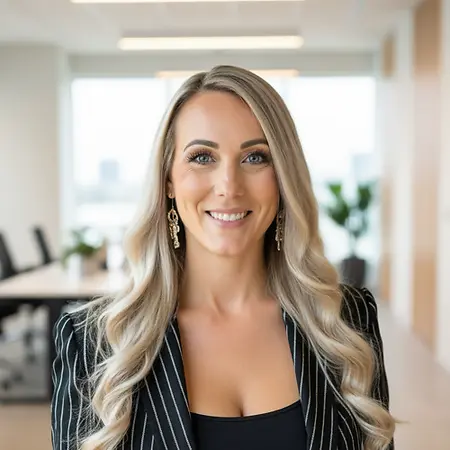
Courtney Barry, PMP, is a Senior AI Strategic Officer and Project Management Professional supporting mission-focused initiatives at the intersection of cybersecurity, artificial intelligence, strategic communications, and emerging technology. With more than 12 years of project management experience, she brings a diverse background spanning healthcare, sales, government contracting, and national security environments.
Courtney is known for translating complex challenges into clear, actionable strategies; coordinating cross-functional teams; engaging stakeholders; and creating structure in fast-moving environments where priorities, requirements, and technologies continue to evolve. Her ability to identify operational gaps, anticipate risks, communicate across diverse audiences, and build scalable processes has been especially valuable in supporting startup-like initiatives and emerging mission areas.
Her nonlinear career path has shaped her leadership style and strengthened her ability to adapt, build trust, and lead with both strategy and empathy. As a PMP-certified leader, Courtney brings organization, accountability, and practical problem-solving to complex efforts where collaboration and clarity are critical.
Beyond her professional work, Courtney is a passionate advocate for her children and others navigating mental health, education, and support systems. Her personal and professional experiences have reinforced her belief in speaking up, challenging incomplete answers, and using what she has learned to help make the path clearer for others.
Through her leadership, resilience, and commitment to advocacy, Courtney continues to demonstrate that influence is not only measured by titles or credentials, but by the ability to create meaningful impact, support others, and drive positive change.
Her Interview
Ten minutes with Courtney
01What do you attribute your success to?
I attribute my success to grit, adaptability, and the willingness to keep moving forward even when I did not have a clear roadmap.
I did not grow up surrounded by career-minded women or examples of what professional success could look like for someone like me. There was no clear path to follow, no blueprint handed to me, and no one showing me how to step confidently into the rooms I hoped to one day enter. I had to build that path for myself, one decision at a time. A lot of my growth came from small but meaningful choices: taking the next opportunity, learning from every environment, asking better questions, and refusing to let fear or self-doubt make decisions for me.
I also think my success comes from learning how to turn what once felt like weaknesses into strengths. I was a quiet child who learned to observe closely, prepare carefully, and notice what others needed. As an adult, those qualities became part of how I lead. They help me recognize gaps, translate complicated information, build structure where none exists, and bring people together around a shared goal.
My career has not been traditional or linear, but every experience has given me something valuable. Healthcare, sales, government contracting, cyber, AI, and strategic communications have all taught me how to communicate with different people, build trust, and solve problems in practical ways.
I also credit motherhood and advocacy with shaping me. Advocating for my children taught me that being capable is not the same as being supported, and that sometimes leadership means asking difficult questions, challenging incomplete answers, and speaking even when you are afraid.
I did not become successful because I had everything figured out. I became successful because I kept learning, kept building, and kept choosing to move forward.
02What’s the best career advice you’ve ever received?
The best career advice I have ever received is to stop disqualifying myself before I even try.
For a long time, I focused on what I did not have. I did not have the traditional degree path. I did not have a perfect career plan. I did not always have someone mentoring me or showing me the next step. Because of that, I sometimes questioned whether I belonged in certain rooms or whether I was qualified for certain opportunities.
Eventually, I learned that growth does not happen by waiting until you feel fully ready. Sometimes you have to step into the room, prepare as much as possible, ask thoughtful questions, and trust that your experience has value.
That advice changed how I viewed my career. I stopped seeing my nonlinear path as something I had to explain away and started seeing it as something that made me more adaptable. Every role had taught me something—how to communicate, how to build relationships, how to understand people, how to solve problems, and how to bring clarity to complicated situations.
Now I remind myself and other women: do not let one missing credential, one unconventional path, or one moment of self-doubt make you underestimate the value of everything you have already survived, learned, and built.
03What advice would you give to young women entering your industry?
My advice to young women entering cyber, AI or any technical and mission-focused field is this: do not wait until you feel completely ready to take up space.
These environments can be intimidating, especially when they are male-dominated or highly technical. But you do not have to know everything on day one to add value. Be curious. Learn the mission. Understand your audience. Ask thoughtful questions. Follow through. Become someone people can trust to bring clarity, structure, and solutions.
I would also tell young women not to shrink themselves to fit someone else’s idea of leadership. You do not have to become louder, harder, or less empathetic to be taken seriously. You can be direct and still be compassionate. You can be confident and still be willing to learn. You can listen carefully and still lead with authority.
Build relationships at every level, not just with people who have titles. Some of the most important lessons come from understanding what people are experiencing closest to the work. The person closest to a problem often sees what the system has learned to overlook.
Document your accomplishments. Advocate for yourself. Find mentors and sponsors when you can, but do not wait for someone else to hand you a roadmap. Build one.
And when you enter rooms that were not built with you in mind, remember that your presence can make it easier for the next woman who walks in after you.
04What are the biggest challenges or opportunities in your field right now?
One of the biggest challenges in my field is the speed of change. Cybersecurity, artificial intelligence, and emerging technology are moving incredibly fast, and organizations are trying to understand not only what these technologies can do, but how to use them responsibly, securely, and effectively.
There is a lot of excitement around AI, but there is also a need for clear strategy, governance, realistic implementation plans, and strong communication between technical experts and decision-makers. Technology alone does not solve a mission problem. People still have to define the need, understand the risk, align the right stakeholders, and create the structure to move from idea to execution.
That is also one of the greatest opportunities.
We need leaders who can translate complexity. We need people who can sit between technical teams, operational users, and senior leadership and help each group understand the other. We need professionals who can identify gaps, ask the right questions, and make sure innovation is tied to real outcomes rather than just the newest tool.
Another major opportunity is bringing more diverse voices into cyber and AI. These fields are shaping the future, and the people involved in that work should bring different experiences, perspectives, and ways of thinking. Women, especially those who have had nonlinear paths, bring tremendous value because many of us have learned how to adapt, communicate across differences, manage complexity, and lead through uncertainty.
The future of this field will not only depend on technical expertise. It will depend on trust, communication, judgment, ethics, and the ability to build solutions that people can actually use.
05What values are most important to you in your work and personal life?
The values that matter most to me are integrity, empathy, accountability, growth, and service.
Integrity is important because trust is everything. Whether I am working with leadership, supporting a team, or advocating for my children, I want people to know that I am honest, prepared, and committed to doing what is right.
Empathy is equally important. I believe people perform better and communicate better when they feel seen and understood. Empathy does not mean avoiding hard conversations or lowering expectations. It means recognizing that every person is carrying something, and the way we lead can either add weight or help create clarity.
Accountability matters because I believe in following through. If I say I am going to do something, I want people to trust that I will do it. I also believe in asking the hard questions when something is not working instead of accepting vague answers or letting problems continue because they are uncomfortable to address.
Growth has shaped my entire life. I did not follow a perfect plan. I had to keep learning, keep adjusting, and keep building as I went. That experience taught me that where you start does not have to determine where you end up.
Service is the value that ties everything together. I want to use what I have learned to make someone else’s path clearer. Whether I am leading a project, supporting a coworker, advocating as a mother, or encouraging another woman, I want to be the kind of person who helps others feel less alone and more capable of moving forward.
For me, success is not just about what I accomplish. It is about whether my presence, my work, and my voice help create clarity, confidence, and opportunity for someone else.
Her Content Hub
Articles by Courtney
The Invisible Weight of Being the Strong One
The Hidden Struggle of Those Who Appear to Have It All Together

There Is a Particular Kind of Loneliness
There is a particular kind of loneliness that comes from being the person everyone believes can handle anything.
You become the dependable one. The problem solver. The person who remembers what everyone needs, anticipates what could go wrong, researches the answers, makes the plan, and steps in when something begins to fall apart.
People see your capability. They do not always see what it costs you.
The Cost of Being the Capable One
For much of my life, strength meant being prepared, helpful, and able to manage difficult things without creating an additional burden for anyone else.
I was the quiet child who worried about disappointing people and tried hard not to cause problems. I learned to observe before speaking, notice changes in people's moods, and prepare for situations that might go wrong.
As I grew older, those patterns became strengths.
Professionally, they helped me lead complex projects, anticipate risks, organize incomplete information, and create structure in environments where the path forward was not always clear. I became someone others could depend on to connect the pieces, translate complexity, and keep things moving, even when there was no clear roadmap.
Personally, however, those same qualities made it easy to believe that I should be able to carry everything alone.
I became accustomed to being the person who took care of everyone else.
Capable and Supported Are Not the Same
But there is a difference between being capable and being supported.
There is also a difference between quietly enduring a difficult situation and using your voice to change it.
Motherhood—and especially advocating for my children—forced me to understand that difference.
When my children needed support, I could not rely on the hope that someone else would eventually recognize what was wrong. I had to learn unfamiliar systems, research complicated processes, ask difficult questions, challenge incomplete explanations, and continue speaking up when something important had been minimized or overlooked.
There were moments when I questioned myself.
- Was I asking for too much?
- Was I being difficult?
- Should I trust someone else's authority more than my own observations?
But I began to recognize something that would change the way I understood both advocacy and leadership:
The person closest to a problem often sees what the system has learned to overlook.
I did not become fearless. I became willing to speak even while I was still afraid.
The Invisible Weight
Eventually, I realized that I was not the only woman carrying an invisible weight.
- There are women leading meetings while privately overwhelmed.
- Mothers researching answers late at night because they do not know where else to turn.
- Professionals solving everyone else's problems while struggling to identify what they need themselves.
- Women who appear strong because life has never given them permission to be anything else.
I know what it feels like to be that woman.
That is why I want to use what I have learned—not because I have solved every problem, but because no woman should have to begin the hardest journey of her life believing she is completely alone.
Join Influential Women and start making an impact. Register now.