Her Story
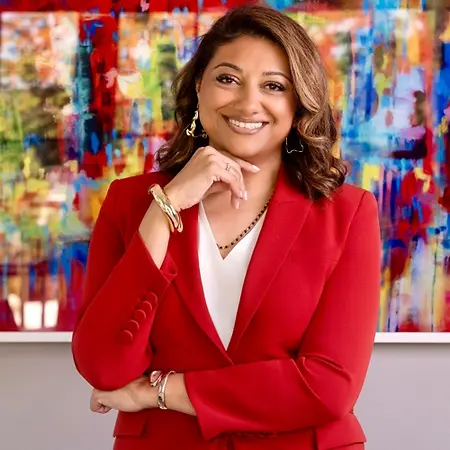
About Deepali
I've spent 25 years building my career, with the last four and a half years in executive search specializing in data science and AI. My days are split between two worlds: running executive searches where I consult with clients, pitch projects, and assess candidates for executive-level positions, and then running my media business where I create content, write my book, do executive coaching, and speaking engagements. I've built a strong reputation in executive search, but what I'm most proud of is democratizing career literacy through my social media presence, sharing the gate-kept information I know from my seat. Early in my career, I struggled with visibility and understanding how to play the corporate game, learning that performance alone isn't enough if nobody knows about it. That experience shaped my content focus today. I learned to find my voice in the right rooms, and I got lucky having not just a mentor but a real sponsor early on. Now I'm completely unabashed about saying what I want, I'm not afraid to say no to clients when it's the right thing, and I'm comfortable and confident in what I know. That confidence has made me even more successful because clients are drawn to my willingness to push back on them. I have zero qualms walking into any room now and saying what I want because I know my stuff.
Her Interview
Ten minutes with Deepali
01What do you attribute your success to?
I attribute my success to finding my voice in the right rooms and getting really lucky by having not just a mentor, but a real sponsor early on. But honestly, what's made me even more successful today is being completely unabashed and saying what I want, not being afraid to say no to clients when I know it's the right thing to say, and just being really comfortable and confident in the things that I know. I have so much more success now because of that level of confidence when it comes to clients, and they're really drawn to me because they know I'm not afraid to push back on them. I think that's been my number one successful trait, being able to push back because they respect me so much more. I have zero qualms walking into any room now and just saying what I want, in the sense of knowing that I know my stuff. When it comes to my subject matter, I know my stuff. It's been liberating. And you know what's crazy? The more I say no now, my clients want me even more. It's the most counterintuitive thing, but my husband told me when I started my own search firm that I can't take everything, I can't say yes to everything, I'm diluting my brand. And when I started saying no, it came back tenfold. When clients start asking me how I would approach something after I say no, that's when you know you're winning.
02What’s the best career advice you’ve ever received?
The best piece of advice I've ever received is learning to say no. It's really counterintuitive, but the more I say no now, my clients want me even more. It's so crazy. My husband told me that when I started my own search firm. He said, 'Deepali, you can't take everything, you can't say yes to everything, you're diluting your brand.' At the time, I didn't understand it, and I was like, 'Honey, I can't say no, we need the money, we need the searches, we need all of it.' And he said, 'Trust me, when you say no, it'll come back tenfold.' It took me a long time for it to sink in. Then when I got to Korn Ferry, the vice chairman that brought me in for his succession plan said the same thing. When you have a loved one say it versus someone else, you need all of these parties to kind of validate it and make it click. I started to realize, you know what, I'm at Korn Ferry, top of my game, I am the best of the best in the world, I can say no. And the client will then ask me, 'Well, how would you approach it?' And that's when you know you're winning. Because when they start asking you, it's game over.
03What advice would you give to young women entering your industry?
My biggest advice to women is know your audience and speak to it that way. Someone that has a very rigid way of 'this is who I am, and this is how I am with everybody,' I just don't think that works. I think you have to have the emotional intelligence to understand your audience and cater your messaging and communication in the way that they need to receive it. I think that's the number one trait that I can tell anybody. Know your audience and speak to them in that manner. That's how you play the game really well. Early on, you kind of have to understand that you can't just rely on putting your head down and performing really well when nobody knows about it, because it becomes invisible work. You have to have self-advocacy and have a voice, whether it's in written form if you're an introvert, or speaking up in meetings if you're an extrovert. You need to be visible at the right time and have a sponsor that kind of elevates you as you figure out your career trajectory.
04What are the biggest challenges or opportunities in your field right now?
I would say that in executive search, whether you're in large or small firms, a lot of people are very transactional. A lot of people are short-sighted where they just want to get the next search and bill, and they kind of ruffle feathers amongst their colleagues and might not bring everybody in that are true experts. First of all, recruiting in general has a low barrier to entry, so you really learn from experience. It's not as if you can take a college course in recruiting and become a recruiter. So there's low barriers to entry, and I feel like there are a lot of behaviors that if you don't learn them well in terms of collaboration and not seeing every client as a transaction, those are integrity behaviors that are learned over time. You have to be extremely comfortable in your skin and completely confident that no one can do the job better than you. Sometimes your colleagues will try to just run with something that they don't have an understanding in and muck it up, and it's something that you can't salvage. I would think that a little bit more self-awareness and less transactional behaviors should be rewarded in my industry, and I wish more people would do it. That's 100% the biggest opportunity - having less transactional behaviors and being more self-aware.
05What values are most important to you in your work and personal life?
I would say that communication and trust are most important. Having an understanding in your family that your career, especially as a woman, especially in my role as a mom, as a wife, as an executive, all of that stuff, that your career has seasons, and those seasons may not be in balance. One season can be completely 'I'm in with my family, I'm doing all the things, I'm so present,' and right now, the season that I'm in is I am working all the time, and my family is super understanding that I'm trying to build multiple businesses. I'm really transparent about it, and I set expectations. I feel like anybody that thinks that everything is in balance all the time is gravely mistaken. You have to think about your career non-linearly, and you have to think about your career in seasons. Sometimes it'll spike, and sometimes you'll have that downtime to enjoy those things, and you have to have understanding parties on the other side as well, but that comes with communication. Like, 'Guys, I'm really gonna work, you're not gonna get 100% of me in the next few weeks.' And that's it, you know? It's a trade-off. Like, 'I got 20% this week, that's it.' I'm real about it.
Join Influential Women and start making an impact. Register now.