
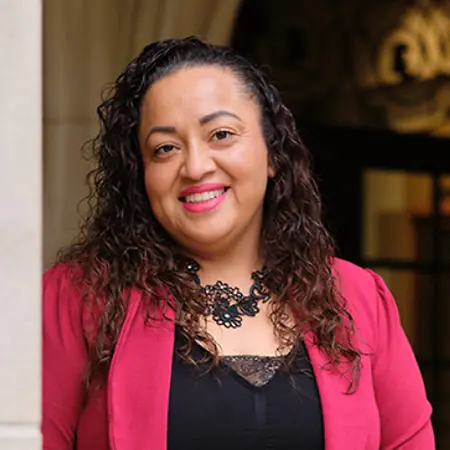
Her Story
About Dr. Wilma
Dr. Wilma Franco serves as Executive Director of the Southeast Los Angeles Collaborative, a role she has held since 2018, where she leads regional, cross-sector efforts focused on strengthening communities, advancing civic engagement, and building nonprofit capacity across Southeast Los Angeles. She brings over 20 years of experience in nonprofit leadership, community development, public policy, and collaborative initiatives. During the COVID-19 pandemic, Dr. Franco lead and coordinated vaccine distribution efforts across the SELA region in partnership with FEMA and the California Governor’s Office of Emergency Services (Cal OES), working to expand equitable access to vaccines for communities disproportionately impacted by the pandemic.
Dr. Franco’s public and civic service includes serving as a Commissioner on the Los Angeles Unified School District (LAUSD) Redistricting Commission. She currently serves on the Steering Committee for the Neighborhood Data for Social Change at the University of Southern California (USC) and as an Advisory Member for the Pacific Southwest Region University Transportation Center (Region 9 UTC).
Dr. Franco holds a Doctorate in Organizational Leadership from the University of La Verne, a Master’s degree in Public Policy from USC, and bachelor’s degrees in Political Science and Chicana/o Studies, with a minor in Public Policy, from UCLA. She has pursued additional professional education in real estate development through USC and has served as a lecturer in the Human Development Department at California State University, Long Beach.
Beyond her professional and civic service, Dr. Franco is the proud mother of two sons, a role that deeply informs her commitment to community and future generations. Throughout her career, she has remained committed to strengthening public trust, community voice, transparency, and accountable leadership. She has built a career focused on strengthening communities through collaborative partnerships, government relations, fundraising, and organizational leadership. Her work emphasizes community-centered strategies, data-informed planning, and building connections among nonprofit, civic, philanthropic, and community leaders across Southeast Los Angeles.
She has recently been appointed to the Los Angeles County Ethics Commission, contributing her experience in leadership, public policy, and community engagement to discussions about government structure and accountability. Throughout her career, Dr. Franco has emphasized relationships, empathy, transparency, accountability, and faith values shaped in part by her family’s immigrant experience and commitment to creating better opportunities for future generations.
Her Interview
Ten minutes with Dr. Wilma
01What do you attribute your success to?
I attribute much of my success to my upbringing and, most importantly, my parents. I am a first-generation immigrant from Guatemala who came to the United States at a young age, brought here by parents who were pursuing their own American dream, filled with hope and aspirations for a better life and greater opportunities for our family. My immigrant journey has profoundly shaped how I see the world, but it was my parents, their faith, their love, and the values they instilled in me that shaped who I am today. They taught me the importance of empathy, kindness, generosity, compassion, and treating others with dignity and respect. They also taught me that success isn't just measured by what we accomplish for ourselves, but by how we show up for others, how we give back, and how we use our voices to advocate for those whose voices are too often unheard. I see my success as a reflection of the foundation my parents gave me, the opportunities they worked to create, and the values that continue to guide both my personal and professional life.
02What’s the best career advice you’ve ever received?
The best career advice I've received is to speak up, trust my instincts, and recognize the value of what I bring to the table. It's also about being comfortable not having all the answers and understanding that there's strength in asking questions and continuing to learn. I think sometimes, because of our upbringing, our experiences, or even as women of color, we can feel the pressure to constantly prove ourselves or question whether we belong in certain spaces. What I've learned is that our lived experiences, perspectives, and the challenges we've overcome are just as valuable as our professional knowledge and credentials. We don't have to know everything to have something meaningful to contribute. Sometimes, the most important thing we can do is trust our voice and have the courage to use it.
03What advice would you give to young women entering your industry?
My advice to young women entering the nonprofit sector is to approach every opportunity and every person they encounter as an opportunity to learn and grow. Be intentional about building a diverse network of leaders and peers you trust, people you can learn from, but also grow alongside. One thing I've learned is that everyone's professional journey takes a different path. Someone you meet today in one role or organization may cross your path years later in a completely different capacity. Those relationships, when built on genuine trust, respect, and mutual support, can open doors to unexpected opportunities, meaningful partnerships, and future collaborations. Never underestimate the power of relationships. Invest in people, stay curious, and remember that success isn't just about how far you go, but also about the people you grow with along the way.
04What are the biggest challenges or opportunities in your field right now?
One of the biggest challenges in the nonprofit sector is that we've normalized the idea that doing good work means accepting less pay, as if our commitment to serving others should come at the expense of our own financial well-being.
Nonprofit professionals are also trying to build financial stability, support their families, and create generational wealth. Yet, the lack of competitive compensation often drives talented and passionate people away from the sector.
But I also see this as one of our greatest opportunities: to redefine how we value nonprofit work and the people behind it. If we are advocating for economic mobility, equity, and opportunity in our communities, we must also ask whether we are creating those same opportunities within our own organizations. At the end of the day, we are strengthening communities, creating opportunities, and changing lives. That impact should be valued just as much as financial profit, and the people doing this work deserve to be compensated accordingly.
05What values are most important to you in your work and personal life?
I try to live and lead by five core values: faith, relationships, empathy, transparency, and stability. Faith is foundational in my life. It grounds me, guides my decisions, and reminds me to stay connected to my purpose.
Relationships and empathy are equally important because I believe how we treat people, how we see their humanity, and how we show up for one another say a lot about who we are. I value building genuine relationships rooted in respect, understanding, and trust. Transparency is about being honest, accountable, and intentional in both my personal and professional life. And stability, whether emotional, physical, or financial, matters because I believe everyone deserves the opportunity to feel secure, thrive, and build a better future for themselves and their families. Ultimately, these values shape not only how I lead, but also the kind of person I strive to be.
Join Influential Women and start making an impact. Register now.