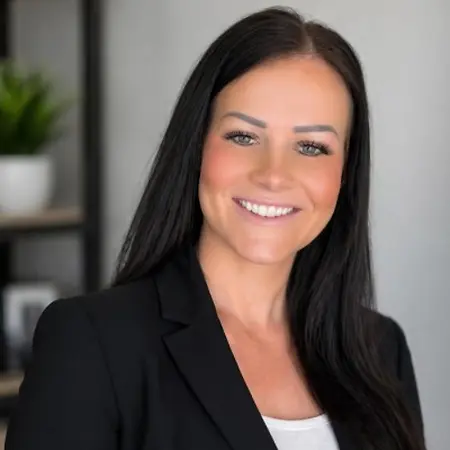
Great leadership does not require choosing between results and people. After years leading teams across warehousing, manufacturing, supply chain, and plant operations, I have learned that accountability and empathy are most powerful when they exist together.
Her Story
About Electra
Electra Wells is a manufacturing leader with nearly 20 years of experience who began her career on the production floor at age 17. She quickly advanced to become the youngest supervisor and the first female supervisor at her company, later moving into management roles while raising her children. After relocating to pursue further growth, she spent seven years at a potato manufacturing company. Most recently, she was recruited to Arizona from Canada to serve as Director of Operations at a potato manufacturing business, where she empowers her team to handle daily operations while focusing on long-term scaling, process development, and team evolution. She holds a couple of online certificates but credits her success primarily to hands-on experience building her career from the ground up.
Her Interview
Ten minutes with Electra
01What do you attribute your success to?
Honestly, I think it's my kids. At the end of the day, I want to provide them with a better future and growth than what I had growing up. Showing them what it's like to be a positive person and contributing is what drives me.
02What advice would you give to young women entering your industry?
Stop waiting until you feel like you're ready. I've watched incredible women believe they aren't ready or haven't met every requirement. Other people are willing to figure it out as they go. You don't have to know everything. Just ask questions, surround yourself with people who do know, and have enough confidence to take the opportunity. Put yourself out there, and it's okay to learn from being told no.
03What are the biggest challenges or opportunities in your field right now?
Change is obviously one. Change management is always that pinpoint for a lot of people. Managing through complex environments. When you have the right people and right processes, execution is key. Sometimes it's the people aspect, sometimes the process aspect, but nothing is super challenging that you can't work through.
04What values are most important to you in your work and personal life?
For me, it is respect. Respect is key. Always be honest and open. Business is business, personal is personal, you don't always have to be the same, but your values of who you are and what you represent really shine through in both aspects. Being open, honest, and raw. It's okay to tell the truth and walk through it and talk through it.
Her Content Hub
Articles by Electra
Accountability and Empathy are not opposites
The strongest leaders create clear expectations, develop their people, and care enough to hold the standard.

Accountability and Empathy Are Not Opposites
For years, leadership has often been presented as a choice.
You can be the leader who drives results, holds people accountable, and expects a high standard.
Or you can be the leader who cares about people, listens, develops teams, and leads with empathy.
I have never believed those things belong on opposite sides of the table.
In fact, after spending much of my career in operations and manufacturing, I have come to believe that the strongest leaders do both.
I built my career from the floor up. I spent years working in warehouse operations, supervising night shifts, managing teams, leading plants, and eventually taking responsibility for increasingly complex operations.
Those environments teach you something very quickly: the plan on paper and the reality on the floor are not always the same thing.
And leadership becomes very real when dozens or hundreds of people are depending on you to make decisions that affect their work every day.
That experience shaped the way I lead.
People Need Clarity More Than They Need Perfection
One of the greatest sources of frustration in any workplace is ambiguity.
What does good performance look like? Who owns the decision? What is the priority? What happens when we miss the expectation?
When leaders fail to answer those questions clearly, employees are left trying to interpret what management wants. Then, too often, we hold them accountable for failing to meet expectations we never properly established.
That is not accountability.
Accountability begins with clarity.
A strong leader makes the standard visible, explains why it matters, provides people with the tools and training to meet it, and follows through consistently.
People do not need a perfect leader. They need one they can understand.
Empathy Does Not Mean Lowering the Bar
There is also a misconception that empathetic leadership means avoiding difficult conversations or continuously making exceptions.
I see it differently.
Caring about people sometimes means having the conversation they would rather not have. It means telling someone when their performance is falling short. It means addressing behavior that is affecting the rest of the team. It means asking questions before making assumptions while still being willing to make the decision afterward.
Empathy helps us understand the person. Accountability helps us protect the team and the standard. Both matter.
The best leaders I have known—and the leader I continually work to become—can sit across from someone, genuinely listen to what is happening in their life, understand the challenges they are facing, and still have an honest conversation about what the role requires.
That is not being harsh. That is being clear.
Listen to the People Closest to the Work
Operations also taught me another lesson I carry into every leadership role:
The person closest to the problem often knows something the person in the conference room does not.
Leaders should understand data, metrics, budgets, capacity, service, quality, and efficiency. Those things matter tremendously.
But data tells us what is happening. People can often tell us why.
Some of the best operational improvements begin with a simple question to the person doing the job every day:
"What is making this harder than it needs to be?"
The answer might be a process that no longer makes sense, inadequate training, unclear ownership, a piece of equipment, poor communication, or something leadership never considered.
Listening does not mean implementing every suggestion. It means respecting the expertise that exists throughout the organization.
Leadership Is Not About Being the Smartest Person in the Room
As my responsibilities have grown, I have become less interested in having every answer myself.
Leadership, to me, is increasingly about building a team capable of finding answers without constantly needing me.
Can I develop a supervisor who becomes a great manager? Can I give someone enough confidence and structure to make decisions independently? Can I build processes strong enough that they continue working when I am not standing there?
Those are better measures of leadership than how many problems I personally solve.
If everything depends on the leader, we have not built a strong organization. We have built dependency.
Your Standards and Your Humanity Can Coexist
I believe deeply in high expectations. I believe in performance. I believe businesses need structure, measurable goals, ownership, and people who do what they say they are going to do.
But I also believe every KPI represents people doing the work.
That means leaders have a responsibility to create environments where people understand what success looks like and have a fair opportunity to achieve it.
You can demand excellence without humiliating people. You can correct performance without attacking character. You can make difficult decisions while still treating people with dignity. And you can care deeply about your team without abandoning the standards necessary for the business to succeed.
Those things are not contradictions. They are leadership.
The Legacy I Want to Leave
There are plenty of operational accomplishments I am proud of throughout my career.
But some of the moments that mean the most to me are seeing people I once coached become strong leaders themselves.
Processes change. Companies change. Titles certainly change.
But the impact we have on people can follow them for the rest of their careers.
If someone who once worked with me eventually leads a little better because I challenged them, taught them something, gave them an opportunity, or simply believed they were capable of more, that is a legacy worth building.
Because ultimately, leadership is not about proving how much the leader can accomplish.
It is about creating an environment where other people discover how much they can accomplish, too.
Join Influential Women and start making an impact. Register now.