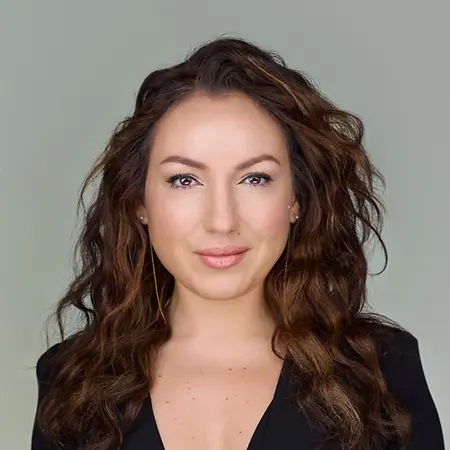
Her Story
About Elena
I've been fascinated with machine learning and AI for two decades, ever since I started studying electrical engineering and computer science in Macedonia. Back in 2006 when I was graduating, we didn't call it AI, we called it machine learning, and I was absolutely fascinated with the idea that we can teach machines to learn. I envisioned a world where there would be so much information and data coming at us from sensors and IoTs, and I believed we needed to teach machines how to learn from infinite data. I initially planned to be a researcher and professor and had a job at the University in Macedonia to teach computer science, but I realized I very much prefer to solve problems than to teach. I decided to give up that job and pursue research in AI, then realized that true technological innovation was happening in Silicon Valley, not where I was in Europe. I moved to the U.S. to become a technologist and work in the AI industry. I became a founder starting in 2019 because I have this innate need to solve things in creative, unusual ways and always question the status quo. I needed to dedicate my work to something very meaningful to me. A lot of machine learning jobs at that time were in advertising, marketing, sales, or military applications, and it wasn't satisfying. I wanted to use AI for solving some of our biggest problems in society. I stayed longest at change.org because they gave me autonomy to function like a founder inside their company and run the AI department the way I thought it should be run. Their mission around social change and empowering everyone to be a social activist resonated with me. Now my company works with leading functional, precision, and integrative medicine practitioners, providing expert-level diagnostic interpretation of data from gut microbiome, blood biomarkers, genetics, and metabolites to help doctors deliver very personalized treatments for solving complex problems and preventative health purposes.
Her Interview
Ten minutes with Elena
01What do you attribute your success to?
I attribute my success to pure awareness of the things I know and the things I don't know. We're not born knowing everything, and we all have our own unique backgrounds. I'm an expert in building AI systems and products, but I don't have all the other skills usually required for success, so I need to be humble and understand what I don't know. I find great people who can help me do things I'm not good at, and I let people who are better than me at certain things do those things. True leaders and successful founders are very self-aware about their lack of knowledge and skills, and they surround themselves with people who can complement them. The other key thing is listening to the world, to the market, and to your team properly, with your ego down, without wanting to be right but wanting to understand. Without that component, even if you have a great idea and a great market, you're not going to execute well.
02What’s the best career advice you’ve ever received?
The best career advice I received came from my first coach, who was transformational for me. She helped me see how much I was disregarding my own qualities, abilities, power, and knowledge. She helped me see my ability to change my circumstances on my own, because I was accepting being in a position that was not good for me, not healthy for me, and definitely not what I wanted to do. I thought I couldn't solve the situation. She challenged me to consider what I truly, really want and what the actual brave thing to do in that moment was to get that. She pointed out that you cannot be a good entrepreneur if you're not fully, with your full heart, full energy and body, committed into that direction. You have to be fully committed if you want to succeed. I think we all know when it's not working and what needs to be changed, but we're scared to make that change. With that realization and the nudge to do what I already knew I needed to do, I was able to turn around my situation 360 degrees in just two weeks, from a place of feeling like I suck to this is my dream coming true. If I did not have that advice, I think I would have suffered in that situation for months.
03What advice would you give to young women entering your industry?
Just try, and don't be scared. The ideal advice is just don't be obsessed with the outcome. Just do what you enjoy, and don't worry about if you look different or how everyone looks different than you. If you really like what you do, love that. Just do it for the sake of enjoying that and see what comes out. You'd be surprised. If people stopped focusing on the outcomes, because you're wanting these outcomes to arrive sooner than they should, and then you get disappointed that they're not there, and oh my god, I'm not good, and all these things. Instead, focus on enjoying the journey, and the outcomes will come when you're ready. When I was competing in physics, I was the only girl oftentimes across a huge group of boys, and I was thinking, well, I can't possibly be the one that can win, one girl against all these boys. But when I did win, when I was usually the best in the regional and even national competitions, that changed my thinking to, well, if I can do this, what else can I do?
04What are the biggest challenges or opportunities in your field right now?
I think it's going to be hugely transformational to apply AI technology in medicine now, because I truly believe we barely understand human biology. We've never looked into the really deep rich data that we are now just able to collect, and we're going down the path of being able to collect even more granular data. Once we start using science to explain what's going on, we will get to new discoveries for how things work. We'll step away from the labels of disease and really be able to say there are these processes, these functions that are happening, and we can fix them in a very precise way. I think prevention will be possible, that will increase quality of life, and it probably will extend life. I think we will be surprised by how much smarter we can get with these optimizations. We've never upgraded our biology, and the body and the mind are one connected. When your body's good and healthy and feeling well, the mind is performing better as well. I think we can get smarter with it. We'll uncover so much more, from the ability to increase our reproductive age to solving cases of infertility that today we can't resolve. But the challenges are that the regulation and structures we have created around old ways of how health should operate would need to be significantly reduced. The payment structures need to change. If AI starts to do parts of the jobs of what doctors are doing today, it needs to be paid by insurance, and new jobs will be created for doctors to do what AI cannot do. We need to restructure everything for this new world, and we need to get doing that sooner so we can move faster, or else we might just have incredible technology that we really can't use.
05What values are most important to you in your work and personal life?
Social impact, innovation, and progress of science are most important to me. I hope with the work we're doing that we can help progress science, progress medicine, and move humanity forward. We strive to do high-quality work, to be proud of what we've created. And to truly serve the people that we're serving. I wanted to use AI and machine learning for solving some of our biggest problems in society. That's why I needed to become a founder, because a lot of the jobs in machine learning at that time were in advertising, marketing, sales, or military applications, and it wasn't satisfying to me to do that work.
Join Influential Women and start making an impact. Register now.