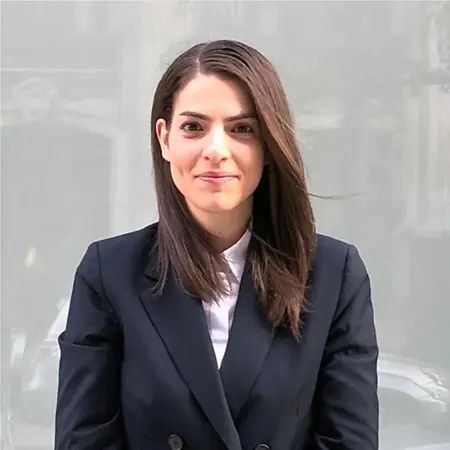
Her Story
About Eleni Stefania
Eleni Stefania Kalapoda is a New York–based architect-engineer, urban designer, and design researcher known for her work at the intersection of climate-responsive architecture, emerging technologies, and urban systems. She is an AIA Associate, LEED Green Associate, and ENV SP, and holds a master’s degree in Architecture and Urban Design from Columbia University in the City of New York. Her practice focuses on creating resilient, people-centered cities and buildings that integrate environmental performance, social equity, and long-term adaptability across complex urban contexts.
Alongside her design practice, Eleni contributes extensively to global research, advisory, and jury panels shaping the future of architecture and sustainability. She has served in roles connected to organizations such as Autodesk (including its Advisory Council), the U.S. Green Building Council, and international conferences and committees spanning architecture, AI, and climate innovation. Her work frequently explores how computational design, novel materials, and systems thinking can improve urban livability, reduce carbon impact, and support more intelligent and equitable development patterns.
Eleni’s portfolio includes large-scale urban and architectural research projects ranging from net-zero towers and climate-adaptive infrastructure to mixed-use civic and cultural developments. She is also an active speaker, reviewer, and mentor across global platforms, including IEEE-related forums and sustainability-focused initiatives. Recognized as a finalist for the 2026 WICE (Women in Construction & Engineering) Awards, she continues to advance interdisciplinary approaches that merge architecture, engineering, and data-driven design to address the challenges of climate change and rapid urbanization.
Her Interview
Ten minutes with Eleni Stefania
01What do you attribute your success to?
I attribute my success to great educators, great mentors, and perseverance. Throughout my career, I've been fortunate to learn from exceptional teachers and industry leaders who have guided me through obstacles and helped me navigate challenges. I believe that having strong mentors and sponsors from the beginning is crucial, as they help make your work visible and support you through the inevitable opposition you'll face, especially as a woman in a male-dominated field. Resilience has been key for me, whether it's adapting to a new job, a new company, or even a new country. I've learned to keep pushing forward, trust my instincts, and remain committed to universal values like fairness while staying true to my professional and personal growth.
02What’s the best career advice you’ve ever received?
The best career advice I've received is to make your work visible and just do it without asking for permission. Early in my career, I was focused on just finishing the job and finalizing projects, but I learned that this approach won't get you promoted. You need to cultivate your personal brand from day one, communicate your work, and demonstrate your value and expertise. I learned to participate in competitions and create a portfolio of work, because at the start of your career, you won't be given the project opportunities you may wish for, but you need to position yourself to show what you can handle. Even if you face criticism, just have it done, have it in your portfolio, in your PDF, on your website, and show the world that you can do it. Don't wait for permission, just start producing and let your work speak for itself.
03What advice would you give to young women entering your industry?
My advice to young women entering architecture is to be resilient, believe in yourself, and trust your instincts. Work hard and look out for mentors and sponsors from the very beginning, because they will help make your work visible and guide you through obstacles. Start with what you have in terms of experience and projects, and keep growing through talks and competitions. Create a portfolio of work, because at the start of your career, you won't be given the project opportunities you may wish for, but you need to position yourself to demonstrate your value and expertise. Just do the work and don't ask for permission. Participate in competitions so you can show that you can handle larger-scale projects, not just small residential buildings. You will face criticism and opposition, even from within your own company or from senior professionals in your field, but keep doing it again and again. Have feedback loops, connect with mentors in the industry, fail quickly but fall forward, and then go back and try again. Let your work speak for itself, and don't be afraid to change organizations if you stop growing based on the structural hierarchy. The struggle is real, and when you advocate for yourself, you'll receive names like 'too loud' or 'crazy,' but stay resilient and keep pushing forward.
04What are the biggest challenges or opportunities in your field right now?
I think AI is one of the biggest challenges happening in architecture right now. The question is to what extent do we integrate it. In the U.S., it's already integrated in terms of visuals, and this year it's starting to focus on automating some of the repetitive processes, which would be really beneficial. In Europe, for example, it's still banned. The second major challenge is sustainability and how we can implement an integrated approach to design that can also be accepted by clients from a cost perspective. Architecture is really slow to change - it takes approximately 20 years to change the model. For example, it takes about 20 years to create a greener cement or reduce the carbon footprint of concrete, which used to be our main construction material. So no matter what we say or design as architects, we need to be proactive as an industry to implement changes in building materials and structural systems. Even in a project like the one I'm working on now, we cannot avoid using concrete for the first 35 stories. But despite these challenges, architecture offers unique opportunities. It's a discipline that bridges the creative with the pragmatic and the engineering side. It's really fulfilling as a professional to integrate your personal and creative aspirations with the science and engineering aspects. There are significant opportunities in transforming former industrial sites into mixed-use projects and cultural districts, and in implementing sustainability through this integrated approach. The combination of sustainability, technology, and digital innovation happening in New York is unique, and it creates opportunities to work on different scales from architectural to city scale while connecting with communities.
05What values are most important to you in your work and personal life?
The values most important to me are fairness and resilience. Fairness is the baseline for everything I do, especially when working on large-scale projects that mostly affect underrepresented communities. I learned during my master's degree the importance of knowing when to stop and ask for support through different community groups, and this community-based approach has shaped how I work. Resilience is what everyone says about me, and it's how I keep reminding myself to overcome obstacles on both personal and professional levels. Whether it's adapting to a new job, a new company, or a new country, resilience helps me stay true to universal values while continuing to grow. I also value the acknowledgment and support that exists in the United States, which is different from Europe where your job, project, and title define your societal image and self-worth. In the U.S., there's more room to bounce back and reinvent yourself, and that flexibility has been crucial to my journey.
Join Influential Women and start making an impact. Register now.