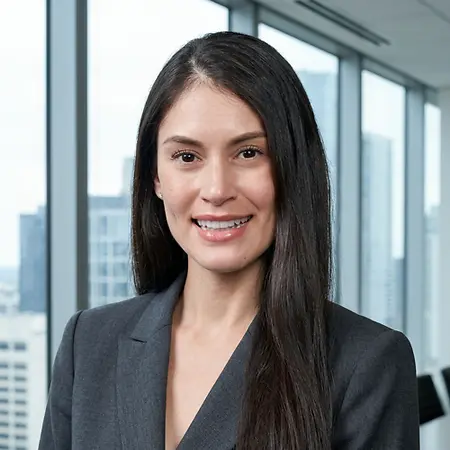
Influential Woman · Venture Capital
Irma Baez
Operations & Platform Manager, Fathom Fund
Houston, TX 77002
Her Story
About Irma
As Operations & Platform Manager at Fathom Fund, Irma Baez works across the firm to build and manage the infrastructure, systems, and relationships that support a growing venture organization. Her role spans firm operations, investor relations, and platform, with responsibility across financial operations, governance and compliance, human resources and benefits, technology and data systems, vendor management, and strategic firmwide initiatives. She also leads founder and investor events and develops platform initiatives that connect portfolio companies with strategic partners, service providers, investors, and resources across the deep-tech ecosystem.
Growing up in Houston’s First Ward as the youngest of seven children of hardworking immigrant parents from Mexico, Irma experienced firsthand the realities of growing up with limited financial resources. Her father worked in construction, while her mother was a homemaker who found creative ways to earn additional income and make the most of what the family had. Their determination to provide for seven children, often through difficult circumstances, shaped Irma’s own sense of resourcefulness, perseverance, and deep respect for hard work. Higher education was not a central part of the conversation in her household, but as Irma began building her own career, she came to recognize education as a way to continue expanding what was possible for her future.
She chose to pursue an education, initially attending school to become a surgical technologist and beginning her career in healthcare. Rather than following a traditional, linear academic path, Irma built her education alongside her career gaining experience, taking on increasingly complex roles, and eventually returning to college to complete her bachelor's degree after already establishing herself professionally.
Her professional journey began in the medical field with LifeGift before she joined Cardinal Health, where she progressed from Data Editor to Senior Analyst supporting clinical specialty and supply chain operations. She later transitioned into financial services with Amegy Bank, gaining experience in Treasury Management and further developing the financial and client-service foundation she carries into her work today.
A defining chapter of Irma's career was her nearly nine years with International SOS. Joining the organization during an early stage of its Houston growth, she progressed through increasingly responsible roles from Senior Bilingual Administrator to Senior Executive Assistant and ultimately Administrative Services Manager. As the Houston regional headquarters grew from approximately five employees to more than 70, Irma helped build the administrative and operational infrastructure needed to support that expansion. Working alongside leaders across Medical, Security, Finance, Human Resources, and Business Development, she managed business operations, budgets, procurement, vendors, people operations, global mobility, and executive support while stepping into interim operational leadership roles when needed. The experience became foundational to how she approaches operations today: understand the business, anticipate what it needs next, and build the structure that allows people to perform effectively.
Irma later brought that experience into the oil & gas industry at Rockcliff Energy, where she partnered with executive leadership across Finance, Legal, Human Resources, Operations, and HSE. Her responsibilities expanded further into corporate governance, enterprise insurance, contract administration, business analytics, executive reporting, and large-scale organizational initiatives. That progression ultimately led her into venture capital, where the breadth of her background allows her to operate across multiple functions within a lean investment firm.
Across more than 20 years, Irma's career has taken her through healthcare, data and analytics, financial services, international health and security risk management, oil & gas, energy, and venture capital. Each transition required her to learn a new industry, navigate increasingly complex environments, and continue expanding the scope of her leadership. Those experiences have shaped an operational approach centered on building scalable processes, solving problems, and creating the infrastructure that enables organizations and people to grow.
Beyond Fathom, Irma serves as Business Lead and Mentor at Office Experts LLC, a volunteer-led community dedicated to the development of administrative professionals. Mentorship and professional development remain important parts of her work, particularly helping others recognize how administrative and operational expertise can evolve into broader organizational leadership.
Irma holds a Bachelor of Applied Arts and Sciences in Applied Administration from the University of Houston–Downtown. She is an HRCI Associate Professional in Human Resources (aPHR) and holds a certification in Leadership and Practical Problem Solving from Houston City College.
Outside of her professional work, Irma brings that same discipline and drive to pursuits that challenge her personally. An athletic enthusiast, she enjoys HIIT workouts, yoga, Pilates, hiking, and hitting the running trails, and has completed more than 200 race finishes. She also enjoys traveling and exploring new places and gives back by volunteering within Houston’s running community. Irma is also a licensed boat captain, an achievement that places her among a relatively small community of women holding professional maritime credentials.
Her Interview
Ten minutes with Irma
01What do you attribute your success to?
I attribute my success to persistence, a willingness to keep learning, and never becoming too comfortable with where I am. There have been times throughout my career when I felt I had to work twice as hard to be recognized or considered for the next opportunity. Rather than allowing that to discourage me, it motivated me to continue developing myself, take on new challenges, and create opportunities instead of waiting for them.
My daughter has also been one of my greatest sources of motivation. I wanted to show her through my own actions that hard work, education, and continuing to invest in yourself can open doors. It was important to me that she grow up seeing possibilities and understanding that she could create opportunities for herself, even when the path wasn't always obvious.
As my career has grown, I've also realized that success means very little to me if I'm not helping others grow along the way. Mentorship and advocacy are deeply important to me because I know firsthand what it feels like to navigate professional growth without always having a strong support system or someone advocating for you. I find genuine fulfillment in helping someone recognize their potential, encouraging them to pursue an opportunity, or making sure their work and contributions are seen.
That has shaped the way I lead. My leadership style is rooted in empathy, encouragement, and advocacy. I believe leadership is about much more than managing people or holding a title. It's about investing in people, creating opportunities for them to grow, and building an environment where they feel supported and valued enough to contribute at their highest level.
Ultimately, I attribute my success to continuing to push myself forward while also reaching back and helping others move forward with me. To me, that's what meaningful leadership and success look like
02What’s the best career advice you’ve ever received?
The best career advice I’ve ever received was to create my own path. Early in my career, around 2012, a mentor shared that advice with me, and it has stayed with me ever since. I learned that growth does not always come from waiting for opportunities to be handed to you. Sometimes you have to actively invest in yourself, build relationships, expand your network, and seek out environments that will challenge you and help you grow both professionally and personally.
That advice has influenced many of the choices I’ve made throughout my career. I’ve been willing to step into new industries, take on unfamiliar challenges, join professional organizations, continue my education, and build relationships with people I can learn from. I believe strongly in continuous learning, whether that comes through formal education, professional certifications, mentorship, or simply being willing to learn something new. The workplace continues to evolve, and I think we have to be willing to evolve with it.
Over time, I’ve realized that creating your own path doesn’t mean having every step figured out. It means being intentional about your growth, remaining curious, continuing to invest in yourself, and being willing to take a chance on yourself. Some opportunities will find you, but others you have to create for yourself and that advice has stayed with me throughout every stage of my career.
03What advice would you give to young women entering your industry?
My advice to young women entering venture capital or the startup ecosystem is to stay curious, build genuine relationships, and don't be afraid to take an opportunity simply because you don't have the traditional background for it.
I came into venture capital from the oil & gas industry. When I met the founders and was presented with the opportunity to join Fathom Fund, venture capital was still relatively new to me. I had heard of the industry, but I didn't fully understand how a venture fund operated or everything that went into building and supporting one. After several conversations and interviews, I was offered the opportunity to join the firm. Accepting it meant leaving an industry I knew for one I would have to learn, but I decided to take the risk.
The transition was challenging, and there was a significant learning curve. I had to learn the language of venture, how funds operate, how investors and limited partners work together, how founders raise and deploy capital, and how the broader startup ecosystem functions. Even now, I am still learning and I think that's one of the things I enjoy most about this industry. There is always another company, technology, market, or perspective to understand.
That's why I encourage women who are interested in venture or startups not to disqualify themselves because their résumé doesn't look like everyone else's. Skills are transferable. My experience in operations, financial services, international health and security risk management, and oil & gas gave me a foundation that I didn't initially realize would translate so well into venture capital. Sometimes your different background is exactly what allows you to bring a perspective the organization needs.
Once you're in the industry, learn beyond your job description. Understand how the fund works, how investment decisions are made, what founders experience as they build companies, and how investors, limited partners, and the broader ecosystem connect. Ask questions, raise your hand for opportunities, and don't be afraid to admit when you don't know something.
Relationships also matter tremendously in venture capital and startups. Build your network before you need something from it, find mentors and peers you can learn from, and be generous about helping others and making connections.
Most importantly, don't wait until you feel completely ready. I wasn't an expert in venture capital when I accepted the opportunity that brought me into the industry. I took a chance, trusted that I could learn, and gave myself permission to be uncomfortable for a while. That decision changed the direction of my career. Sometimes growth begins with being willing to step into a room where you still have a lot to learn and then doing the work to earn your place there.
04What are the biggest challenges or opportunities in your field right now?
One of the biggest challenges in venture capital right now is navigating uncertainty while still identifying and supporting long-term innovation. Market conditions, fundraising environments, and investment priorities can shift quickly, which creates pressure for both firms and founders to adapt while continuing to grow sustainably.
In Houston specifically, another challenge is that the venture capital ecosystem is still developing compared to more established markets like Austin, Silicon Valley, or New York. However, I also see that as a major opportunity. Houston has incredible strengths across energy, healthcare, aerospace, climate tech, and deep-tech innovation and there are many people actively working to help strengthen the city’s venture infrastructure and founder ecosystem.
I also think there is a growing opportunity for administrative and operations professionals within venture capital. Many people still view administrative roles through a traditional lens, but in reality, strong operational and executive support professionals are often the backbone of a firm. They help manage communication, investor coordination, governance, logistics, execution, and the day-to-day operational structure that allows leadership teams to stay focused on strategy and growth.
As the industry continues evolving, I believe administrative professionals have an opportunity to position themselves as strategic business partners by developing business acumen, learning emerging technologies, building strong relationships, and understanding the industries they support. The operational side of venture capital is just as important as the investment side because strong infrastructure is what allows firms and founders to scale successfully.
05What values are most important to you in your work and personal life?
One of the values that matters most to me, both professionally and personally, is respect. I strongly believe people should never be valued solely based on their title, education level, or position within an organization. Every individual contributes to the success of a company, from executive leadership to the people working behind the scenes to keep operations moving forward. Throughout my career, I have always tried to treat everyone with the same level of kindness, professionalism, and respect because I understand what it feels like to want to be seen, valued, and heard. Often, the people doing the day-to-day work quietly behind the scenes are the foundation of a successful organization.
Empathy and compassion are equally important to me. Growing up in a low-income household, I experienced firsthand some of the challenges that come with financial hardship. There were times when my family struggled to keep household utilities on, and I remember experiencing hunger and uncertainty at a young age. Those experiences taught me resilience and gratitude, but they also taught me not to make assumptions about someone's circumstances. We rarely know what another person may be carrying when they walk into work each day. Because of that, I try to lead with understanding, offer support when I can, and treat people with dignity regardless of their circumstances.
I also value genuine human connection and communication. Some of the strongest relationships I've built throughout my career have come from simply taking the time to listen, have meaningful conversations, and get to know people beyond their role or what they can do for me. I believe there is tremendous value in making people feel acknowledged and creating relationships built on trust and mutual respect.
As I continue growing in my career and working toward senior leadership, one thing I never want to lose is humility. I never want a title or position to change the way I treat people. To me, leadership is not demonstrated by how important you are in a room, but by how you make the people in that room feel. I want people who work with me, regardless of their position, to feel respected, appreciated, supported, and confident that their contributions matter.
Join Influential Women and start making an impact. Register now.