
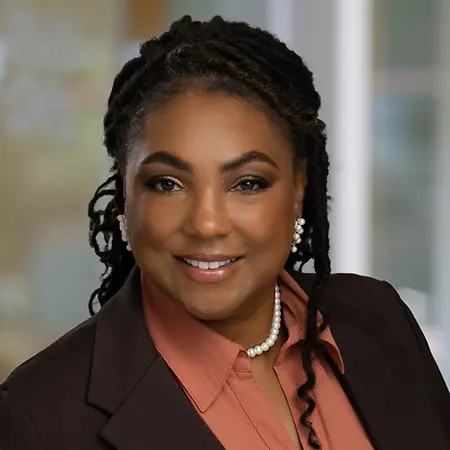
Her Story
About Jacinda Nicole
Jacinda has spent much of her life discovering that the path forward rarely looks exactly as expected.
A mother as a teenager, Jacinda entered military service in 1990 and went on to serve 23 years in the U.S. Army and Air Force, retiring in 2013 as a senior noncommissioned officer. Her experiences in military medicine and leadership shaped her understanding of service, responsibility, and the importance of the people behind every mission.
After retirement, she made an intentional decision to begin her civilian career as an individual contributor. Having spent years leading others, she wanted to learn a different workplace culture, develop new skills, and discover which aspects of her leadership approach needed to evolve.
Today, Jacinda serves as Director of Quality & Patient Safety for Ascension Medical Group Texas. Her 36 years in healthcare span military medicine, healthcare technology, population health, quality improvement, and patient safety. At Ascension, she progressed from clinical business analyst through quality coordination and management into her current leadership role. She holds a B.S. in Technology Management and an MBA in Health Services Administration.
Beyond her professional work, Jacinda values family, community service, mentorship, and the relationships that have shaped her life. Through Kappa Epsilon Psi Military Sorority, Inc., she remains connected to a sisterhood rooted in military service and a shared commitment to supporting others.
Her curiosity also extends into family history. Through Magnolia Roots, an ongoing research and writing project, she is reconstructing generations of her family's Louisiana and Mississippi Gulf Coast history. What began as questions about her own family has become an exploration of identity, memory, and the stories that survive—or disappear—across generations.
Jacinda is especially passionate about encouraging young women whose circumstances may make their futures feel limited. She doesn't believe her journey offers a blueprint for anyone else's life. Rather, she hopes it encourages others to remain open to opportunities they may not yet know exist.
Her Interview
Ten minutes with Jacinda Nicole
01What do you attribute your success to?
Curiosity has probably played a bigger role than anything else. At my sixth-grade graduation, I received the “Most Inquisitive” award, complete with a trophy shaped like a question mark. Apparently, I've been asking questions for a very long time!
That curiosity has served me well. I've never felt I had to know everything before trying something new, but I did feel responsible for learning what I didn't know.
I've also benefited from people who were generous with their knowledge, honest with their feedback, and willing to give me opportunities. Success is rarely something we accomplish entirely on our own, and I certainly haven't.
02What’s the best career advice you’ve ever received?
One of the best pieces of advice came from my younger brother: “As long as you do what you love, you'll never work a day in your life.”
I've learned that loving what you do doesn't mean every day is easy. It means finding something meaningful enough that even the difficult days give you a reason to keep showing up, learning, and contributing.
I've been fortunate to find that sense of purpose in several very different areas of healthcare. Sometimes the work I enjoyed most was work I didn't even know existed earlier in my career.
03What advice would you give to young women entering your industry?
Explore! Healthcare offers so many more ways to make a difference than most people realize. You don't have to work at the bedside to influence what happens there.
Take opportunities to learn how different parts of the healthcare system work. Ask questions, find people willing to teach you, and listen to those doing the work every day.
Don't become so focused on your next title that you overlook what your current experience can teach you. And remember that whether you're working with patients, technology, data, or operations, your decisions ultimately affect real people and families.
04What are the biggest challenges or opportunities in your field right now?
We have more healthcare data, technology, and clinical knowledge available than ever before. Our challenge is turning all of that information into better care without making an already complicated system even harder for patients and the people caring for them.
We can't keep responding to every challenge by adding another metric, dashboard, or task to someone's day.
I see tremendous opportunity in better-connected systems, smarter use of technology, and involving the people closest to the work in designing improvements. Sometimes the most meaningful innovation isn't adding something new. It's recognizing what we can simplify, improve, or stop doing altogether.
05What values are most important to you in your work and personal life?
Integrity, service, and accountability are important to me, both personally and professionally.
Integrity means being willing to do what's right, even when it's inconvenient. Service is about recognizing that what we do affects people beyond ourselves. And accountability includes being willing to question my own decisions, not just those of others.
As I've gotten older, I've also started thinking more about what we leave behind. Not necessarily something with our name on it, but the people we've helped, the knowledge we've shared, the things we've improved, and the stories we've taken the time to preserve.
I suppose I want to know that I made good use of what I was given.
Join Influential Women and start making an impact. Register now.