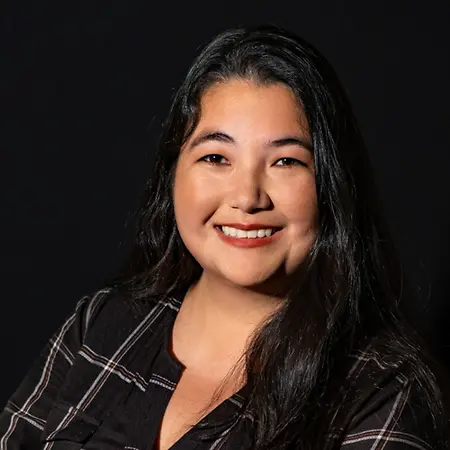
Her Story
About Jennifer
I've been in the museum field since 2010, which is about 16 years now. I started my journey with a degree in astronomy from the University of Florida, graduating in 2009, but I wasn't enjoying the research side of astronomy. What I did love was volunteering with the pop-up planetarium, taking it to elementary schools and doing star shows with kids. A professor told me 'you're really good at this, you should do this full-time,' and I was shocked because I didn't know that was an option. That moment led me to explore science education and communications, and I ended up at Seton Hall University for graduate school, majoring in museum professions with a focus in education. Now, as an Education Manager at the Intrepid Museum, I lead the youth leadership team focusing on teen programs and career pathway programming. We run a six-week summer youth employment program in partnership with NYC's Department of Youth and Community Development, focused on aerospace engineering and primarily serving young women to help narrow the gender gap in aviation and engineering fields. My days vary greatly - I might be teaching school programs in the morning from 10:15 to 1 PM, then spending afternoons on curriculum development, coordinating field trips to JFK to meet with airlines, bringing in working professionals to speak with our participants, and managing our school year internship program. We work on a hybrid schedule with 2 days work from home and 3 days on-site. Our museum is located on a retired World War II-era aircraft carrier docked at Pier 86 in the Hudson River on the west side of Manhattan.
Her Interview
Ten minutes with Jennifer
01What do you attribute your success to?
I honestly wouldn't be where I am today without that professor who was a woman in astronomy. She told me 'you're really good at this' when I was volunteering with the planetarium, and that one comment changed everything for me. There's this element of women supporting women that is a very key component of my success. Whether it's a female professor making one comment, or someone like my mom who was supportive throughout my whole life, different levels of support mean so much. I have a team of all women, and we support our cohort of girls year to year, and we tell them 'you can do this.' Even if they don't want to go into aviation, just knowing there are opportunities available is huge, because then maybe they can point out to another young woman that this opportunity is available to them. That's how we're going to make any strides in this field as a collective - by continuing to spread that idea of women supporting women.
02What advice would you give to young women entering your industry?
I talk about networking a lot, and we really emphasize to students that there's no such thing as a dumb question. Ask it. You never know - someone else might have it, or it might be something that nobody's ever asked before. I try to instill this confidence of just talking to people and getting the answers that they seek out, whether that be about jobs or just a curious topic. When we have mentors come in for our summer program, we do an hour of open Q&A panel, then an hour of open networking where we encourage our students to approach these mentors one-on-one, introduce yourself, talk about your projects, ask them questions, ask them for feedback, ask them if their company offers internships. We're trying to instill those skills of just talking to people. You never know who's going to have an opportunity for you, and you're not going to find it if you're not talking to people and actively seeking that out as often as you can.
03What are the biggest challenges or opportunities in your field right now?
Like every nonprofit, we experience challenges with funding. We're a not-for-profit museum, so there's always challenges with funding and dreams that we could do so much more, but sometimes we're on a shoestring budget. My programs are largely grant-funded and supported, and right now we're in a very good place to be able to deliver the programs that we do, but that's not always been the case. We've had to really take a look, especially with the pandemic, at what we should let go of because we cannot adequately deliver it when the budget doesn't stretch that far. One challenge very specific to us is our location. We're a retired World War II-era aircraft carrier docked in the Hudson River at Pier 86 on the west side of Manhattan, and the nearest subway stop is a mile away, .9 miles. That's a long walk. We've had students accepted to our summer program come for the first day, realize how grueling a .9 mile walk is in the July heat, and just never came back. For field trip groups, we see challenges with buses getting here on time, and for people with disabilities, trying to get them adequate transportation just to get to the programming we offer. It sounds like such a silly thing, but it's something that we deal with daily.
04What values are most important to you in your work and personal life?
The most important thing in working with these young women is just showing them the places that are open to them. Whether or not there is a woman already there, it doesn't mean that that career path is closed off to them. It just means that they haven't gotten there yet. I was a woman in STEM in undergrad and I was in the minority. In my astronomy major, there were 3 of us - 3 out of 20 majors that were women. Even though I ultimately did not go on into astronomy research, knowing that statistic and having lived a very real version of it is still jarring to me. I want to show young women that these are the paths that are open to you, introduce them to other women that did get there, and let them hear those stories of how they got there, just to make the possibilities more real. That's a huge part of my job. I remember when DEI was under attack in 2025, we had a NASA engineer pull out of our Girls in Science and Engineering Day event 3 weeks out because it had girls in the title. I suggested we could take girls out of the title, but our president Susan looked at me and said 'absolutely not.' To have leadership at that level say we're not sacrificing what this event is about - that's really inspiring.
Join Influential Women and start making an impact. Register now.