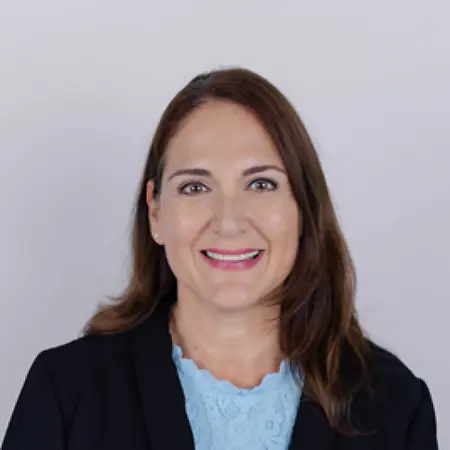
Her Story
About Julia
My main area of expertise is identifying gaps in processes and helping the business unit on how to close those gaps and increase efficiency, while also promoting a risk-aware culture. I'm really good at bringing the right people to the table and connecting them. What I love most about my role is that it's never the same. I attend quite a few task force and committee meetings, mostly with senior management or VPs and above, where I offer that risk management perspective by making comments or asking questions. I sit in on various projects led by a project manager to offer a risk management perspective. I research and respond to all complaints that are sent to our regulatory body, the National Credit Union Administration. I conduct risk assessments on products that are going to be introduced at Logix to ensure we've covered our bases. I lead my team in developing content for our risk management committee meetings with senior management every month to provide content that's of value, and we offer analytical insights into the data we collect to display if we are within our risk appetite by monitoring key risk indicators. It's a complex position because I'm kind of all over the place, but at the same time, I'm focused on making sure our activities are delivering the information we need to roll it to senior management and the board of directors. A big part of my job is building relationships, earning trust, and making the business units feel comfortable enough to be transparent with me so I can help them manage risk in their area.
Her Interview
Ten minutes with Julia
01What do you attribute your success to?
I attribute my success to having a strong work ethic and overcoming obstacles. I know that even if I don't feel like I'm pushing the needle too far, my consistency in my approach to work doesn't go unnoticed. One of the challenges I've had moving from a production role to more of a specialist role is that my success isn't easily quantified, so sometimes I'm not assured that I'm making an impact on the organization, that my work matters and is valued and can easily be recognized. It's harder to quantify the work I do now, so I've learned to recognize that those small wins count. I just go to work every day with a positive attitude, always trying to do what's in the best interest of the credit union.
02What advice would you give to young women entering your industry?
I think the biggest advice is to stay hungry and be willing to learn. One of the biggest parts of my role is constant learning - everything's constantly changing. So just being hungry for that knowledge, being hungry to understand, wanting to advocate, wanting to improve working relationships, policies, procedures, wanting to increase efficiencies, just generally wanting to help. It's a combination of staying hungry, and also a big part of just being a woman in my field, and I think maybe any field, is just advocating for yourself, knowing your worth, knowing what you have to contribute, and not being afraid to advocate for yourself.
03What are the biggest challenges or opportunities in your field right now?
I think some of the biggest challenges is that we have a great culture at my company, and sometimes our culture hinders us in the sense that people aren't used to being held accountable. In risk management, you have to be able to hold others accountable, revisit some risks and controls that are used to mitigate risk that might not be working as effectively, and ask the business units what they've done to improve or replace controls. Also, just being in a specialist position and not having anyone report to me, and having to liaise with the entire credit union - 44 business units, branch operations, and sales - it's having that influence without authority. On the opportunities side, I think one of the greatest opportunities I have is to provide transparency between the departments. A lot of times there are several touchpoints when we're providing member service, and if one department isn't really aware of what another department is doing, their workflows, if there's not clear lines drawn in the sand, then sometimes it can create a challenging work relationship and impact the service we're providing to the member. Since I liaise with all the departments, conduct risk assessments with them yearly, and have a general understanding of what each department does, I think increasing that transparency so that we're only better together is one of the biggest opportunities in my role.
04What values are most important to you in your work and personal life?
I would say honesty, integrity, transparency, and professionalism are most important to me. I think having strong communication skills and being able to admit when I'm wrong, when I've made a mistake, and learn from it without being ashamed of it is crucial. I also think it's important to carry myself in a way that allows others to feel like they can trust me, that I sincerely care. A big part of my job is building relationships, earning trust, and making the business units feel comfortable enough to be transparent with me so that I can help them. If they're not willing to tell me what's not working, I really can't help them manage risk in their area. So I do pride myself on building those types of trusting relationships, being honest, being transparent, and having the difficult conversations, even when they're uncomfortable.
Join Influential Women and start making an impact. Register now.