Her Story
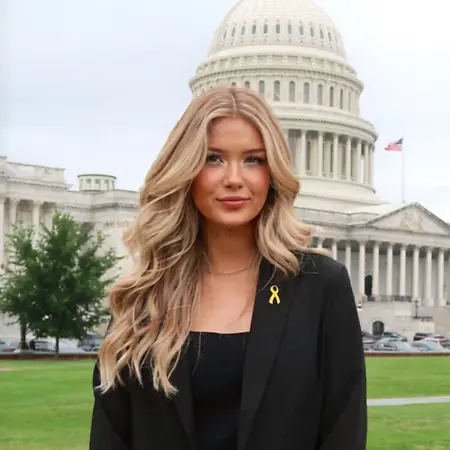
About Kristen
I started my career in marketing 7 years ago, teaching myself website design and specializing in creating luxury websites for clients across the country and even internationally in Norway. I've done graphic design work for nonprofits supporting endangered animal organizations in South Africa and Madagascar. At 24, I founded my own marketing company called Sunday Studio in 2022, working as a team of one doing social media, email marketing, graphic design, and website design for clients. My work has always been about storytelling through marketing, creating designs and brands that make people feel the brand's mission and vision, not just look at them. For the past year, I've been pivoting into women's health advocacy, driven by my own 6-year battle with endometriosis. After finally getting my surgical diagnosis at Johns Hopkins this past March, I was quickly connected with women's health organizations and was sponsored to attend Capitol Hill Day last month, where I spoke with congressmen and women about the gaps in endometriosis research and funding. I've been invited to be a TEDx talk speaker for the first TEDx event in Ocean City. I'm now working on starting Freya Lab, a business focused on specialized lab work and diagnostics for women with chronic illnesses, and I'm studying to become a certified Functional Diagnostic Nutrition Practitioner so I can help women run their own labs and be their own specialists instead of being dismissed by doctors.
Her Interview
Ten minutes with Kristen
01What do you attribute your success to?
I attribute my success to my future children. More than anything, since I was little, my biggest aspiration in life was to be a mom and to give my future kids the life I always dreamed of - the Golden Retriever, the white picket fence. Everything I've done is for my future kids. I always knew I wanted to have my own business so I can set my own hours and hopefully be at home and be very present in their childhood and growing up. It's always been about my future kids and the future mother in me. That vision has driven every decision I've made in building my career and my businesses.
02What’s the best career advice you’ve ever received?
The best career advice I ever received came from one of my close friends who I originally nannied for. She founded and owns her own wildly successful therapy practice based in Northern Virginia, and I actually transitioned from nannying to being her marketing director at one point. Her best advice was to always believe in myself, and when that imposter syndrome kicks in, to remind myself of how much I've accomplished at already such a young age. She told me that the hard work was done, and that I have everything in me to become who I want to be - I just can't give up on myself. That advice has stuck with me and helped me push through the doubts.
03What advice would you give to young women entering your industry?
The advice I would give to young women entering my industry today would be: Don't be intimidated by age and experience. Believe in yourself, and listen to your body. I think it can be very intimidating and scary coming in and having the stereotypes to fit senior-level roles, but when you have a talent and you are confident in that talent, it will take you pretty far. You need to be your number one fan. And when it comes to the women's health world, you know your body better than anyone else. I knew what I was feeling, and the pain was very real. Whether someone said it or not, they weren't feeling what I was feeling, so I fought for it, and I'm happy I did. Don't give up on yourself.
04What are the biggest challenges or opportunities in your field right now?
The biggest challenge in my field right now is the massive gap in endometriosis care, especially in rural areas. There's a little over a million women on the Delmarva Peninsula, and 1 in 10 women have endometriosis, which means over 100,000 women on the peninsula probably have it - and there's not a single endometriosis specialist on the Eastern Shore. I brought this up at congressional offices during Hill Day. The opportunity I see is connecting with the communities that we have and making a safe space for them to come. I've already had so many women reach out to me locally after sharing my story, and they feel heard. I'm hoping to eventually start a nonprofit called Endometriosis Foundation of Rural America, helping communities like mine on the Eastern Shore that don't have a specialist. It would give women a place to go and learn about their own health and find specialists they can be connected to, closing those gaps. The biggest opportunity is connecting with the people who are close to you and local to you, and working with organizations like Women's Health Advocates on the policy side to bring awareness to the whole country, especially the policy makers who can start to make things happen.
05What values are most important to you in your work and personal life?
I am a big storyteller, and I value that a lot in my work and my personal life, because I think it translates to feeling things deeply. In my work, I like to create stuff that tells a story and that creates a feeling where people aren't just looking at designs or brands, but they're really feeling the brand's mission and vision. That translates into my personal life because I feel things deeply, and I like to think of the deeper meanings behind things and connect with others in that kind of way. I think that translates into my work of wanting to make people feel connected to my work, just like how I like to connect with people in my personal life. Growing up, I always wanted to feel understood as a little girl. I viewed the world very fully and deeply, and I think I learned to communicate that through my own language of telling a story - whether that was in poetry to my mom to explain how much she means to me, or in my art. I had to create a feeling instead of trying to explain it verbally.
Join Influential Women and start making an impact. Register now.