Faith didn't just carry me, it reminded me that healing looks different in every culture, and every culture deserves a healer who understands its language.
Choosing Herself Without Apology
Explore more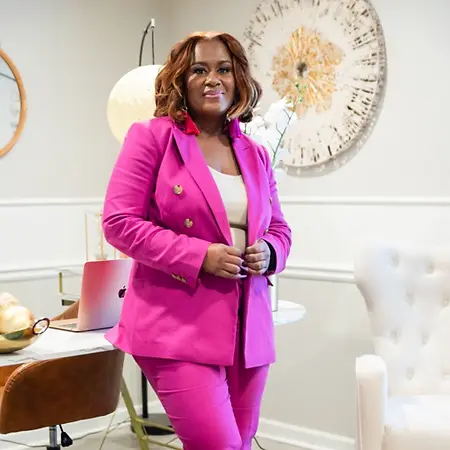
Influential Woman · Mental Health Therapy
LPC, LPCC, LMHC
Founder / Therapist, Healing In Color
Atlanta, GA 30329
I learned that resilience isn't returning to who I was before the setback; It's becoming someone the setback could no longer define.
LaShundra Vines, LPC, LPCC, LMHC, NCC, CPCS · In Her Own Words
Faith didn't just carry me, it reminded me that healing looks different in every culture, and every culture deserves a healer who understands its language.
Choosing Herself Without Apology
Explore moreHer Story
Healing Communities, One Story at a Time
LaShundra Vines has spent more than two decades proving that healing and representation belong together. As a licensed professional counselor, clinical supervisor, and founder of both Awaken Mind Therapy and Healing In Color, she has built a career — and a movement — around a simple but powerful belief: everyone deserves access to mental health care that truly sees them.
Vines's journey began in 2002, working as a case manager for children in state custody and later as a high school teacher, experiences that shaped her lifelong commitment to serving people at their most vulnerable moments. That commitment eventually led her to launch Awaken Mind Therapy, her private practice, where she has helped countless children, adults, and families navigate their healing journeys with adaptable, deeply personal counseling approaches.
But Vines didn't stop at her own practice. Recognizing a persistent gap in culturally competent care, she founded Healing In Color — a nationwide directory connecting Black, Indigenous, and People of Color communities with mental health and wellness providers who understand their lived experience. It's a bold answer to a real problem, born from her belief that representation isn't a bonus in mental health care — it's essential.
Licensed in 11 states and holding the credentials of LPC, LPCC, LCMHC, LMHC, NCC, and CPCS, Vines has also poured her expertise into the next generation, mentoring and supervising fellow therapists so her impact multiplies far beyond her own caseload.
Grounded in faith, family, and an unwavering commitment to integrity, LaShundra Vines continues to expand what equitable mental health care can look like — one client, one clinician, one community at a time.
Her Interview
01What do you attribute your success to?
My faith has been the foundation of everything I've built. There were seasons — building my private practice from the ground up, going through the process of becoming licensed in multiple states, expanding into founding Healing In Color — where the path forward wasn't clear, and honestly, it would have been easy to quit. My faith is what carried me through those uncertain seasons. It gave me the confidence to keep moving even when I couldn't see the whole picture, and the peace to trust that the work I was doing mattered, even before the results showed up.
And my family has been the other half of that foundation. Having a strong, supportive family means I've never had to build this alone. They believed in this vision before it looked like anything — before there was a practice, before there was a directory, before any of it was proof of concept. That kind of support is rare, and I don't take it for granted. It's given me the freedom to take risks I might not have taken otherwise, because I knew I had people in my corner no matter what.
Faith and family aren't separate from my success — they are the success, in a lot of ways. Everything else — the licenses, the practice, Healing In Color — grew out of that foundation being solid first
02What’s the best career advice you’ve ever received?
During my internship, my boss, Burl Robertson, told me, 'You can't save everyone.' I remember I was working these long hours, trying to do everything for everyone, and it was draining me mentally and emotionally. He looked at me and said, 'Go home. You can come back tomorrow.'
That stuck with me because it was the first time someone gave me permission to have limits in this field. Early in your career, you think dedication means giving everything you have to every single person who needs help — but trying to save everyone can drown you. Burl taught me that sustainable care starts with taking care of yourself first. I still carry that with me today, in how I run Awaken Mind Therapy and how I mentor the therapists I supervise. You can't pour from an empty cup, and you certainly can't help anyone if you've drowned trying to save them.
03What advice would you give to young women entering your industry?
Lead with integrity, even when it's the harder path. This field will test you — you'll face moments where cutting a corner or staying quiet would be easier, and I want young women coming into this industry to know that your reputation and your clients' trust are worth more than any shortcut.
Don't wait until you feel completely ready to step out on faith. I built Awaken Mind Therapy and later Healing In Color without having every answer figured out in advance — you learn by doing, and by allowing yourself to grow into the vision instead of waiting for the vision to feel comfortable first.
Also, find your community. This work can be isolating, especially if you're one of the few people in the room who looks like you or understands your community's specific needs. Seek out mentorship, build relationships with other clinicians, and don't be afraid to ask for help — none of us got here alone, no matter how it looks from the outside.
And finally — remember why you started. There will be hard seasons in this industry. Let your purpose, not just your paycheck, be what carries you through them."
04What are the biggest challenges or opportunities in your field right now?
"One of the biggest challenges is still access — even with all the growth we've seen in mental health awareness, there's still a real shortage of culturally competent providers, especially for BIPOC communities. That gap is exactly why I founded Healing In Color. People shouldn't have to settle for care that doesn't understand their lived experience, but for a long time, that's been the reality for a lot of communities.
Burnout is another challenge, both for clients trying to access care and for clinicians trying to provide it. Insurance reimbursement rates haven't kept pace with the actual demand for services, which pushes a lot of talented therapists toward burnout or out of the field altogether. I see it in the clinicians I mentor and supervise — the passion is there, but the systems around them don't always make sustainable practice easy.
But I actually think this moment holds real opportunity too. Telehealth has permanently changed what access can look like — a client in a rural area can now connect with a culturally aligned provider hundreds of miles away, which simply wasn't possible a decade ago. There's also a real cultural shift happening around mental health — stigma is coming down, especially among younger generations, and more people are proactively seeking care instead of waiting for a crisis.
And I think there's a growing opportunity for clinicians to diversify how they build their practice — through insurance credentialing platforms, EAP networks, digital content and community-building — rather than relying on any single revenue stream or referral source. The therapists who learn to build sustainable, multi-channel practices are the ones who'll be positioned to serve their communities for the long haul, instead of burning out in year three or four."
05What values are most important to you in your work and personal life?
Integrity is at the top of the list for me, in both my work and my personal life. Doing right by my clients, my colleagues, and the therapists I supervise — even when no one's watching — isn't negotiable. People trust me with some of the most vulnerable parts of their lives, and I take that seriously. That same standard carries over into how I try to show up for my family and the people close to me.
Faith is another core value — it's not separate from how I practice or how I live, it's woven through both. It's what grounds me when things get uncertain, whether that's in my personal life or in building something new like Healing In Color.
Representation matters deeply to me as well. I've built my career around the belief that people deserve care from providers who understand their lived experience, and that value shapes how I run my practice, how I built the Healing In Color directory, and how I mentor other clinicians.
And family — the people who believed in this vision before it was anything — remain central to who I am. Success has never meant much to me if it came at the cost of the people I love. I try to build a life and a career where those two things support each other instead of competing."
Her Content Hub
A Licensed Professional Counselor challenges the belief that strength and therapy are incompatible, sharing her journey of building Healing In Color while exploring why many BIPOC communities resist mental health support.
Redefining strength: why the strongest people seek therapy
The phrase I hear most often in this field isn't a diagnosis. It's a defense.
LaShundra Vines, Founder & Licensed Professional Counselor, Awaken Mind Therapy & Healing In Color
It was 3 a.m. when the vision for Healing In Color woke me up.
Not a dream I could shake off and forget by morning. A vision—clear, specific, and insistent. A directory connecting BIPOC communities to mental health providers who truly understood their lived experiences. I lay there in the dark, wide awake, and I knew exactly what I was being shown.
I believe God will not give you a vision without provision.
That belief has been tested more than once.
I'm on my third website developer. I had to rebrand my private practice and essentially start over—with a new name, a new identity, and a new foundation—after already building something once. And I've done all of it while raising my son as a single mother, with no built-in partner to hand things off to when exhaustion hit.
There were nights when I wondered if the vision had been a mistake. If I'd misheard something at 3 a.m. that felt so clear in the dark and so uncertain by daylight.
But provision doesn't always look like ease.
Sometimes provision looks like the strength to start over a third time. Sometimes it looks like figuring out how to rebuild a brand while still showing up for my son, maintaining my therapy caseload, and believing in something no one else could see yet.
That belief is the only reason Healing In Color exists today. Because if I had waited until I felt fully equipped, fully funded, or fully ready, I'd still be waiting.
I tell that story because it's connected to something I hear constantly in this field—from clients, family members, and strangers who ask what I do for a living and then quickly assure me they don't need it:
"I am too strong for therapy."
It's usually said with pride. Sometimes with a laugh. Beneath both, it's almost always fear.
Because here's what I've learned after two decades in this field: strength was never the thing keeping people out of therapy. Fear was. Fear of being seen. Fear of what they might find if they finally stopped holding everything together. Fear that needing help means the strength was never real to begin with.
So the phrase becomes armor. "I'm too strong for therapy" is easier to say than, "I'm afraid of what I'll feel if I stop being strong for one hour."
I understand where it comes from.
For many of the communities I serve, strength wasn't optional. It was survival. Somewhere along the way, entire generations learned that falling apart wasn't safe—not at work, not at home, and not in front of the people counting on them. So they learned to carry it. They became good at carrying it. Eventually, the carrying began to look like identity instead of what it truly was: exhaustion wearing a strong face.
Let me say this as plainly as I can, drawing from every year I've spent in this work:
Strength was never the opposite of therapy. Strength is what makes therapy possible.
It takes strength to sit across from someone and say the thing you've never said out loud. It takes strength to examine a pattern you inherited and decide not to pass it on to the next generation. It takes strength to be honest about what's beneath the armor instead of performing that everything is fine.
What I've witnessed, over and over, both in my work and among the clinicians I mentor, is this:
This is exactly why representation in this field matters so much to me.
Many people who say, "I'm too strong for therapy," have never seen someone who looks like them, prays like them, or comes from where they come from sitting in the therapist's chair—let alone the client's chair. It's difficult to imagine healing as an option when you've never seen someone like you choose it.
That's part of why I built Healing In Color. Because strength and healing were never meant to be opposites. And no one should have to abandon their culture, their faith, or their sense of self to ask for help.
God didn't wake me up at 3 a.m. and hand me a fully formed practice, a directory, a team, or a plan. He handed me a vision. The provision—the third developer who finally got it right, the strength to rebrand and start over, and the stamina to do it all while raising my son alone—showed up as I moved, not before I started.
That's true for healing, too.
You don't have to have it all figured out before you begin. You don't have to be "healed enough" to walk into a therapist's office. The provision meets you in the movement, not before it.
So if you've ever said those words—"I am too strong for therapy"—I want you to hear this instead:
You are not too strong for therapy.
You are strong enough to finally put something down.
And that is not weakness.
That is the bravest thing your strength has ever done.
Join Influential Women and start making an impact. Register now.