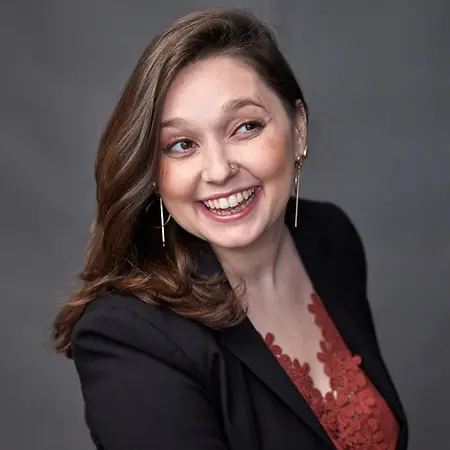
Her Story
About Miranda
I've been working in sustainability for 10 years now, and my career has been driven by a passion for making a measurable impact on climate change. I started in the nonprofit space, spending about 6-7 years working first at CDP and then at the Science-Based Targets Initiative, both focused on corporate sustainability, greenhouse gas reductions, and climate change. For the past 4 years, I've been working as a senior manager in consulting at EY Ernst & Young, where I'm client-facing and manage between 4 to 7 projects at a time. All of my projects focus on climate and sustainability, supporting large Fortune 500 companies in achieving their sustainability goals. This includes everything from setting greenhouse gas emissions targets to analyzing climate-related risks and preparing organizations for new sustainability regulations. I work extensively with industrial, transportation, consumer, and manufacturing organizations, with a focus on reducing emissions in line with climate science. What makes me most proud is the measurable impact I've had on reducing emissions across the globe. The organizations I work with often have emissions profiles larger than entire countries, so supporting them on their journey to reduce emissions means the metric tons reduced or abated that I calculate every day are much more significant than what I could achieve through my own personal decisions alone.
Her Interview
Ten minutes with Miranda
01What do you attribute your success to?
I attribute my success to never giving up and being willing to put in the work. Having a strong support system around you is crucial, especially on the hard days. That support system includes other professionals who work in the space as well. I think being vulnerable with others, your teams, and your sustainability friends to say, hey, I'm feeling pretty down about this right now, or hey, I'm not sure if I'm making enough impact, what's your feedback, what's your perspective, can be really helpful. This career is focused on impact, and it requires a lot of discipline and soul-searching to always ask yourself if what you're doing right now is driving the most impact you can. If it's not, you need to figure out how to make a change, either within the organization you're in or go to another organization to drive the impact you're looking for.
02What’s the best career advice you’ve ever received?
The best piece of advice I've ever received came from my dad, who used to always say, even when I was a kid, that the company can't love you back. I didn't really know what this meant when I was younger, but now I very much understand it. I think that's useful professional advice to understand how to prioritize yourself and how to prioritize the relationships at your organization, as opposed to feeling specific loyalty to a certain brand or a certain place. Even though we may feel so passionately about our work, there's an aspect of it that still is transactional, even when you're working in an impact field. Understanding where those lines are drawn can be very helpful for protecting your own boundaries and navigating challenging points in your career.
03What advice would you give to young women entering your industry?
First, don't self-select out. That's something we do a lot as women. When there are criteria and you meet half of them, a man is like, I'm perfect for this job, and a woman is like, I don't have everything on the list. But then you get there and realize nobody has every single thing on the list, or when you become a hiring manager, you realize that was your nice-to-have, not your need-to-have. Reach out to other people. Men are so willing to help each other, and sometimes as women, we are scared to ask and scared to help. We feel we have limited social capital, which is not just a feeling, it's often true. But the way men grow their social capital is by supporting each other and coaching each other into being winners and succeeding with specific behaviors and perspectives. As women, we're so often socialized to be nice and to not ruffle feathers, and that can sometimes be a limiting behavior, even though it's what people want us to do. So you're kind of stuck between a rock and a hard place. What I try to do and what I tell the women on my teams or my peers is to think about what a man would do in your exact situation, and then think about whether or not you should do that thing. I would also say read a lot of books. There was a really good book I read called Nice Girls Don't Get the Corner Office, which helped me break out of the just-being-nice view. The author didn't even pick that title, but it was very useful. Mentorship and sponsorship in your career is so important, and I think asking for it and convincing yourself that you're worth it is crucial, because you are, even if it's a little bit of a harder journey for us than it might be for men to feel that way.
04What are the biggest challenges or opportunities in your field right now?
The biggest challenge right now is that we're at a point where a lot of the low-hanging fruit have been exhausted. What I mean by that is a lot of the things that organizations could do to reduce emissions and save money have already been capitalized on, because we're now 10-plus years into this push of sustainability past the Paris Agreement, so everybody kind of did their LED upgrades already. Now we're at this point where it requires a bit more collaborative action, a bit more creativity, pushing boundaries on things we haven't before, and investing in R&D and technology. That's a challenging place to be, especially understanding that climate and sustainability is very impacted by political headwinds or tailwinds at any given time. Continuing to push forward even when you're swimming upstream a little bit is where we are as an industry right now, and I think it's those times that are more important than ever to continue swimming, otherwise you'd be swept up by the current in the opposite direction. But the biggest opportunity is that folks in sustainability are literally building the future. We're working on the things that really matter, in the sense that it's how you deliver energy and food and needed services to all of the humans on Earth while also sustaining our planet, our livelihoods, and the ecosystems around us. It's a really fun, interesting, challenging question, and I think we're going to see the fruits of that labor in our lifetime. I think it's an easier challenge to solve than many other social or political challenges we're currently facing in the world, and you can see it changing. The numbers have changed since I've been in this career, even 10 years ago. New renewables on the grid are the cheapest source of energy, and 90-plus percent of new energy going on the grid today is renewable. Twenty to 30 percent of the grid in the U.S. today is powered by renewables, and solar is one of the cheapest forms of energy today, and that was not the case when I joined this space 10 years ago. Heat pumps outsold boilers for the first time this year. There's just a lot of things to see in the change and the shifts, and I think it is on the timescale of our lifetimes.
05What values are most important to you in your work and personal life?
Making an impact is important to me. It's a good question because right now it's a question I'm asking myself. I think it's good to revisit your values on a regular basis and try to understand what you're optimizing for. Learning to prioritize your own needs and wants so that you're able to continue to show up the best for yourself and for others is important. Spending time with the people you love is important. I don't necessarily think I'm one of those people that is in it just for the paycheck, but I think it's also important to not pour your entire heart and soul into your career either, because that's also unsustainable. So trying to find that balance, I think, is something we are always striving for, and is always imperfect. It's about healthy boundaries.
Join Influential Women and start making an impact. Register now.