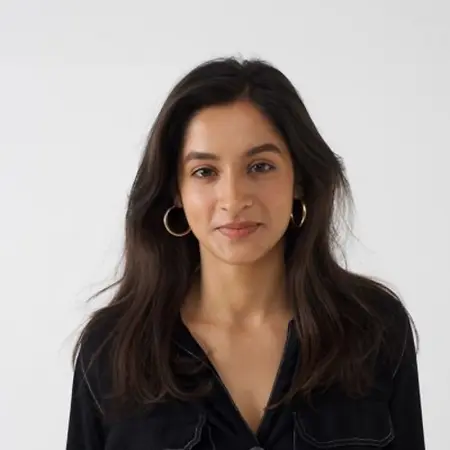
Her Story
About Mridu
My journey has been one of following curiosity and filling in the questions in my head, though I'll be frank - for most of the past six and a half, seven years, I was more lost than certain of what I was doing because I was jumping ships. But those experiences have come together to help me see the world in so many different ways and perspectives. At the intersection of design, helping technologies scale, and sustainable materials, I focus on how we get a product out of a lab and into the market through brand building, communication, storytelling, and go-to-market strategy. One of my most fulfilling achievements was bringing over 100 people together through Terrarium to talk about sustainable materials - creating a platform dedicated to materials where everyone could see and believe that sustainable alternatives like mycelium or mango leather are here, they are resilient, and we can live in a world made of sustainable alternatives. Sports has been one of my biggest teachers - I spent more time on the sports field than in classrooms growing up, and it taught me about working in teams, leadership, and communication. Even today when I'm trying to make a really hard decision, I draw from principles learned on the field.
Her Interview
Ten minutes with Mridu
01What do you attribute your success to?
I think there's definitely no shortcut to hard work - you just have to put in the work, and I will admit that I'm a workaholic. But I also think it's really, really important to be curious, to be in rooms where you probably don't understand much, but that's also where you have the most to understand, and also where you probably have a different perspective to bring than most people in that room. I remember when I was starting to work with sustainable materials, I don't have a science background - physics was really not my area of expertise. I would find myself in labs and conferences about biotech where, for the most part in the early days, I didn't understand anything, and it was both intimidating but also made me feel like I had to contribute. I couldn't stop thinking, oh yeah, there's a better way to communicate this, there's a story here that can get lost in a research paper or in more academic presentation styles. And of course, nothing is possible without your family, your friends, a strong support system that carries you through all the ups and downs.
02What’s the best career advice you’ve ever received?
I think growing up, a lot of times you think in this default way of having to choose between things, like it's either this or that - whether it's choosing between two jobs or two very different paths you could probably go down. But one thing that I've been challenging myself to see is that there are trade-offs, there sure are trade-offs, but I think there's always a world in which AND is a possibility. Like, you can have one thing and the other thing. That's been really important for me - to think from a place of abundance rather than scarcity, and also to operate from a place of love rather than fear in decision making. It's almost like a principle that I've come to over time.
03What advice would you give to young women entering your industry?
I think be curious, that's important, but it's equally important to believe in yourself. It's almost, in my view, actually one of the most important things to believe in yourself, because unless you believe in yourself, you're not gonna be punching above your weight, and it's important to punch above your weight if you want to keep moving up. So believe in yourself, and don't overthink things. If you feel like reaching out to a person because you think you can learn a lot from them, just reach out. What's the worst that'll happen? You don't get a response, right? That's fine, the downside is too small, but the upside is you do get a response, and then you get to learn a lot from this other person.
04What are the biggest challenges or opportunities in your field right now?
I think we're living in a very interesting time where what jobs in 2030 are gonna look like with what AI is doing is a big question. I definitely think there's gonna be some people who are gonna be able to tap into AI and really make the most of it, and then there's a large number of people who, unless you kind of get on the AI wave and figure out how to keep up and use AI to work with AI versus it being you versus AI - I think it's a really important thing. Irrespective of what kind of role, job, sector, industry you're in, it's really important to just keep thinking about how do I work with AI? Where can AI actually support or boost my productivity, versus where does it pose a threat to what I'm bringing to the table? There are two schools of thought here - one is that specialists get eaten first by AI, which I don't completely agree with because experience can't be replaced by AI at the end of the day. And two, there's another school of thought that says adaptability is the only skill that you need to have, which I completely agree with. Being able to switch contexts, exposing yourself to different kinds of fields, domains, and applications in those spaces is really important because that's a way for you to keep up, to think out of the box, to figure out what makes you different, but also make sure you're using AI to its best to work with you and make yourself more useful.
05What values are most important to you in your work and personal life?
One value is definitely quality over quantity. I think this is personally - in the past, I'm just a really enthusiastic person, and sometimes I find it hard to say no to things, but I think one of the most important decisions that you can actually make is staying focused and being able to say no, because the more you're able to focus on the few things that matter, the better the chance for it to actually become something meaningful and purposeful. That's been an anchor for me recently, definitely.
Join Influential Women and start making an impact. Register now.