
Discover why proper positioning is essential for effective CPR. Learn evidence-based techniques to maximize compression quality, minimize rescuer fatigue, and improve patient survival outcomes during cardiac arrest.

Influential Woman · Nursing education leadership
Natalie Barlick-Reed
Nursing instructor, House supervisor, Penn State University
Altoona, PA
1Article published
Her Story
About Natalie
Natalie Barlickreed serves as a nursing instructor at Penn State University at University Park, delivering both theory and clinical instruction. She also works on a per diem basis as a house supervisor at a local facility. With a background that began as a paramedic, she transitioned into nursing and has accumulated 10 years in education alongside 17 years in leadership roles. As a registered nurse, she is currently pursuing her Doctor of Nursing Practice in leadership at Penn State. Natalie is deeply involved in the Nurse Honor Guard, having joined her local group and gone on to lead two additional county groups while helping to form four more, bringing the total she has supported to between six and eight. She has three papers currently under review, covering proper hand placement during CPR, nurse retention strategies, and nurse resilience.
Her Content Hub
Articles by Natalie
CPR hand positioning - why is it so important!!
Master the essential body mechanics and positioning techniques that make CPR truly effective in saving lives.
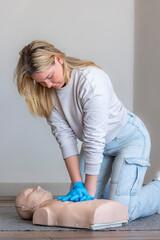
CPR: Why Proper Positioning Is Key!
Cardiopulmonary resuscitation (CPR) is a critical, life-saving intervention for patients experiencing cardiac arrest. High-quality CPR significantly improves survival and neurological outcomes by maintaining cerebral and coronary perfusion until advanced care can be provided. Current American Heart Association (AHA) guidelines emphasize that CPR effectiveness depends not only on compression rate and depth but also on rescuer body positioning. Performing CPR incorrectly, such as from a standing position while facing the patient, reduces compression quality and increases rescuer fatigue, ultimately compromising patient outcomes.
According to the American Heart Association and the International Liaison Committee on Resuscitation (ILCOR), high-quality adult CPR includes the following evidence-based components:
- Patient Positioning: The patient should be placed supine on a firm, flat surface to allow effective sternal compression (AHA, 2020; Berg et al., 2023).
- Rescuer Positioning: The rescuer should kneel beside the patient with shoulders directly over the hands, arms locked, and elbows straight to allow the use of body weight rather than arm strength alone (AHA, 2020; Berg et al., 2023).
- Hand Placement: Hands should be placed on the lower half of the sternum, avoiding the ribs and the xiphoid process (AHA, 2020).
- Compression Depth and Rate: Compressions should be delivered to a depth of 2–2.4 inches (5–6 cm) at a rate of 100–120 compressions per minute, allowing full chest recoil between compressions (AHA, 2020; Berg et al., 2023).
- Minimizing Interruptions: The chest compression fraction should exceed 80%, with minimal pauses (AHA, 2020).
This technique maximizes forward blood flow and optimizes myocardial and cerebral perfusion during cardiac arrest.
Performing CPR from a standing position while facing the patient prevents proper alignment of the rescuer’s body and significantly reduces compression quality. Several biomechanical and clinical factors explain why this position is ineffective:
1. Poor Force Transfer and Compression Depth
Standing CPR limits the rescuer’s ability to position their shoulders vertically over the patient’s sternum. Without proper alignment, force is applied at an angle rather than directly downward, resulting in shallow or inconsistent compression depth. A 2024 randomized crossover simulation study demonstrated that standing CPR led to significantly worse compression depth and increased pauses compared with kneeling CPR (Zhang et al., 2024).
2. Increased Rescuer Fatigue
Standing compressions rely heavily on upper-extremity and core muscle strength rather than body weight. Electromyography studies show that standing CPR causes significantly greater muscle fatigue, particularly in the deltoids, quadriceps, and lower extremities, than kneeling CPR, leading to rapid declines in compression quality (Cho et al., 2020).
3. Reduced Compression Consistency and Recoil
Biomechanical studies indicate that standing CPR is associated with greater variability in compression depth and increased rates of incomplete chest recoil, both of which reduce coronary perfusion pressure (Zhang et al., 2024).
4. Deviation From Evidence-Based Guidelines
Current AHA and ILCOR guidelines implicitly discourage standing CPR by emphasizing kneeling or bed-height-adjusted positions that allow vertical force application. No major resuscitation guideline endorses face-to-face or standing CPR on a patient positioned on the floor (AHA, 2020; Berg et al., 2023).
Improper CPR technique, including standing and face-to-face compressions, places patients at higher risk for poor outcomes due to inadequate perfusion during cardiac arrest. From an educational and clinical competency standpoint, healthcare providers must be trained to position themselves correctly and recognize when environmental modifications (e.g., moving the patient to the floor or adjusting the bed height) are necessary. Emphasis on proper body mechanics also reduces rescuer fatigue and supports sustained, high-quality CPR during prolonged resuscitation efforts.
High-quality CPR requires correct patient positioning, rescuer alignment, and biomechanical efficiency. Performing CPR from a standing position while facing the patient is ineffective because it limits compression depth, increases rescuer fatigue, reduces compression consistency, and deviates from established evidence-based guidelines. Adhering to current CPR standards by kneeling beside the patient and using body weight to deliver vertical compressions is essential to optimizing patient survival and neurological outcomes.
So, if you are going to perform CPR, be sure to do it right with proper positioning!
Natalie Barlick-Reed
DNP-S, MSN, BSN, RN, PHRN, paramedic
References
1. American Heart Association. Highlights of the 2020 Guidelines for CPR and ECC. https://cpr.heart.org/-/media/cpr-files/cpr-guidelines-files/highlights/hghlghts_2020_ecc_guidelines_english.pdf
2. Berg KM, et al. (2023). International Consensus on CPR and ECC Science With Treatment Recommendations. https://pmc.ncbi.nlm.nih.gov/articles/PMC10713008/
3. Cho Y, et al. (2020). Muscle Fatigue During Chest Compressions in Standing vs. Kneeling CPR. Australasian Emergency Care. https://www.ausemergcare.com/article/S2588-994X(20)30054-3/abstract
4. Del Rios M, et al. (2025). 2025 American Heart Association Guidelines for CPR and ECC. https://cpr.heart.org/-/media/CPR-Files/2025-documents-for-cpr-heart-edits-posting/Resuscitation-Science/252500_Hghlghts_2025ECCGuidelines.pdf?sc_lang=en
5. Zhang N, et al. (2024). How Does Rescuer’s Position Setting Impact Quality of Chest Compression? Emergency Medicine International. https://onlinelibrary.wiley.com/doi/pdf/10.1155/2024/9950885
Natalie
Natalie Barlick-Reed, DNPc, MSN, BSN, PHRN
Join Influential Women and start making an impact. Register now.