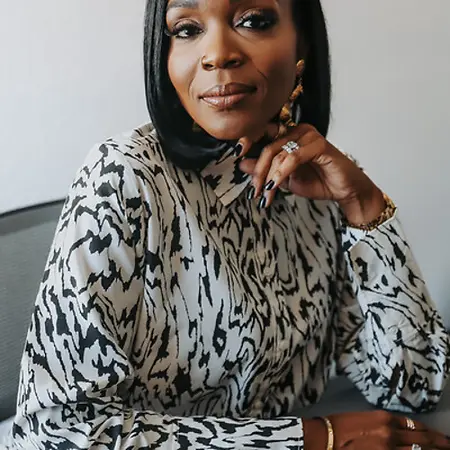
Her Story
About Nichelle
I've been in my field for over 15 years, working with families for over 20 years directly. I am a social worker with a bachelor's in social work, and I understood the one-on-one opportunity that was needed to work with families, but at the same time, I wanted to have a bigger role in making sure that the systems and operations were in place and that families had a voice at the larger tables. I got my master's in education in adult organizational development, which allowed me to really understand adults and help employ adults who serve families directly, because I wanted to serve through people who served people. I wanted to mentor and create change. I call myself the underdog because I started my work at another college, went to a community college, then went to college again, and finally got my bachelor's in social work. Then I started having my children, went back to school and got my master's in education, and worked the entire time through both degrees. Working with families and learning about families at the same time was a power play - not easy, but definitely for me and the way that I learn, it was an opportunity for me to understand it and feel the work at the same time. I kept building on that initial premise of wanting to directly serve and support families, and I landed my way all the way here as the CEO of Children's Therapy Center.
Her Interview
Ten minutes with Nichelle
01What’s the best career advice you’ve ever received?
The best advice I was given in my whole career and my journey is that every day is a new day. I carry it with me, I use it for my children. It resets you. It really does. It really resets you and lets you know that all things have passed, and I can start fresh today. It's gonna be alright. Absolutely.
02What advice would you give to young women entering your industry?
The best piece of advice I would give to a young professional is that the work is intended to be hard, and to not give up on it. Because they're working in systems that, unfortunately, didn't think about them. That's just the way of the world. But to not give up on the system. Because it's going to look different, it's going to be arbitrary, it's going to be convoluted, it's going to triangulate. Instead of lying to young professionals and telling them that everything's gonna be great and you'll never face hardships and there'll never be things wound up - because in my mentorship, I was given a glossified version that all things will work well. Not really. Sometimes they don't. And what does it look like for me to stay in the game? And how do I take care of myself while I'm doing that? Because people don't talk about self-preservation and self-awareness as a young professional, and when we can no longer identify ourselves because we're too wrapped up in the work, we harm ourselves. Because we don't know what it looks like for us to be depressed or stressed in work, because we're so new to work.
03What are the biggest challenges or opportunities in your field right now?
There are many challenges in my role. I have to make a concerted effort to directly understand the impact to families and to staff. There is a reality that I have a very large degree of separation as a CEO, and I have to make a concerted effort to go into community, go into the spaces, go to the parades, go to the festivals, go to the schools, so I can hear directly for myself. There's a nice amount of space in between us and the family. Another barrier or boundary for our line of work is funding. Making sure that people understand that we're a non-profit, meaning that we don't make a profit on the work that we do, so fundraising and understanding through storytelling, through families being able to share their stories is really important, because there's such a disconnect from the actual reality of what's happening in the communities versus what we see on screen or what we see on social media. We have to get off our phones, out of our house, out of the car, and meet people and have conversations. I think the biggest barrier is the human contact and the human connection. We have to take the time to get out of our own pandemic, if that makes sense. Get back into the world.
04What values are most important to you in your work and personal life?
My value is rooted in integrity. It's rooted in understanding that there are more people than me in the world. I believe in inclusivity to a fault. I believe that you have to be interested in knowing the people around you. You have to be interested in being self-aware. I value just the planet, and I know that sounds cheesy, but the environment matters to children. Just how we have a library, have a bank, have a school, and a community matters. I value diversity to just the greatest lengths, because how we learn and how we're interested in others and how we make room for others matters. I also value just the commitment for connection, making sure that people know what space you're in and what that looks like, and not just making it up, but really creating spaces for people to see themselves in the work, physically, mentally, and emotionally. So I very much value belonging, too.
Join Influential Women and start making an impact. Register now.