My greatest turning point wasn't becoming someone new; it was finally giving myself permission to become the woman I had always been.
The Advice She Finally Stopped Following
Explore more
Influential Woman · Behavioral Health Nonprofit
Director of Human Resources and Communications, Continuum Behavioral Health & Recovery Services
Medford, OR 97501
A major career disappointment felt like the end, but it turned out to be the catalyst for becoming the person and leader I was always meant to become.
Nicole Roberts · In Her Own Words
My greatest turning point wasn't becoming someone new; it was finally giving myself permission to become the woman I had always been.
The Advice She Finally Stopped Following
Explore moreHer Story
Nicole Roberts is an executive leader, speaker, and trauma-informed workplace advocate specializing in organizational culture, nonprofit leadership, workforce development, and equity-centered systems transformation. With a master’s degree in Organizational Leadership from Lewis University and a background spanning higher education, behavioral health, operations, compliance, and human resources, Nicole is known for helping organizations build psychologically safe, high-performing workplace cultures rooted in trust, accountability, and human connection.
Her commitment to nonprofit leadership began more than 20 years ago following the premature birth of her daughter, an experience that profoundly shaped her passion for service, advocacy, and supporting individuals navigating complex systems and barriers. After earning her bachelor’s degree in social science and psychology, Nicole spent nearly a decade in higher education leadership, where she developed a deep commitment to student success, mentorship, and organizational development.
Nicole later transitioned into workforce development and behavioral health nonprofit leadership, serving in progressively senior operational and executive roles. During her tenure at Jasper Mountain, a children’s behavioral health nonprofit, she advanced from Compliance Manager to Executive Director, leading major organizational transformation efforts that included eliminating a multimillion-dollar deficit and securing over $1 million in new program revenue through strategic state partnerships.
Today, Nicole serves as Director of Human Resources and Communications at Continuum Behavioral Health & Recovery Services, where she focuses on leadership coaching, organizational culture, workforce sustainability, and embedding trauma-informed practices into daily operations. She is widely recognized for her thought leadership in trauma-informed workplace culture and regularly speaks and writes on topics including psychological safety, leadership accountability, burnout prevention, and resilient organizational systems.
Nicole is also the author of Six Principles of Trauma-Informed Leadership, the first in an ongoing series focused on helping leaders and organizations create healthier, more sustainable workplaces where both people and performance can thrive.
Her Interview
01What do you attribute your success to?
I attribute my success to a combination of curiosity, resilience, and a genuine desire to understand people. Throughout my career, I’ve never been someone who was satisfied with simply maintaining the status quo, I’ve always wanted to understand why systems work the way they do, how they can improve, and how leadership impacts the people within them.
I also think my lived experiences shaped how I lead. Navigating difficult personal and professional challenges taught me the importance of empathy, adaptability, and staying grounded during uncertainty. Those experiences helped me develop a leadership style centered on trust, accountability, and human connection.
Above all, I’ve been willing to keep learning, keep evolving, and step into challenges even when the path forward wasn’t completely clear. I think that combination of resilience and authenticity has opened many doors throughout my career.
02What’s the best career advice you’ve ever received?
One of the earliest and best pieces of career advice I ever received came when I stepped into my first management role in retail. I was trying to do everything myself because I thought that was what strong leadership looked like. My regional manager pulled me aside and reminded me that having a team meant I didn’t have to carry everything alone. He explained that allowing people the opportunity to step in, contribute, and succeed was how they felt valued and invested in the team. By trying to do it all myself, I was unintentionally limiting their growth and creating resentment.
That conversation fundamentally changed how I view leadership. It taught me that effective leadership isn’t about control or proving how much you can personally accomplish, it’s about empowering others, building trust, and creating opportunities for people to grow and thrive alongside you.
03What advice would you give to young women entering your industry?
My advice to young women entering this field would be to be fearless enough to take up space, even before you feel fully ready. Don’t let fear, self-doubt, or someone else’s limitations define what you believe you’re capable of accomplishing. Some of the most meaningful growth in my career came from stepping into challenges that felt uncomfortable or uncertain at the time.
I would also encourage women not to fear failure. Some of the experiences that felt like setbacks or disappointments ultimately became the greatest lessons and growth opportunities of my career. Be willing to keep learning, evolving, and stretching yourself beyond what feels comfortable.
Most importantly, trust yourself. There will always be people who underestimate you or try to define what leadership should look like, especially in spaces that have traditionally been male-dominated. Don’t shrink yourself to fit someone else’s expectations. Dream big, continue growing, and give yourself permission to pursue opportunities that feel bigger than what others think is possible.
04What are the biggest challenges or opportunities in your field right now?
One of the biggest challenges in the nonprofit and behavioral health sectors right now is sustainability, particularly around funding, workforce retention, and navigating constant uncertainty. Many organizations are operating in environments where funding sources can shift quickly, grants become less predictable, and the demand for services continues to grow. That creates significant pressure on organizations to remain adaptable while still delivering high-quality care and support to the communities they serve.
At the same time, I think one of the greatest opportunities is community connection and innovation. Organizations that are deeply engaged with their communities, transparent about their mission, and willing to think creatively about partnerships and outreach are often better positioned to build trust and long-term sustainability. At Continuum, community engagement is a major focus for us. We participate in events year-round and actively work to connect people to our mission, because relationships and visibility matter tremendously in the nonprofit space.
I also believe there is a growing opportunity around trauma-informed leadership and workplace culture. Organizations are beginning to recognize that supporting employee well-being, psychological safety, and sustainable leadership practices isn’t just good for people, it’s essential for retention, resilience, and long-term organizational success.
05What values are most important to you in your work and personal life?
The values that matter most to me, both professionally and personally, are honesty, integrity, connection, compassion, and meaningful purpose. I believe people do their best work when they feel valued, supported, and connected to something bigger than themselves, and I try to carry that philosophy into both my leadership style and my personal life.
Hard work is also incredibly important to me, but I’ve learned over time that hard work alone isn’t enough if it isn’t aligned with your values and the kind of impact you want to have on the world. Finding alignment between personal values, organizational culture, and meaningful work has become increasingly important to me throughout my career.
I also deeply value authenticity and human connection. Whether in leadership, teamwork, or personal relationships, I believe trust is built through honesty, empathy, consistency, and the willingness to truly listen and understand others. At the end of the day, I want the work I do and the relationships I build to positively impact people in a meaningful and lasting way.
Her Content Hub
Explore how leaders can transform failure into growth by redefining organizational culture, embracing vulnerability, and building resilient teams that innovate without fear.
How redefining failure as growth transforms leadership and organizational culture.
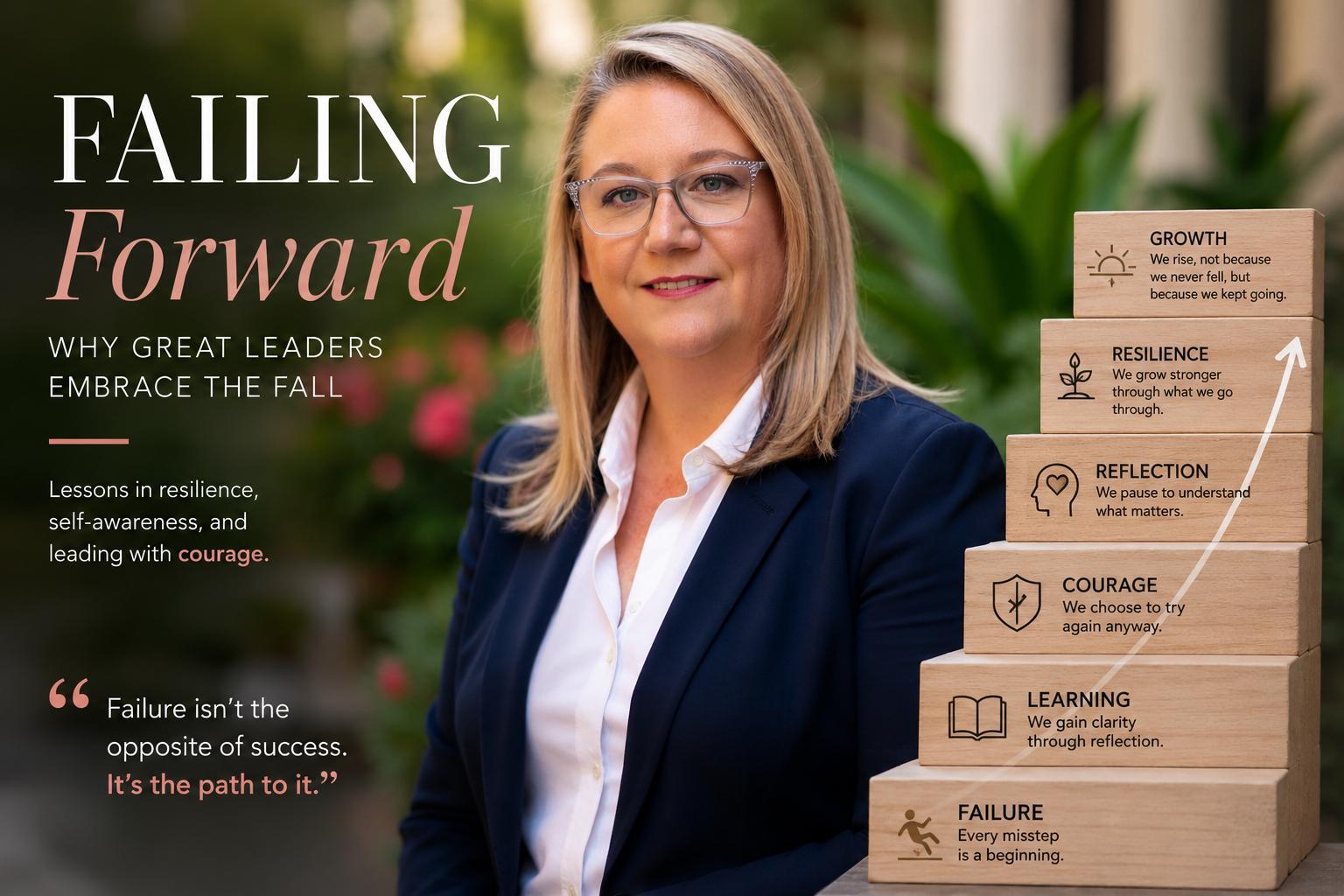
I’ve been hearing a lot about the idea of “failing forward,” and it struck a chord with me—not because it’s trendy, but because it is deeply aligned with one of my core beliefs as a leader:
To fail is human, and it should never be feared, ridiculed, or shamed.
Failure is not the opposite of success. It is part of the path to success. It is how we grow, how we learn, and how we become better—as professionals, as leaders, and as people.
From an early age, most of us are taught that failure is something to avoid. We are graded, scored, and ranked. We are rewarded for the “right” answers and quietly penalized for the wrong ones.
By the time we enter the workplace, failure has become something we fear. Something we hide. Something we believe might cost us a promotion, damage our reputation, or even jeopardize our job.
But here is the truth:
Every innovative idea, every strong team, and every breakthrough solution is built on the shoulders of someone who failed and kept going.
Failure is not the end.
It is a pivot point.
The difference between people who fail and people who fail forward is simple:
They choose to learn.
They choose to grow.
They choose to keep moving.
Years ago, I accepted a leadership role that, on paper, looked like a dream. It was the kind of opportunity people told me I should want.
But deep down, I knew the culture was not right.
There were red flags: unspoken dysfunction, unclear expectations, and a lack of meaningful support. Still, I said yes.
For a while, I pushed through. I tried to fix things. I tried to make it work.
Until one day, it all came crashing down—emotionally, professionally, and personally.
It felt like a failure.
I questioned everything.
Was I not strong enough?
Not smart enough?
Not experienced enough?
But stepping away from that role and reflecting on what happened became a turning point.
It taught me how to listen to my intuition.
It taught me to honor values over titles.
And it taught me never again to sacrifice my wellbeing—or the wellbeing of others—to prop up a broken system.
That perceived failure became the foundation for the kind of leader I am today: one who values alignment over appearances, impact over ego, and honesty over perfection.
When failure is met with shame, blame, or silence, people stop taking risks.
They stop innovating.
They play it safe.
But when failure is met with curiosity, reflection, and grace, real growth begins.
If we want resilient, creative, and courageous teams, we must create cultures where failure is not feared but valued.
Here is how I try to model that:
No one gets it right all the time.
And the leaders who act like they do are doing everyone—including themselves—a disservice.
Let’s normalize the stumble.
Let’s share the missteps.
Let’s teach the next generation of leaders that falling is not failing—it is a necessary step on the path upward.
As leaders, we have a responsibility to create environments where people can learn, grow, and recover from mistakes without fear.
That is where innovation begins.
That is where trust is built.
That is where resilience grows.
Failure is not something to fear.
It is something to honor, reflect upon, and move through with intention, humility, and courage.
Join Influential Women and start making an impact. Register now.