Failing Forward: Why Great Leaders Embrace the Fall
How redefining failure as growth transforms leadership and organizational culture.

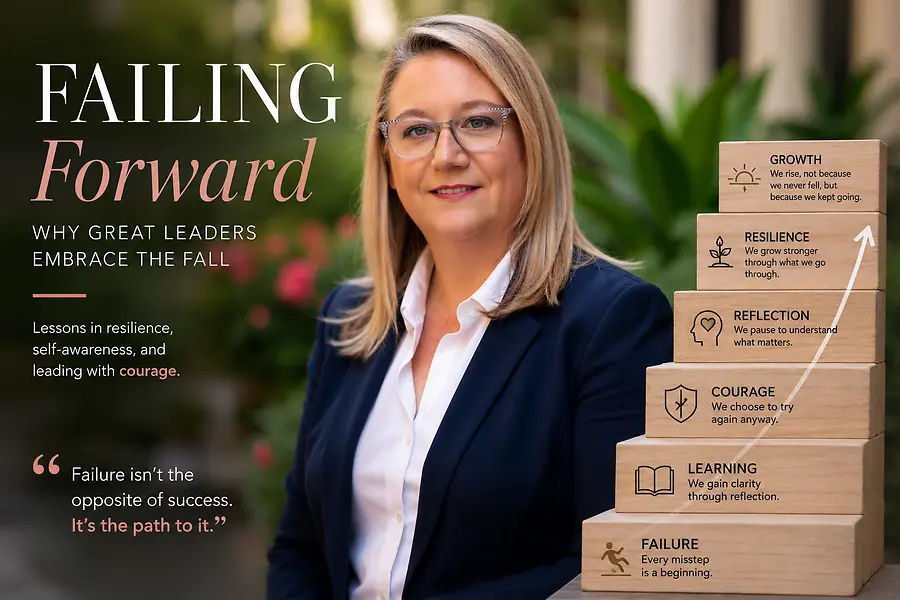
Failing Forward: Why Leaders Must Redefine Failure
I’ve been hearing a lot about the idea of “failing forward,” and it struck a chord with me—not because it’s trendy, but because it is deeply aligned with one of my core beliefs as a leader:
To fail is human, and it should never be feared, ridiculed, or shamed.
Failure is not the opposite of success. It is part of the path to success. It is how we grow, how we learn, and how we become better—as professionals, as leaders, and as people.
Why We Fear Failure (And Why We Shouldn’t)
From an early age, most of us are taught that failure is something to avoid. We are graded, scored, and ranked. We are rewarded for the “right” answers and quietly penalized for the wrong ones.
By the time we enter the workplace, failure has become something we fear. Something we hide. Something we believe might cost us a promotion, damage our reputation, or even jeopardize our job.
But here is the truth:
Every innovative idea, every strong team, and every breakthrough solution is built on the shoulders of someone who failed and kept going.
Failure is not the end.
It is a pivot point.
The difference between people who fail and people who fail forward is simple:
They choose to learn.
They choose to grow.
They choose to keep moving.
My Story: When a “Success” Almost Broke Me
Years ago, I accepted a leadership role that, on paper, looked like a dream. It was the kind of opportunity people told me I should want.
But deep down, I knew the culture was not right.
There were red flags: unspoken dysfunction, unclear expectations, and a lack of meaningful support. Still, I said yes.
For a while, I pushed through. I tried to fix things. I tried to make it work.
Until one day, it all came crashing down—emotionally, professionally, and personally.
It felt like a failure.
I questioned everything.
Was I not strong enough?
Not smart enough?
Not experienced enough?
But stepping away from that role and reflecting on what happened became a turning point.
It taught me how to listen to my intuition.
It taught me to honor values over titles.
And it taught me never again to sacrifice my wellbeing—or the wellbeing of others—to prop up a broken system.
That perceived failure became the foundation for the kind of leader I am today: one who values alignment over appearances, impact over ego, and honesty over perfection.
As Leaders, We Set the Tone
When failure is met with shame, blame, or silence, people stop taking risks.
They stop innovating.
They play it safe.
But when failure is met with curiosity, reflection, and grace, real growth begins.
If we want resilient, creative, and courageous teams, we must create cultures where failure is not feared but valued.
Here is how I try to model that:
- I own my mistakes publicly and without excuses.
- I invite feedback, even when it is uncomfortable.
- I focus on what we learned, not just what went wrong.
- I remind my team that progress matters more than perfection.
Fail Forward, Together
No one gets it right all the time.
And the leaders who act like they do are doing everyone—including themselves—a disservice.
Let’s normalize the stumble.
Let’s share the missteps.
Let’s teach the next generation of leaders that falling is not failing—it is a necessary step on the path upward.
As leaders, we have a responsibility to create environments where people can learn, grow, and recover from mistakes without fear.
That is where innovation begins.
That is where trust is built.
That is where resilience grows.
Failure is not something to fear.
It is something to honor, reflect upon, and move through with intention, humility, and courage.


