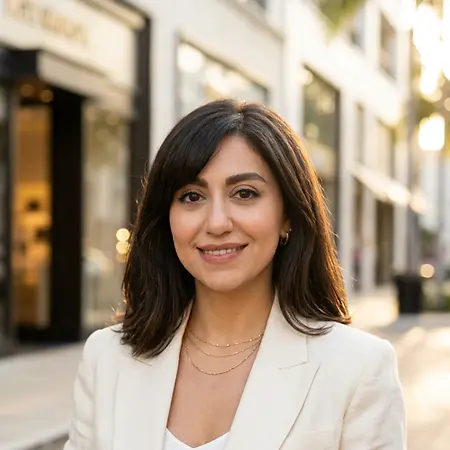
Her Story
About Nooshin
Nooshin Darvishinia is a Ph.D. candidate in Curriculum and Instruction at Kansas State University, where she focuses her research on the intersection of artificial intelligence, virtual reality, and the future of education. Originally from Iran, Nooshin’s academic journey reflects her passion for using education as a tool for transformation and opportunity. She earned her bachelor’s degree in English Literature and a master’s degree in Teaching English as a Foreign Language before moving to the United States in 2022 to pursue doctoral studies. Her research explores how emerging technologies can enhance teaching and learning while promoting inclusive and equitable educational experiences.
Throughout her doctoral career, Nooshin has contributed to advancing educational technology through research, teaching, and innovation. She has helped establish the Immersive Technologies for Learning Lab at Kansas State University’s College of Education, where she works to expand access to virtual reality and immersive learning experiences, particularly for rural schools and diverse student populations. Her scholarly work examines topics such as AI adoption in education, virtual reality in STEM learning, multilingual education, and ethical approaches to integrating emerging technologies into classrooms. She has published and presented research at national and international conferences, including work on teachers’ and pre-service teachers’ perceptions of ChatGPT and the role of VR in supporting English Language Learners.
Beyond her research, Nooshin is committed to mentorship, leadership, and creating opportunities for others in education and STEM. She has served as President and Vice President of the Education Graduate Student Organization at Kansas State University, supporting graduate students through professional development and community-building initiatives. She is also involved in professional organizations and university committees focused on technology, diversity, equity, and inclusion, and is a member of Phi Kappa Phi and other academic honor communities. Inspired by mentors who encouraged her independence and growth, Nooshin advocates for measuring success not only through academic achievements but also through the impact made by empowering others to pursue their goals.
Her Interview
Ten minutes with Nooshin
01What do you attribute your success to?
Throughout my journey—from teaching English in Iran to pursuing a Ph.D. in the United States—I have been fortunate to learn from mentors who challenged me to think independently, pursue meaningful questions, and never lose sight of the people my work is meant to serve. Their guidance taught me that success is not simply about achieving personal milestones, but about using those opportunities to create opportunities for others.
02What’s the best career advice you’ve ever received?
"Don't build your career around what is popular—build it around the problems you genuinely want to solve."
That advice transformed the way I approach research and leadership. It reminded me that meaningful work begins with purpose. Today, whether I'm researching AI, virtual reality, or teacher education, I try to ask one question first: How will this improve people's lives?
03What advice would you give to young women entering your industry?
My advice to young women entering my field is to define success beyond personal achievements. While publications and academic milestones are important, true success comes from empowering others, sharing knowledge, and creating opportunities for those who follow. By supporting one another and making the journey easier for future generations, we can create a stronger and more inclusive academic community.
04What are the biggest challenges or opportunities in your field right now?
Artificial intelligence is changing education faster than many institutions can adapt. While AI presents extraordinary opportunities to personalize learning, increase accessibility, and support educators, it also raises important questions about ethics, equity, critical thinking, and the future role of teachers.
I believe our greatest opportunity is not simply learning how to use AI, but learning how to prepare educators to use it responsibly, thoughtfully, and in ways that strengthen—not replace—human learning and connection.
05What values are most important to you in your work and personal life?
Integrity. Curiosity. Compassion.
I believe knowledge carries a responsibility. Education should never be about collecting credentials alone; it should be about creating opportunities, serving others, and leaving every community stronger than we found it.
I hope to approach every opportunity with humility, a willingness to keep learning, and a commitment to helping others grow alongside me.
Join Influential Women and start making an impact. Register now.