Exploring what lies beneath intelligence: how mature leadership transcends power, domination, and extraction to serve life itself through conscience, discernment, and planetary stewardship.
Verified Member
Influential Woman · Wellness, Personal Development & Holistic Health
Nora Liana Yolles Young
Founder / Holistic Life Coach / Hypnotherapist, Young Integrative Consulting, LLC
Pittsboro, NC 27312
15Years experience
13Articles published
Her Story
About Nora
Nora Yolles Young is a transformational strategist, board-certified hypnotherapist, bestselling author, speaker, and founder of Young Integrative Consulting, LLC. For more than 15 years, she has helped high-achieving women, entrepreneurs, and conscious leaders navigate profound life transitions by integrating the science of the mind with the exploration of human consciousness.
Her professional journey began in archaeology and the study of human origins before an unexpected inner calling led her into the healing arts. Today, she specializes in transpersonal hypnotherapy, Life Between Lives® hypnotherapy, past-life regression, and holistic coaching, helping clients uncover the original imprints that shape their beliefs, relationships, and sense of identity. Her work invites people beyond coping and into lasting transformation by accessing expanded states of consciousness where insight, healing, and authentic change become possible.
Nora is the creator of Soul Connection Hypnosis Certification Training, where she trains practitioners from around the world in advanced, client-centered approaches to transformational hypnosis. She has served as a teaching assistant with the Michael Newton Institute for Life Between Lives Hypnotherapy and is a board-certified hypnotherapist and certified instructor through the International Association of Counselors and Therapists (IACT).
She is the bestselling author of The Sacred Middle Finger: Your Permission Slip to Break Free from Other People's Rules and Live Your Best Life, a book that encourages readers to challenge inherited expectations, reclaim their authentic voice, and create lives rooted in purpose rather than performance.
Whether working with executives, entrepreneurs, healthcare professionals, or individuals experiencing profound spiritual transformation, Nora is known for creating a grounded bridge between practical personal development and the exploration of consciousness. Her work explores the intersection of psychology, spirituality, and human potential while empowering people to become the most authentic leaders of their own lives.
When she isn't working with clients or teaching, Nora enjoys writing, exploring the mysteries of consciousness, and spending time in nature. She is currently expanding her work through keynote speaking, international practitioner training, and her upcoming novel, continuing her mission to help people remember who they are beneath conditioning, fear, and limitation.
Her Interview
Ten minutes with Nora
01What do you attribute your success to?
If there is one principle that has shaped both my life and my work, it is this:
The moments that transformed me most were rarely the ones that looked successful from the outside.
Like many people, I spent years trying to follow paths that made sense, paths that promised security, achievement, or approval. Whenever I organized my life around someone else's definition of success or the belief that I "should" be living differently, I found myself increasingly disconnected from who I truly was.
Those experiences were not failures. They became invitations.
Over time, I learned to replace external validation with a different compass.
I began listening deeply.
To my body.
To the quiet intelligence that speaks through intuition.
To the patterns that repeat until they are understood.
The synchronicities and moments of unexpected congruence that gently redirect my path.
Rather than forcing life to unfold according to expectation, I have learned (through trial and error) to follow what feels deeply aligned, even when it doesn't make logical sense in the moment.
This has required unlearning many of the inherited beliefs that tell us how we are supposed to live, succeed, achieve, or contribute. It has been an ongoing practice of releasing conditioning and cultivating a relationship with something wiser than fear, performance, or social approval.
The greatest transformations in my life have never come from trying harder to become someone else.
They have come from becoming more fully myself.
This is not blind faith or wishful thinking. It is an ongoing practice of discernment, presence, humility, and courageous authenticity. It asks me to remain open to learning, to trust what resonates deeply, and to allow life itself to become both teacher and guide.
The work I offer others is the same work I ask of myself.
To listen.
To become deeply and radically honest.
To live with integrity.
To allow the wisdom of the heart, the body, and expanded consciousness to work together rather than compete with one another.
I believe authentic transformation begins from within. As our inner landscape becomes more coherent, our relationships, our leadership, our communities, and our stewardship of the Earth naturally begin to reflect that same coherence.
For me, this is not simply a philosophy.
It is a way of living.
02What’s the best career advice you’ve ever received?
Don't be afraid to follow what you're drawn to. You don't have to get it right the first time. Every experience teaches you something valuable. If it turns out it's not your path, make a course correction. Progress comes from moving, learning, and trusting yourself enough to adjust along the way.
03What advice would you give to young women entering your industry?
Look at your career as a craft that you're continually refining rather than a destination you have to reach. Like a musician, an artist, or a master artisan, your work deepens through practice, curiosity, and a willingness to keep learning.
I also believe each of us has a unique reason for being here. If you're willing to listen deeply, life has an incredible way of revealing it. It whispers through what continually draws your attention, what lights you up, what breaks your heart, and what keeps calling you back.
The work I do is deeply sacred. It requires scientific curiosity, psychological understanding, profound compassion, and the humility to stand in the mystery of human consciousness. But more than anything, it requires a willingness to know yourself.
Don't choose this path if you're unwilling to look at your own shadow. The greatest tool you will ever bring into the room is your own level of self-awareness. The deeper you are willing to understand yourself, the greater your capacity to guide others with integrity.
I'd also encourage young women to let go of perfectionism. Perfectionism is often fear wearing a very convincing disguise. Learn the fundamentals. Respect the teachers who came before you. Follow established methods when they're appropriate. But don't mistake someone else's path for your own.
Innovation has always come from people who were willing to ask, "What if there's another way?" Every breakthrough, every record that has ever been shattered, every meaningful advancement in science, business, athletics, and the arts happened because someone honored what already existed while having the courage to explore beyond it.
Master your craft. Then trust yourself enough to contribute to its evolution.
04What are the biggest challenges or opportunities in your field right now?
One of the greatest challenges is overcoming the longstanding stigma and misconceptions surrounding hypnotherapy and expanded states of consciousness. At the same time, there is tremendous opportunity as more people seek authentic healing, purpose, and deeper meaning beyond traditional approaches. Growing acceptance of holistic wellness, personal development, and consciousness work is creating significant demand for experienced practitioners and educators.
05What values are most important to you in your work and personal life?
Integrity, authenticity, compassion, honesty, and personal freedom are the values that anchor my life. They aren't simply ideals I aspire to. They're daily practices that shape how I make decisions, lead, love, and serve.
I strive to lead from within rather than from external expectations, staying aligned with what feels deeply true instead of what simply looks successful. I've learned that the most meaningful life isn't built by following someone else's blueprint. It's built by listening, having the courage to evolve, and living in alignment with your own values.
Family and community are also at the heart of who I am. I believe we're living in a time when people are yearning for genuine connection, belonging, and purpose.
More than ever, we're remembering that we aren't meant to navigate life alone. We heal, grow, and flourish in relationship with one another.
If there's one thing I hope to contribute, it's helping people reconnect with themselves so they can show up more fully for the people and communities they love.
Her Content Hub
Articles by Nora
Beyond Intelligence:
Why intelligence without conscience becomes dangerous, and what mature leadership actually requires.

Beyond Intelligence
The third essay in the Beyond Intelligence series.
In the first two essays of this series, I explored how perception shapes possibility—and how exceptional leadership requires more than intellect, strategy, or execution.
It requires a wider architecture of intelligence: attunement, discernment, maturity, collaboration, meaning, and the capacity to translate what we perceive into action.
But there is a more confronting question beneath all of it:
What is our intelligence in service of?
Because expanded perception without moral maturity is not necessarily wisdom. It can simply make a person more sophisticated at getting what they want.
Power without conscience does not become leadership because it is efficient, persuasive, strategically brilliant, or capable of commanding attention. It becomes more dangerous.
And before we can talk honestly about corruption, coercive power, greed, or moral bankruptcy, we have to be willing to look at the rot. Not only the rot in institutions. Not only the rot in the people who have learned to benefit from confusion, division, fear, and extraction.
The rot that can permeate a society when enough of us decide—consciously or unconsciously—that we would rather be led than awake.
This is not because human beings are bad at our core. I do not believe that. I think we are exhausted. Overstimulated. Afraid. Busy surviving. Trained to believe someone else is more qualified to decide what is true, what matters, what is possible, and where we are headed.
So, we become the third horse in a line of horse rumps making its way down the trail. Just follow that tush. We hand over our attention. We trade discernment for convenience, mistake familiarity for safety, and become so accustomed to being told what matters that we forget we possess the capacity to look, question, sense, evaluate, and decide for ourselves.
And then, slowly—almost imperceptibly—we allow the people most comfortable with power to define reality for the rest of us. It is time to take the blinders off.
Power Is Not Leadership

When power serves life, it becomes regenerative.
We use the word leadership so casually that we often fail to distinguish it from influence, authority, visibility, status, wealth, or the ability to get people to comply.
But leadership is not the power to make people move. Leadership is the capacity to help human beings move toward something worth creating.
It has a relationship to truth and responsibility. To actual consequences. A relationship to the health of the whole. It understands that people are not raw material from which productivity, loyalty, votes, wealth, labor, or attention can be extracted. They are human beings: complex, intelligent, vulnerable, creative, and worthy of consideration and care.
Leadership asks: What are we building? Who does it serve? What does it cost? Who bears that cost? What happens to the people, communities, ecosystems, and future generations who must live inside the consequences of this decision? What are the arenas that benefit? Who loses? What will be done to optimize net benefit over profit?
Domination asks a different set of questions.
How do I keep control? How do I avoid accountability? How do I maintain the appearance of legitimacy? How do I get people to doubt themselves long enough for me to do what I intended to do anyway?
Basically: How do I protect my own ass and let everyone else absorb the consequences?
When power must operate through intimidation, behind-the-scenes coercion, abuse, blackmail, deception, fraud, distraction, neglect, humiliation, or the systematic destabilization of shared reality, it has already revealed its moral bankruptcy.
This is leadership rendered as theater: the performance of legitimacy while domination carries on behind the curtain. It is obnoxious, insulting, and absurd—and perhaps it is time to admit that it has also been one of our historical definitions of leadership: power that prevails, whatever it costs.
But it will not carry us where we need to go. Leadership has to become something better. It has to become embodied truth: the willingness to see what is real, take responsibility for what our power creates, and act in ways that strengthen rather than diminish the life around us.
Domination can never be a long-term strategy for human thriving. Like a parasite, it survives by draining its host—and eventually destroys the very conditions that sustain it.
The Corruption of Shared Reality

When reality is distorted, clarity becomes an act of self-trust.
One of the most damaging forms of power is not merely the power to lie. Human beings have always lied. We can be self-protective, frightened, ambitious, ashamed, and deeply invested in preserving an identity we cannot bear to lose.
The more dangerous power is the power that asks us to abandon our own perception while the lie is being told. To accept that up is down and down is up. To believe that what we can plainly see is not actually happening.
To question our memory, our instincts, our values, our sanity, our compassion, and our ability to recognize basic cause and effect.
Most people know this dynamic from intimate relationships. An unfaithful spouse insists that the evidence is meaningless. A manipulative partner denies harm while explaining why the injured person is irrational, dramatic, confused, or responsible for the very behavior that hurt them.
The goal is not simply to conceal the truth. The goal is to make the other person lose confidence in their capacity to know truth at all. A society can be manipulated this way, too.
When people are overwhelmed by contradiction, scandal, spectacle, outrage, misinformation, and the endless churn of competing narratives, discernment gets exhausted. It becomes easier to stop looking, to retreat into certainty, to follow the loudest voice, the most familiar tribe, the most forceful explanation, or whatever allows us to get through the day without feeling the full weight of what is happening.
This is why the quality of our perception matters so much. Perception is not passive. It is not merely noticing what is in front of us. It is the ongoing capacity to register patterns, question assumptions, sense incongruence, track consequences, and remain willing to revise what we think we know.
A person who cannot trust their own perception is easy to control. A people who cannot trust their shared reality are easy to divide. And a society that cannot distinguish truth from manipulation becomes increasingly vulnerable to anyone willing to exploit the confusion.
The Cost of Looking Away
We did not arrive here only because some people are willing to behave terribly. We arrived here, at least in part, because too many of us have been conditioned to look away. Again, this is not a moral indictment. It is an invitation to honesty.
Looking away is understandable. When our most immediate needs for safety, stability, belonging, health, and provision feel uncertain, it is intuitive to turn our attention toward what is closest: our families, our work, our bills, our private hopes, and the people we love.
It can feel stabilizing to believe that someone else has the larger situation handled. To trust that the people in charge must know something we do not—the bigger picture. To assume that the systems around us are sturdier than they appear.
It is tempting to keep following the horse in front of us. But trusting others does not require surrendering our own agency. Healthy interdependence is not learned helplessness, and valuing expertise does not mean abandoning our ability to recognize when something no longer makes sense.
The world does not need every person to become a policy expert, political strategist, activist, historian, economist, spiritual teacher, or full-time watchdog. That is not the point.
The point is this: Our greatest thriving, as individuals and as collective inhabitants of this planet, lies in honing the distinct perception, value, and wisdom each of us is here to contribute to the larger whole.
Too many archaic models of power and leadership keep human beings distracted from that deep, intrinsic value: our individual and collective intelligence, creativity, and capacity. They can profit from it as long as we remain disconnected from it.
Because the moment we remember what we carry—and what we can create together—we remember that we are designed for this level of brilliance—the jig is up.
From Outrage to Agency

Agency begins when we tend to what has been harmed—and turn together toward what is possible.
The next generation of leadership is not something we have to invent from scratch. It is already wired within us. These capacities are the unexercised muscles of our untapped brilliance: deeper perception, morally sound vision and imagination, relational intelligence, creativity, discernment, courage, and the ability to recognize that our individual well-being is inseparable from the well-being of the whole.
Many younger people are already beginning to flex these subtle but powerful capacities. They are questioning inherited rules. Refusing false choices. Asking larger questions about justice, belonging, identity, sustainability, power, and what kind of future is actually worth participating in.
Acknowledging what has harmed us and what is dysfunctional is valid. It must be expressed. Grief has a place here. Anger has a place here. The refusal to normalize what should never be normalized has a place here.
Genuine healing has no shortcuts. It asks to be held in sacred reverence—with honesty, tenderness, and room for the full emotional reality of what has happened. The days of swallowing our responses, tamping down our feelings, and calling that strength must be recognized as part of the continued harm we perpetuate against ourselves, often in service of systems that benefit when we remain disconnected from our own truth.
But outdated, too, is the way we make known that something no longer works. Outdated is the old script of the village coming for Dr. Frankenstein with an angry mob with pitchforks and torches: collective outrage without discernment, passion that becomes groupthink, and the mistaken belief that reactivity is the same as agency.
The next shift tasks us with digging deeper. It asks us to peel back the layers of malaise, reflexive helplessness, and inherited reactivity that keep us from recognizing the agency still available to us.
It asks us to hold wrongdoing accountable from an unwavering center of truth—not from numbness, vengeance, or the reflexive impotence that leaves the work to someone else. It asks us to stay connected to what is human while tending the wounds within our communities, among the people we love, and alongside the healers, space holders, advocates, and steady-hearted people who help us metabolize what has happened—and alchemize the lead of our collective pain and wounding into the gold of what we are becoming.
We do not need less feeling. We need feeling held inside greater consciousness.
Like the shuddering of an animal’s body after it has escaped the hunt, our nervous systems need space to express grief, pain, injury, and fear. They need environments where those responses are witnessed with reverence—not treated as inconvenient disruptions to be hidden, managed, or pushed away.
For too long, human pain has been treated as an invisible adjunct: the “hysterical” woman removed from view, the young person told not to cry, the wounded body asked to stay quiet and carry on until some imagined day when there will finally be time to feel.
That day is not guaranteed to arrive unless we make room for it now. Healing requires spaces where the full truth of what has happened can be felt without shame, witnessed without spectacle, and allowed to move through the body without being mistaken for weakness.
Only then can grief reveal what matters, anger clarify a boundary, compassion remain present without excusing harm, and accountability restore dignity rather than reproduce violence.
Only then can the wisdom held within the full alchemical process emerge—the wisdom we cannot think our way into, rush toward, or access through bypassing what the body, heart, and soul still need to move through. This is sacred work—not to be missed. And only after we face our collective dark night of the soul do we reach the threshold of what our next iteration can become.
That is not a passive process. It is the act of choosing agency mature enough to create something better than what harmed us.
What do we have to contribute—not only to our own survival and thrival, but to the good of humanity as a whole, the well-being of this planet, and our readiness to become responsible planetary stewards and ambassadors to the world beyond our own?
Planetary Sovereignty
There is a form of sovereignty we usually think of as personal: the work of no longer arranging our lives around approval, inherited rules, fear of rejection, or what other people might think.
But perhaps it is time to scale that question. What would planetary sovereignty look like?
It would mean looking in the mirror, clearing the cobwebs from our eyes, and taking a deeper step into radical responsibility for what we are creating here. It would mean refusing to organize our future around the hubris of human exceptionalism—the assumption that we are the only intelligence worth considering, the only perspective that matters, or the only beings affected by what we build.
It would mean looking up, out, and beyond. Not as an escape from Earth—an excuse to say, “We screwed the pooch here; now we have to terraform Mars”—but as an expansion of responsibility.
Whether or not humanity is ever witnessed by other forms of intelligence, we can still ask: What would it mean to become a species worthy of being known beyond our own world?
Do we want to be recognized for our capacity to dominate, extract, destroy, and then deny the consequences? That is what we call the villains in our stories. Yet human beings rarely want to imagine ourselves in that role. We want to see ourselves as the heroes.
Perhaps it is time to start acting heroically.
Perhaps it is time to create some congruence between our inflated perception of ourselves and the persistent patterns of villainous behavior we continue to normalize. To recognize that we have been gaslighting ourselves for long enough.
Course correction requires owning our own hindering bullshit—and being willing to chuck it in favor of something more fruitful: an intentional return to our re-emerging capacity to see clearly, repair, collaborate, create, and steward from centered, aligned strength.
That is the kind of congruence that can support genuine thriving on—and within—the extraordinary planet we have inherited.
The truth is, we do not need an audience in the stars to make this question matter. We only need the courage to recognize that the way we treat one another, this planet, and the future is already a declaration of who we are becoming.
The Moral Purpose of Power
 Earth glows against deep teal space as a fine golden arc extends outward from its horizon.
Looking beyond Earth begins with deeper responsibility for the world we already share.
Power itself is not corrupt. Power is simply the capacity to affect change.
Contrary to popular belief, power is not reserved for the few. It exists within all of us. But many of us have been trained to doubt the source of our true power and to mistake force for strength.
Force is not strength. It is often the refuge of insecurity—the impulse to dominate another person’s will because we have not developed the inner authority to lead ourselves. It is the aggression of toddler-level development: No. Mine.
If we are serious about turning our gaze toward the stars, we will need to mature beyond this petty orientation toward force and into a more expansive capacity for coherent strength, emotional mastery, discernment, and genuine stewardship.
Consider how much of life within the great oceans of this planet remains unknown to us. Then turn that lens toward the stars. Are you beginning to feel the largeness of what is before us?
Once we distinguish power from force, the real question becomes: What does our power serve? Does it expand agency, dignity, resilience, coherence, and possibility? Does it leave people, communities, and systems more capable, more connected, and more alive than it found them?
Or does it depend on keeping others confused, depleted, dependent, divided, and afraid? Does it strengthen the conditions that sustain it? Or does it extract from them until there is nothing left but profit, rubble, and exhaustion?
And what is wealth when only a few are permitted to hold it while the systems and people that made it possible are diminished?
That is not abundance. It is distortion.
We can see the isolation, misalignment, and deprivation of meaning that accompany a life organized around behaving villainously toward one’s own people and world. Whatever wealth, influence, or control such a person accumulates, it cannot create inner coherence.
In the quiet moments of stillness, that has to matter.
And what is abundance unless it can be shared? Who wants an ivory tower in isolation, surrounded by stacks of wealth and separated from the living world that made it possible?
Regenerative power functions within interdependence. It knows that real strength is not demonstrated by how much can be controlled or extracted, but by how much life can be supported to flourish. It does not ask only, What can I get? It asks, What becomes possible when we are all strengthened by what we create together? That is true prosperity.
Perpetual thriving cannot be built by burning out people to sustain a company, abandoning a community’s most vulnerable members, destroying the shared reality a nation requires to cooperate, or continually betraying one’s own humanity.
The same is true of leadership. Anything that depends on degrading the people, systems, or planet that sustain it is not strong. It is structurally unsound.
It may look powerful for a while. It may produce extraordinary short-term results. It may persuade people that it is inevitable. But it is already standing on borrowed ground—shortsighted, boorish, and incapable of sustaining what it consumes. If we intend to survive and thrive as a species, the empowering pivot is toward stewardship.
The Galactic Question
And it may be time to ask a larger question still: What are the universal, multidimensional, and—yes—galactic implications of what we are building here?
Whether you believe the recent cultural buzz around UAPs points to something profound, something mundane, or simply another distraction is beside the point. The possibility alone offers a useful mirror.
If another intelligent civilization were observing us, what would they see? Would they see a species in the early, awkward stages of maturity—still learning how to manage power, still wrestling with fear, greed, tribalism, and the impulse to dominate? Would they see a species so dazzled by its own cleverness that it is about to squander an astonishing planetary inheritance for the sake of short-term gain?
Or would they see a species standing at the precipice of a profound evolution—toward sovereign planetary stewardship and a more mature form of leadership?
It is hard not to imagine the cosmic version of: Oh, the toddlers are at it again.
There they are, living on an extraordinarily magnificent blue planet with breathable air, abundant water, breathtaking biological diversity, vast intelligence, creativity, spiritual capacity, and the technological brilliance to solve problems their ancestors could barely imagine.
And they are still arguing over whether everyone deserves dignity. Still caught in cycles of war, economic and class caste systems, and the dualistic fiction of “us versus them”—even though those they call them are also us.
Still destroying the systems that keep them alive. Still allowing immense human talent and resources to be absorbed by domination, extraction, distraction, and the desperate pursuit of more.
Maybe they’re not ready.
We are a little like the entitled trust fund child of a billionaire: given an extraordinary inheritance and every imaginable advantage, only to squander it on selfish pursuits because we never developed the maturity to understand the majesty of what we were holding.
But what if we did?
What if we became more interested in achieving the things that bring forth the best of our human and planetary potential? If Earth were our house—and we were inviting fascinating new friends over to see what we had built here—what would we be excited to show them?
Certainly, we would show them the pyramids. The ancient temples. The great works of art, music, literature, science, engineering, architecture, and human imagination. We would show them the places where people came together to create beauty, preserve wisdom, care for one another, and reach beyond what had previously seemed possible. We would be proud of those accomplishments.
Would we be equally eager to show them the ecosystems we have destroyed? The communities we have treated as expendable? The ways we have made profit from illness, loneliness, fear, violence, and the diminishment of human beings?
That discomfort is not a verdict. It is an opening—an opportunity to become more conscious, present, honest, and more capable of creating what we would be proud to share.
If it makes us squirm, perhaps that is because it touches a knowing we have not entirely lost. Somewhere beneath the noise, the numbness, the distraction, and the stories we have been told about what is normal, we know the difference between power that protects life and power that consumes it.
We know the difference between what is worthy of pride and what is merely familiar. Between what looks impressive and what is truly elevated. Between a civilization capable of extraordinary achievement and one mature enough to be trusted with its own capabilities.
That knowing changes the purpose of leadership.
Leadership cannot simply be the management of people, resources, and outcomes in service of maintaining the status quo. Its higher purpose is to help us create more life: more dignity, agency, balance, possibility, and more room for human brilliance to emerge.
It asks: What are we building? Who does it serve? What does it cost? Who bears that cost? What will this decision make possible—or impossible—for people, communities, ecosystems, and future generations?
It also asks: Are we trying to solve the future from inside a structure that was never designed to hold it? Are we willing to recognize that our static definitions of leadership may be constraining the very vision, creativity, and collective intelligence we most need?
Gone must be the age of static mechanization: the belief that human beings, organizations, and a living planet can be managed like machines—forced into predetermined shapes, optimized for output, and discarded when they no longer serve the system, leaving behind buried accumulations of scorched earth.
We are not machines. Earth is not a machine. Neither can be endlessly extracted from, manipulated, and expected to carry on without consequence.
What we need is not a better version of the old box. We need an altogether different architecture: leadership and planetary infrastructure organized around thriving. Systems that are responsive, relational, regenerative, and capable of evolving toward greater coherence, balance, creativity, dignity, and life.
A living ecosystem, not another cage.
Technology can help us get there. It can reveal patterns, connect ideas, automate labor, and expand the range of what is possible. But technology cannot do the work of human maturation for us. Technology cannot do what it is not designed to perceive.
It cannot access the intelligence of the divine. The soul. The deeper field of consciousness from which human meaning, moral clarity, visionary thought, healing, and genuine wisdom emerge.
For me, this is not merely an idea. In my work, the evidence is ever-present for anyone willing to look. We are not only biological beings managing a human life. We are spiritual, conscious beings having a lived, collective human experience—here, I believe, by choice: to evolve, to grow, to remember, and to become more fully capable of what we came here to create.
Technology may amplify and support what the human mind can do. But the work of becoming mature enough to use that power wisely belongs to us.
And it is precisely where the old power structure begins to fail. It was built to preserve itself through control, rigidity, secrecy, and the endless attempt to force square pegs into round holes—then manipulate the documents when the evidence refuses to cooperate.
Sorry, old guard. The world is changing too quickly, the consequences are becoming too visible, and too many people are remembering what their own perception is for. The future belongs to those willing to become mature enough to build something better.
The Moment We Stop Pretending
There comes a point in every failing system when hoping it will return to what it once was becomes another form of denial.
We may long for a past version of reality. We may wish that the people with influence would remember their conscience. We may hope that the evidence will finally become overwhelming enough, the harm visible enough, the suffering undeniable enough, that those responsible will change course.
Sometimes people do change. Individuals can grow. Institutions can reform. Repair is possible. But true course correction requires radical honesty.
It requires a genuine willingness to see harm as harmful; take responsibility and make meaningful changes; acknowledge the failure; and reconfigure systems around more life-affirming, wellness-oriented values.
It requires becoming different in action—not merely in language.
As they say: talk is cheap.
If moral clarity, public pressure, evidence, suffering, or the obvious consequences of their actions were enough to create transformation, we would already be living in a different world.
So, we get to stop making our future contingent on the conscience of people who have repeatedly demonstrated that conscience is not directing their choices. This is not hopelessness. It is the end of misplaced hope—and the beginning of reclaiming our own responsibility for what comes next.
Yes, it may feel deeply uncomfortable to look at and face. But discomfort can be the threshold of a more honest, empowered choice. It is the moment we stop waiting for an old architecture to save us and start becoming capable of building the new one.
Higher Ground
 Four people walk together along a sunlit mountain ridge toward a wide, glowing horizon.
Higher ground is not escape. It is the choice to move together toward what can sustain life.
There is a principle often spoken about in disaster survival: the people most at risk are not necessarily those who lack intelligence or strength. They may be those who cannot quickly accept that the conditions have changed.
They keep expecting normal to return. They wait for another announcement. Another sign. Another person to tell them what to do. Another reason not to leave what feels familiar.
And while they wait, the water rises. I do not say this to create fear. Fear is already being used skillfully enough. I say it because reality is always kinder than denial in the long run.
Recognizing that a system is failing does not require us to collapse into despair. It gives us information. It asks us to adjust. To prepare. To look for higher ground. To gather people. To carry what matters. To become more resourceful, more connected, more discerning, and more capable of helping one another.
Higher ground is not a bunker. It is not an escape from humanity. It is the decision to build the conditions in which humanity can survive and thrive.
It is more truthful leadership, resilient communities, ethical businesses, regenerative systems, and courageous conversations. More people willing to develop the inner stability required to resist manipulation and the relational maturity required to remain connected across difference.
It is the willingness to create structures that do not require anyone’s diminishment in order to succeed. It is the decision to stop calling extraction success.
Beyond Intelligence
This is why the future of leadership does not only go to the most intelligent, articulate, forceful, wealthy, connected, strategic, or technologically capable among us.
Leadership in this new age rises through people with range: people capable of thinking and sensing through the art of heart-centered awareness.
People who no longer perceive others as lesser and therefore have no need to revert to low-maturity strategies of power and control. People who are unwilling to step on, diminish, or exploit others in order to feel elevated themselves.
People skilled at listening openly and deciding clearly. Receiving and acting. Holding complexity without abandoning clarity. Recognizing patterns without becoming paranoid. Feeling deeply without becoming immobilized. Remaining open without becoming gullible.
Those who know to the depths of their DNA that there is no room for corruption, psychopathy, sociopathy, or sadism in a healthy, galactically oriented civilization—one in which all life is valued and planetary thriving for all beings is the goal.
We need leaders who understand that intuition without discernment can become projection; that analysis without humanity can become cruelty; that confidence without curiosity can become arrogance; that execution without meaning can become extraction.
Leaders who are willing to ask and feel the difference between, Can we? and Should we? Not only, Will this work? but What will it cost in the long run? Not only, How do we win? but Who loses if this is won?
This is what I mean by Beyond Intelligence.
It is not a rejection of intellect, ambition, strategy, innovation, achievement, wealth, or power. We need all of those capacities. But we need them held inside a larger architecture of consciousness.
One capable of recognizing that human beings are not machines to be mastered. We are beings to be deeply valued with intrinsic worth. That the health of the individual and the health of the whole are inextricable and inseparable. That no outcome is truly successful if it requires the destruction of the conditions that make life meaningful, livable, and possible.
Much of what I am pointing toward has not yet been widely imagined, practiced, or permitted within our current dominant systems.
It may emerge as radically new to this dense, dualistic, intellect-first age—not because these capacities are foreign to us, but because we have been trained to overlook them.
The solutions may have been in plain sight all along, rendered nearly invisible by thousands of years of linear thinking, inherited power structures, and the assumption that what cannot be measured or controlled cannot be trusted.
The work begins within, because no one leads outside of themselves.
We bring our wounds, fears, loyalties, blind spots, conditioning, maturity, integrity, and capacity for self-honesty into every decision we make. We bring them into every room. Every institution. Every relationship. Every future we help create.
So this is not an essay about someone else’s moral bankruptcy. It is an invitation to examine our own relationship to power. Where have we handed it away? Where have we used it carelessly? Where have we mistaken compliance for peace, numbness for safety, or silence for consent?
Where have we allowed ourselves to become the third horse in line because looking up felt too frightening, too exhausting, or too inconvenient? And where are we ready to become more awake? We know where the old pattern leads.
Haven’t we been on this hamster wheel long enough to recognize its destination? More extraction. More disconnection. More harm explained away as necessary, inevitable, or simply the cost of doing business.
We do not need to keep running in order to learn what this model produces. We have enough evidence. The opportunity before us is to step off—and begin creating from a different center.
The future will not be created by the people most invested in preserving what is failing. It will be created by those willing to perceive clearly, tell the truth, remain connected to what is human, and build what comes next.
What are you willing to contribute to humanity’s survival?
The Work of Becoming
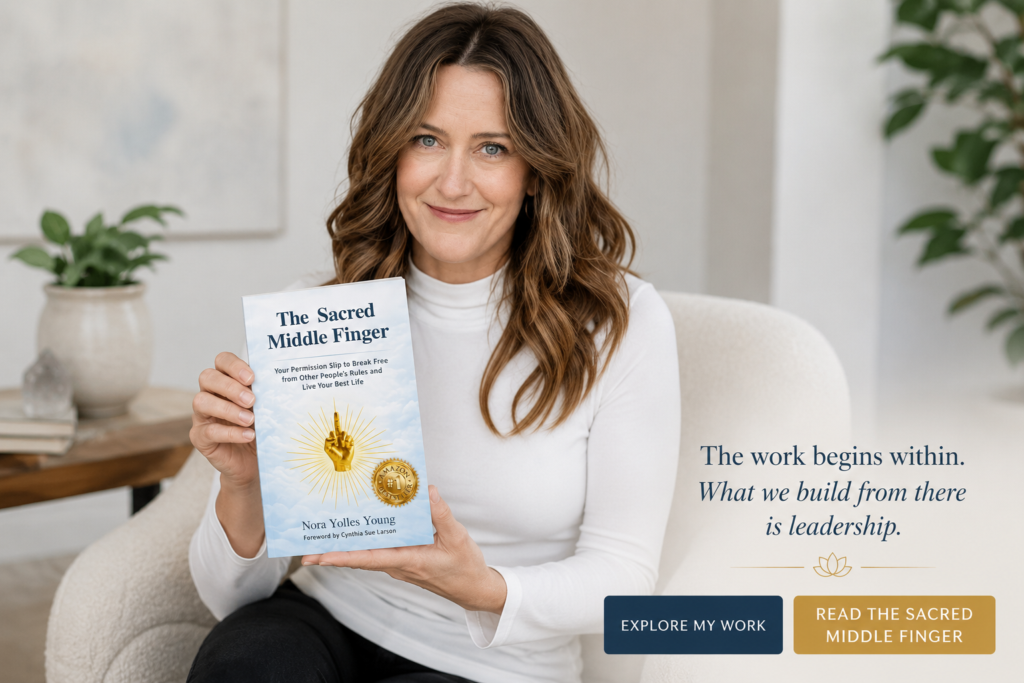
Author Nora Yolles Young holding her book, The Sacred Middle Finger, alongside the message “The work begins within. What we build from there is leadership.” (image)
The way we lead others begins with the way we lead ourselves.
The first essay in this series began with a multilayered idea: the quality of our perception shapes the field of possibility available to us.
The second explored what happens when that expanded perception becomes more than awareness—when it is brought into relationship with meaning, attunement, discernment, collaboration, decisive action, and execution.
This essay asks the question underneath both:
What is all of that intelligence, power, and capacity in service of?
Because the future does not require us to become less intelligent, less ambitious, less innovative, or less powerful. It asks us to become mature enough to hold those capacities with conscience. To use them in service of life. To create from a wider field of perception, a clearer relationship to truth, and a more coherent understanding of what it means to thrive together.
That is the work of becoming. It is personal. It is relational. It is organizational. It is planetary.
And it begins within.
As someone who has always been curious about what lies beyond the obvious, I explore the practical applications of consciousness: how expanded perception can transform the way we live, lead, relate, and create.
My work bridges the seen and unseen, spiritual intelligence and practical action, with a particular focus on women, leadership, and human potential.
I’m Nora Yolles Young: board-certified hypnotherapist, certified instructor, Life Between Lives® practitioner, coach, and author of The Sacred Middle Finger: Your Permission Slip to Break Free from Other People’s Rules and Live Your Best Life.
I help people expand perception, strengthen self-trust, question inherited rules, and become more fully themselves—so that what they create in the world is a clearer reflection of who they truly are.
If this exploration resonates, The Sacred Middle Finger is an invitation to begin there: to examine the beliefs, loyalties, fears, and old identities shaping your choices, and reclaim the sovereign, grounded authority required to build a life that is actually your own.
Because before we can change the architecture of leadership, we have to become willing to examine the architecture within ourselves.
And before we can build a future worthy of humanity, we have to remember that we are part of its creation. What are you willing to release in service of a world worth living in? And what might become possible when we stop waiting for someone else to lead us home?
Explore how exceptional leadership transcends traditional intelligence to integrate perception, intuition, collaboration, and meaningful action for transformative impact.
The Architecture of Perception
From Expanded Perception to Decisive Action: The Architecture of Exceptional Leadership

The second essay in the Beyond Intelligence series.
 What we perceive shapes what we are capable of creating.
There comes a point when expanded perception must become something more than awareness. More than philosophy or armchair navel gazing. It must enter our lives through the heart of what we build, create, change, and contribute.
Whether we are building a company, leading a team, raising a family, creating a body of work, solving a problem, shaping policy, developing technology, or simply questioning a way of doing things that no longer makes sense, we are constantly translating what we perceive into the world around us.
We take what we perceive and give it form. This is where perception becomes consequential.
It is one thing to perceive more: patterns others miss, the tonal undercurrent in a room, the gravity of human cost buried beneath the numbers, the emotional immaturity and distorted thinking that can hide behind an intellectually defensible position, or possibilities beyond the boundaries of the current strategy.
It is another thing to bring what you perceive into the world.
Expanded perception matters because it changes what becomes available for us to create. But possibility alone changes nothing. At some point, insight must become decision, vision must become structure, and what we perceive must become tangible enough to affect the lives and systems around us.
This is where conversations about consciousness and leadership can become frustratingly vague. We talk about intuition, empathy, purpose, authenticity, connection, awareness, and expanded consciousness. All worthwhile. But eventually there is a harder question:
What are you going to do with what you perceive?
Perception without execution does not transform systems. It simply gives us a more interesting view of them.
Exceptional leadership requires both: the capacity to perceive beyond what is immediately obvious and the ability to translate what becomes visible into clear, decisive, effective action.
The evolution is not away from strategy, rigor, analytical intelligence, or execution. It is toward a larger architecture of human intelligence capable of informing them.
Expanding the Architecture
For generations, leadership has been shaped by a powerful collection of capacities: analytical intelligence, strategic thinking, decisiveness, competition, efficiency, authority, and execution.
We needed them. We still do. But they represent only part of the perceptual capacity available to a human being.
We perceive through the intellect, but also through the body. Through emotion and relationship. Through pattern recognition, intuition, subtle sensory information, and forms of higher-sense perception capable of registering information before the analytical mind has assembled enough evidence to explain why we know what we know.
Most of us have experienced some version of this. You walk into a meeting and immediately sense something has changed. Someone says all the right words, yet something in you registers incongruence. An opportunity looks impeccable on paper, but your entire system says no.
A decision is supported by the data while something about its human implications feels profoundly wrong. Or an idea arrives seemingly intact before you can explain where it came from, and only later does the evidence reveal why it made sense.
We often dismiss these forms of information because they do not arrive through the channels we have been trained to trust. But the next evolution of leadership does not require rejecting what has worked.
It requires expanding the architecture. What happens when analytical intelligence is joined by embodied intelligence? When strategy is informed by intuition? When decisiveness is strengthened by relational awareness? When measurable information exists alongside our ability to perceive patterns, consequences, incongruence, human impact, and possibilities that cannot yet be reduced to a spreadsheet?
And what happens when we stop treating these capacities as opposites?
For a long time, many of the qualities associated with leadership have also been qualities culturally associated with masculinity: strength, certainty, rationality, independence, competition, authority, action.
Meanwhile, capacities more frequently associated with the feminine have occupied a different position: receptivity, intuition, sensitivity, empathy, relational awareness, collaboration, and the ability to hold complexity without immediately forcing it into resolution.
The opportunity before us is not to replace one with the other. It is to integrate them. Receptivity without action leaves possibility unrealized. Action without receptivity can move extraordinarily fast in the wrong direction.
Intuition without discernment can become projection. Analysis without intuition can overlook what has not yet become measurable. Empathy without boundaries can exhaust the person attempting to lead. Power without empathy can exhaust everyone else. Neither represents the whole.
The more interesting possibility is a leader capable of moving fluidly among them: perceiving broadly, questioning deeply, collaborating intelligently, discerning carefully, deciding courageously, and executing exceptionally.
The Leadership Advantage of Range
This may also be one reason women are particularly well positioned for what leadership is becoming. Not because women are inherently more evolved, intuitive, empathic, collaborative, or relational. Women are no more monolithic than men.
But many women have spent their lives developing capacities that leadership culture is only beginning to recognize for what they are: sophisticated forms of perception.
Reading environments. Tracking multiple layers of information simultaneously. Recognizing subtle shifts in tone, behavior, and coherence. Navigating relationships. Holding competing needs. Moving between the wellbeing of an individual and the needs of a larger system.
Many women have developed these capacities while simultaneously learning to excel within analytical, strategic, performance-driven environments historically built around a narrower definition of leadership. They have had to develop range. And range may prove to be one of the most valuable leadership capacities we have.
The next evolution of leadership may belong not to the person who most perfectly embodies our historical image of a leader, but to the person capable of accessing the widest field of relevant intelligence and translating what they perceive into meaningful action. And that intelligence does not reside within the leader alone.
No One Sees the Whole
One of the limitations of our fascination with exceptional leaders is the assumption that the leader should somehow be capable of seeing everything.
No one does.
Every perspective reveals something. Every perspective conceals something. Which means one of the greatest perceptual resources available to a leader is other people.
This changes the purpose of collaboration. Much of professional culture has trained us to approach ideas competitively. We present a position, defend it, challenge competing positions, and eventually determine which idea wins.
But what if the highest function of collaboration isn't determining who has the best idea?
What if it is increasing what the group is capable of perceiving?
A great team can operate more like the layers of a masterpiece. No single layer is attempting to become the entire painting. Light contributes something shadow cannot. Texture reveals something color cannot. Negative space allows something else to become visible. Each retains its distinction while contributing to something none of the individual elements could create alone.
Human intelligence works this way too. One person sees the numbers. Another sees the pattern. Someone understands the history. Someone closest to the customer sees what leadership cannot see from twenty thousand feet. Another notices a subtle change in morale or behavior before it appears in performance.
Someone asks the question nobody thought to ask, and suddenly the entire problem reorganizes itself. None of these perspectives has to defeat the others to have value.
The intelligence is in the integration.
The goal is not to flatten distinct perspectives into consensus. Nor is it to determine which perspective wins and discard the rest. It is to discover what becomes visible when they are brought into relationship.
 The intelligence is in the integration.
This may be one of the most important capacities of exceptional leadership: not being the person capable of perceiving everything, but becoming the person capable of creating conditions in which more can be perceived.
Leadership becomes less about possessing intelligence and more about orchestrating it. That requires confidence of a different kind. The confidence to invite perspectives capable of disrupting your own.
The maturity to remain curious when your position is challenged. The humility to allow a better possibility to emerge without needing ownership of it. The discernment to distinguish useful information from noise.
And the decisiveness to recognize when enough has become clear. Because collaboration is not the destination either. Eventually, someone has to build the masterpiece.
Intelligence Is Not Maturity
This distinction is key. We have become extraordinarily good at rewarding intellectual sophistication. But intellectual sophistication and human maturity are not the same thing.
A highly intelligent person can construct a brilliant argument in defense of fear, insecurity, greed, domination, prejudice, self-interest, or a need to be right. Intelligence does not determine what intelligence is being used in service of.
Intelligence can defend a position.
Maturity asks whether the position deserves defending.
 Intelligence is a capacity. What we place it in service of is a measure of maturity.
This is where greater perceptual range matters. Can I recognize when my certainty is actually fear? Can I notice when defending my idea has become more important than solving the problem?
Can I distinguish intuition from projection? Can I recognize the human cost of a decision even when the numbers support it? Can I allow new information to change me? Can I perceive beyond my own immediate benefit to understand what my decision creates elsewhere in the system?
These capacities demand more than intelligence. They require self-awareness, emotional maturity, curiosity, discernment, and enough internal stability to encounter information we may not particularly want to see. That is a much higher bar for leadership.
It should be.
Knowing When Enough Is Enough
Expanded perception does not mean perpetual openness. More information is not always better. More perspectives are not always necessary. Continued inquiry can eventually become another form of avoidance.
Exceptional leadership requires knowing when to open the perceptual field and when to close it. There is a period for curiosity, listening, questioning, sensing, challenging assumptions, gathering information, allowing disagreement, and remaining willing to discover that the answer may be different from the one you expected.
Then there is a moment when enough has been revealed. Not everything. Enough. The direction becomes clear. Attunement is not hesitation. It is not endless receptivity. It is not refusing to commit because another possibility might still exist.
The deeper purpose of expanded perception is to become capable of decisive action informed by a wider field of intelligence.
When meaning is clear, perception is broad, essential perspectives have been integrated, and discernment has done its work, execution can become surprisingly concise. There is less thrashing. Less second-guessing. Less manufactured urgency.
Less energy spent protecting an idea because someone has attached their identity to being right. Less pressure required to make people execute something they neither understand nor believe in.
The decision has coherence behind it. And when coherence is present, decisive action does not have to be forced. It becomes the inevitable next move.
Meaning Changes Execution
But there is another piece of this architecture that may be even more fundamental. Meaning. We are human beings.
We need to experience ourselves as individuals with something valuable to contribute, and we need to experience ourselves as part of something larger than ourselves. These needs are not contradictory. At their best, they strengthen one another.
I want to know that what I bring matters. And: I want to know that what we are creating together matters. This may be one of the most overlooked dimensions of leadership.
People are not simply resources from which productivity can be extracted. They are participants in living systems, each carrying perspective, experience, intelligence, creativity, and ways of perceiving that may be essential to what the whole is capable of becoming.
The role of leadership is not to flatten those differences in pursuit of agreement. Nor is it to turn them against one another in perpetual competition for whose contribution matters most. It is to recognize their value and bring them into relationship with something worth creating.
When people understand what they are building, why it matters, how their particular contribution serves it, and how the whole contributes something worthwhile beyond itself, execution changes. It becomes less pressurized. People do not have to be continually pushed toward something they can already see themselves inside.
The work has meaning. Their contribution has meaning. The outcome has meaning. Effort begins to organize around purpose rather than pressure.
 Shared meaning turns individual effort into collective movement.
This is not idealism. It is architecture.
The Problem With Extraction
This broader view of leadership also requires us to reconsider what we mean by success. A system that thrives by continually diminishing the people, communities, resources, or environments that sustain it may produce extraordinary short-term results.
It may hit its targets. Increase productivity. Expand market share. Produce extraordinary returns. And still be fundamentally unsustainable.
Because anything that thrives by diminishing the system that sustains it cannot indefinitely sustain itself. That is not simply an ethical problem. It is a structural one.
A parasitic system eventually compromises its host.
 What thrives over time must also sustain the system that sustains it
Whether that host is an employee, a community, an ecosystem, a customer base, a relationship, or eventually the leader herself, extraction encounters a limit.
A regenerative system operates differently. It recognizes that the health of the individual and the health of the whole are interdependent. This does not require abandoning profit, performance, innovation, ambition, or growth. It requires perceiving them within a larger field.
Are the people contributing to this system strengthened or diminished by their participation? Does what we are creating genuinely serve the people for whom it exists? Does our success contribute something of value beyond ourselves?
Can the system continue functioning without requiring someone or something else to be depleted in the process? And perhaps the more confronting question:
What is our excellence actually in service to?
These are not soft questions. They are questions of systems intelligence, sustainability, meaning, and exceptional leadership. If the only measure of success is how much a system can extract, then leadership eventually becomes exceptionally good at consuming the very conditions that make its success possible.
We can raise the bar higher than that.
When Execution Becomes Inevitable
We often imagine execution as the hard part. Make the plan. Set the deadline. Establish accountability. Push harder. Move faster. Get everyone on board.
Sometimes leadership absolutely requires urgency and extraordinary effort. But how often is difficult execution evidence of something that remained unresolved further upstream?
Perhaps the meaning was never clear. Perhaps essential perspectives were excluded. Perhaps people cannot see their value within what they are being asked to create. Perhaps the decision was made before the perceptual field was sufficiently open.
Perhaps the organization is trying to execute something its people, consciously or unconsciously, recognize as incoherent. Or perhaps everyone has been gathering information for so long that nobody is willing to make the decision.
Exceptional leadership offers another possibility. Open widely. Listen deeply. Perceive beyond the obvious. Invite the intelligence of the whole. Discern what matters. Choose. Then move. Clearly. There is enormous power in execution that no longer needs to prove itself.
When people understand what they are building, why it matters, what they uniquely contribute, and where they are going, extraordinary effort may still be required.
But the effort has direction. The pressure changes. Energy previously consumed by confusion, competition, defensiveness, disconnection, and internal resistance becomes available for creation.
This may be one of the most important shifts in how we understand decisive leadership. Decisiveness is not the opposite of receptivity. It is what becomes possible when receptivity has done its work.
And perhaps the highest expression of execution is not how much pressure we can apply to make something happen. It is how little unnecessary pressure is required once enough of the system is coherent.
A More Complete Form of Leadership
Perhaps exceptional leadership is not defined by any single capacity. Not intelligence, intuition, empathy, decisiveness, vision or execution. Not even expanded perception. It is the architecture through which these capacities are brought into relationship.
Meaning gives us something worthy of our attention. Attunement expands what we are capable of perceiving. Collaboration reveals what no individual perspective can see alone.
Maturity allows us to question the lens through which we interpret what we see. Discernment helps us recognize what matters. Decisiveness gives perception direction. Execution gives it form.
And our relationship to the whole determines whether what we create merely extracts value or contributes something of value in return.
This is not a rejection of the leadership that brought us here. It is an expansion of what leadership can become. A leader capable of thinking and sensing. Listening and deciding. Receiving and acting. Holding complexity and creating clarity.
A leader who honors individual brilliance without losing sight of collective intelligence. Who can access higher-sense perception while remaining grounded enough to question it. Who can recognize the humanity within a system while still expecting excellence from it.
And who understands that the highest expression of leadership may not be how effectively we can compel people to execute our vision. It may be how effectively we create the conditions in which human beings can bring their highest value to something worthy of their participation.
When those conditions are present, execution no longer has to be the place where meaning, humanity, and expanded perception disappear. It becomes their expression. Perhaps that is the architecture we have been missing. Not a softer form of leadership. A more complete one.
Leadership Begins Before You Lead Anyone Else
Exceptional leadership does not begin with learning how to influence other people. It begins with becoming someone you can trust.
Someone willing to examine the beliefs, conditioning, fears, loyalties, and inherited rules shaping what you perceive. Someone capable of recognizing when you are responding from wisdom and when you are responding from an old wound, a need for approval, fear of rejection, or an identity you have simply outgrown.
Because we don't lead outside of ourselves. We bring ourselves into every decision we make, every room we enter, every conflict we navigate, every person we manage, and every future we help create.
The wider our perception becomes, the more important our inner development becomes with it.
Before we can genuinely honor the intelligence of other people, we have to stop abandoning our own. Before we can build cultures where people are valued for what they uniquely contribute, we have to recognize our own innate value without requiring someone else to validate it. And before we can lead toward something meaningful, we have to become discerning enough to know which definitions of success are actually ours.
Leadership begins there.
If this exploration resonates with you, much of my work is devoted to helping people develop that inner architecture: expanding perception, strengthening self-trust, questioning inherited rules, and becoming more fully themselves so that what they create in the world is a clearer reflection of who they actually are.
And if you're wondering where to begin, my book, The Sacred Middle Finger: Your Permission Slip to Break Free from Other People's Rules and Live Your Best Life, was written for exactly that territory.
Because before we can change the architecture of leadership, we have to become willing to examine the architecture within ourselves.
The work begins within. What we build from there is leadership.
The way we lead others begins with the way we lead ourselves.
Discover how expanding your perception beyond analytical thinking transforms leadership. Learn about resonant coherence, attunement, and integrated intelligence—the next evolution of visionary leadership in complex systems.
Beyond Intelligence
Expanding Your Perception to Unlock the Future of Leadership and Human Potential

How the Way We Perceive Determines the Way We Lead
The first essay in the Beyond Intelligence series.
Perception is the lens.
Possibility is the field it reveals.

The whole often reveals what the individual parts cannot.
What if the greatest limitation in your leadership isn’t your strategy, your experience, or your resources? What if you’ve simply been making decisions from a field of perception that is smaller than the one available to you?
Every meaningful act of leadership begins long before the decision itself. It begins with the quality of attention a leader brings to the realm of possibility. Possibility isn’t determined by circumstance. It’s determined by perception.
The quality of our perception shapes the breadth of possibilities available to us. Those possibilities shape discernment. Discernment shapes decisions. Decisions shape leadership. Leadership shapes culture. And culture shapes the future.
The next evolution of leadership isn’t about thinking harder. It’s about perceiving more. For generations, we have measured leadership through a remarkably narrow set of metrics.
We have celebrated intelligence, rewarded certainty, admired confidence, and elevated those who could produce the quickest answers. We built organizations around efficiency, competition, prediction, and control, believing that if we could gather enough information and think hard enough, we could solve almost any problem before us.
Those capacities have taken us far. They have also brought us to the edge of challenges they cannot solve on their own.
 Perspective changes what becomes visible.
The world no longer asks us to solve simple problems. It asks us to perceive living systems. Climate change. Technological acceleration. Fractured communities. Geopolitical instability. Polarization. Ecological misuse. These are not isolated challenges waiting for better strategies. They are interconnected expressions of a reality far more intricate than any single discipline, ideology, or perspective can fully comprehend. The leaders who will shape the future won’t be those who simply think harder. They’ll be those who have cultivated the capacity to perceive more of the whole.
Yet most leaders have been trained to search for answers before they have learned to expand their perception. Leadership has never been defined by decision-making alone. Decision-making is simply the visible expression of something much deeper.
Meaningful decisions begin long before we commit to a course of action. They begin with the quality of our attention. What we attend to shapes what we perceive, and what we perceive shapes the possibilities we are able to recognize. Historically, when people commit their attention to a point of view, they lock in.
When we focus exclusively on decisions, we ignore the process that gave rise to them. We attempt to improve our outcomes without examining the quality of awareness from which those outcomes emerge. We refine strategy while overlooking the field from which strategy is born.
No amount of tactical brilliance can compensate for a vision constrained by fear, inherited assumptions, unconscious conditioning, or historic ways of seeing. Strategy is indispensable. It organizes complexity. It aligns people. It transforms vision into action. But strategy can only work with the possibilities available to the person creating it.
Details built in isolation rarely create coherence.
A perfectly executed strategy built upon limited perception can still move an organization in a direction that falls short of what might otherwise have been possible. As awareness expands, so too does our capacity to perceive relationships, patterns, and opportunities that were always present but previously beyond our view. Vision always precedes strategy. Perception always precedes vision.
Which raises a more important question than, What is the best strategy?
Perhaps the better question is:
Who must I become to perceive what my current way of seeing cannot yet reveal?
That question changes everything. Because it shifts leadership from the pursuit of better answers to the cultivation of greater awareness. This is where I believe leadership enters its next stage of evolution.
Not through more information, faster thinking, or even greater confidence. But through the disciplined practice of attunement.
Attunement is the ongoing capacity to return to center as new information arrives. It is the practice of finding equilibrium while certainty has not yet revealed itself; remaining open enough to continue listening instead of rushing to conclude. It is the willingness to allow perception to expand before demanding an answer.
This is what I call resonant coherence.
 Attunement is the ongoing capacity to return to center as new information arrives.
Resonant coherence is not a moment of inspiration. It is not an act or a personality trait. It is a continual calibration. It is a way of relating to reality that allows the brain, body, heart, and soul to contribute their unique forms of intelligence before discernment takes shape.
Every state of consciousness shapes perception, and perception determines what becomes available to us. Fear naturally narrows that field. It directs our attention toward threat, certainty, and survival. While indispensable in moments of genuine danger, fear alone cannot perceive the full landscape of possibility.
Yet fear has quietly become the default operating system of much of modern leadership. Organizations make decisions from the fear of losing market share, losing speed, losing relevance, losing profits, losing influence, or being left behind. Individuals make decisions from the fear of failure, rejection, uncertainty, or getting it wrong. Fear isn’t inherently problematic. It is an extraordinary survival mechanism. The problem arises when survival becomes the dominant lens through which we interpret every challenge, opportunity, and possibility.
In a coherent state, fear no longer dominates the conversation. Logic is no longer asked to carry responsibilities it was never designed to hold. The body becomes another source of intelligence. The heart reminds us what serves life. And something deeper begins to emerge—not as wishful thinking, but as a quiet knowing that does not require force or defense.
The goal is to become so deeply attuned that fear is no longer the only signal you can hear.
Fear often mistakes the horizon for the edge of the world. Beyond that horizon lies a field of possibility that fear itself is incapable of perceiving. Discernment is not something we manufacture. It is evidence that our perception has expanded.
When I use the word consciousness, I’m not referring to a belief system or a mystical experience. It can be part of that. I’m referring to the total field through which we perceive, interpret, and relate to reality. It is the lens through which every decision, relationship, strategy, and act of leadership emerges.
Our educational systems, professional training, and organizational cultures have become remarkably sophisticated at cultivating one extraordinary way of knowing. We learn to analyze, categorize, compare, measure, predict, and build understanding piece by piece. This linear, logical, cumulative process has given humanity extraordinary advances in science, medicine, technology, and countless other fields.
It is one of our greatest achievements. It is also only one expression of human intelligence. Human beings possess a far richer field of perception than we’ve generally been taught to recognize. We are capable of heightened sensory awareness, embodied knowing, emotional and relational intelligence. We are capable of perceiving patterns that only emerge when we step back far enough to see the whole rather than becoming consumed or siloed by the individual parts.
And there are moments when we simply know. A profound clarity arrives before language has formed, before analysis has completed its work, or before evidence has caught up with what something deeper already recognizes.
These ways of perceiving are not in competition with one another. They are complementary. Each reveals dimensions of experience that contribute to a more robust interpretation of reality.
The next frontier of human potential is not abandoning analytical intelligence. It is learning to access the full field of human perception, where analytical intelligence becomes one powerful way of knowing within a broader, integrated whole.
 Every form of intelligence reveals something. Wisdom emerges through their integration.
Perception doesn’t arrive all at once. It reveals itself in moments. A new insight. A subtle knowing. A relationship that suddenly becomes visible. Alone, each moment may seem insignificant. Together, they reorganize the landscape through which we experience reality. With every expansion of perception, possibilities that were always present become newly available to us.
The challenge is not that reality lacks possibility. It is that our habitual ways of perceiving often become so familiar that they subtly define the boundaries of what we believe is possible. Over time, our perceptual frames become so familiar that we stop recognizing them as perspectives at all.
We experience them as reality itself. And when that happens, possibilities that exist beyond those frames don’t disappear. They simply become unavailable to our awareness.
The work of leadership is not to arrive at a final way of seeing. It is to remain available to a continually expanding relationship with reality. To recognize that every lens reveals something.
Every lens conceals something. And every expansion of perception brings into view possibilities that were present all along, simply waiting for us to become available to them.
If our perception shapes what becomes available to us…
The future of leadership will not belong solely to those who accumulate the most knowledge, master the most sophisticated strategies, or produce the fastest answers.
It will belong to those who cultivate the courage to continually expand the way they perceive. Because every meaningful shift in leadership begins long before a decision is made.
It begins with perception. And perception is never finished. It continues to evolve as we become curious enough to question what we have mistaken for the whole of reality.
If our perception shapes what becomes available to us…
What, then, shapes perception?
That is where we’ll begin in the next essay.
We’ll explore the invisible perceptual frames that quietly form through our experiences, identities, successes, fears, and conditioning, and how they become the architecture through which we interpret reality itself.
Because before we can expand perception…
We first have the opportunity to become curious about the lens we’ve been looking through all along, recognizing that what we’ve experienced as reality may simply be the current perspective through which we’ve been viewing it. From there, if we choose, perception has room to expand.
 Every Every meaningful transformation begins with a willingness to perceive something differently.
About Nora Yolles Young
Nora Yolles Young is a board-certified hypnotherapist, leadership consultant, author of The Sacred Middle Finger: Your Permission Slip to Break Free from Other People’s Rules and Live Your Best Life, and founder of Young Integrative Consulting. Her work explores the intersection of consciousness, leadership, human potential, and expanded perception, helping visionary leaders cultivate deeper discernment through embodied awareness, heart intelligence, and resonant coherence.
If this essay stirred something in you, perhaps that’s worth paying attention to.
My work is devoted to helping leaders, entrepreneurs, and visionary women cultivate a broader field of perception from which clearer discernment, wiser leadership, and more meaningful innovation naturally emerge. Together, we explore how analytical intelligence, embodied awareness, heart knowing, and expanded consciousness can work in harmony rather than in isolation.
If you’re curious about what becomes possible when you begin leading from a broader field of perception, I’d be honored to explore that conversation with you.
Topics:
Consciousness • Decision Making • Discernment • Embodied Leadership • Expanded Perception • Human Potential • Innovation • Leadership • Resonant Coherence • Systems Thinking
Join Influential Women and start making an impact. Register now.