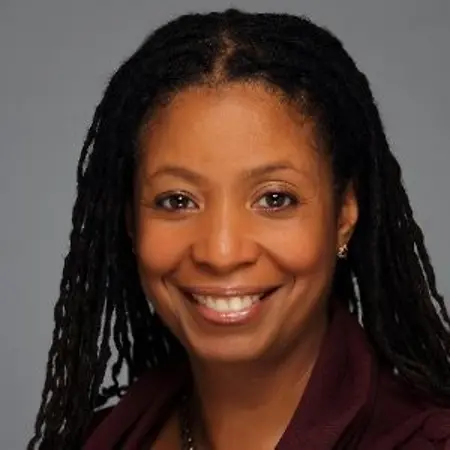
Her Story
About Patricia
I began my career in banking after earning my MBA in finance in 1993. I worked as a branch manager for Citi for a number of years, where I discovered my passion for the people side of business - I loved seeing my employees develop themselves and giving career advice. However, I was dealing with my own struggles of managing and being authentic while trying to understand what professionalism was in the workplace. I noticed that other people were experiencing this tension as well, where they often felt they had to withhold personal perspectives or values in order to fit in, or maybe refrain from talking about their culture. That tension was very intriguing to me and caused me to go back to school in 1998 to work on my PhD in organizational behavior, which I received in 2003. During my time in the program, I developed a construct called creating facades of conformity, which describes the pressure that people feel to suppress their personal values and even to pretend to go along with the values of the organization and those around them. I've studied authenticity and creating facades of conformity now for over 20 years. As a professor, I also consult for organizations. I have interviewed hundreds of people and administered surveys to thousands of managers and employees internationally. I just wrote a book called Staying True to You, coming out in August with Penguin Random House, which helps readers understand how to identify their most important values and bring those into the forefront of contexts, finding the right balance between conforming to a given environment versus being authentic.
Her Interview
Ten minutes with Patricia
01What’s the best career advice you’ve ever received?
I was told to develop relationships across all levels, not just with people above you in higher ranks. Yes, developing relationships with those in higher positions is important, but developing relationships at all levels is critical - people who report to you, or people who may not be on the same hierarchical level but work in another division. One of my mentors would say, relationships determine your destiny. I have had people from all walks of life and skill sets and in different contexts where I've worked, where I've received advice and critical information. I can think of one particular person who was an administrative assistant for someone else, not even working on my particular project, and she shared very important information that I needed. Understanding that those relationships are important and that we should not just focus on those who are on the top of the hierarchical level has been invaluable to me.
02What advice would you give to young women entering your industry?
I would say be very aware of what is happening in organizations - the most important challenges that are occurring within one's immediate environment, whether it's AI, whether it's emotional intelligence, or authenticity. Take time to consider solutions. We live in a world where we have a lot to say about problems, but we need more solutions that can help leaders and employees in general flourish in the work that they do. As we are mindful of the critical events, the challenges, those thorny issues that are happening in the workplace, we should not shy away from them, but engage in them in order to develop solutions. I would also say be open to developing your leadership skills.
03What are the biggest challenges or opportunities in your field right now?
As a researcher who's been studying authenticity for a very long time, I have interviewed hundreds of people and administered surveys to thousands of managers and employees internationally. What I have been finding over the years is that people are struggling between balancing conforming to a given environment versus being authentic. Those who are most successful with finding that balance tend to have a really high level of well-being and peace of mind. I just wrote a book about that coming out in August called Staying True to You. In this book, I help readers understand how to identify those most important values and bring those into the forefront of contexts. These values don't have to be all that one holds, but the most relevant values to a given context. In so doing, you can thrive in those values and be able to acknowledge the context that one is in. I help readers understand how to assess a situation and identify which values are most important. I call that being in the middle self, having that right balance that protects one's personal integrity as well as giving one a peace of mind.
04What values are most important to you in your work and personal life?
I value integrity. I have learned a long, long time ago that integrity is our greatest protector, and that's really important. Having come out of the field of banking, where integrity is really critical because you're managing other people's money, it's important to build trust among your clients as well as your employees. Being able to truly walk the talk has been critical for me.
Join Influential Women and start making an impact. Register now.