Explore how nonprofit and philanthropic leaders can move beyond heroic crisis management to embrace systemic stewardship, transforming organizational chaos into opportunities for building resilient, democratized systems.
Verified Member
Influential Woman · Nonprofit/Philanthropic Consulting
Rachel Branaman
Principal Consultant & Author of Rooted Together: Democratizing Power for the Collective Good, Talem Consulting
National Capital Region, VA 20001
3Articles published
3Awards received
“
True adaptation means trading the expert script for collaboration by becoming ecosystem architects who share power, root work in systemic stewardship, and prioritize relationships over heroism.
Rachel Branaman · In Her Own Words
Her Story
About Rachel
Rachel Branaman (she/her) is a nonprofit executive, organizational strategist, and the Principal Consultant at Talem Consulting. With over two decades of experience navigating complex social impact landscapes, Rachel specializes in organizational development, fundraising, strategy, and executive leadership during critical transitions.
Rachel's path into the sector was driven by a fascination with the "architecture of the possible." While she initially explored a career in Industrial-Organizational (I-O) psychology, she pivoted to the nonprofit sector to apply those behavioral insights toward social justice rather than corporate HR. Holding a Master’s degree in Nonprofit Management from Regis University (Summa Cum Laude), her current work represents a sophisticated hybrid of practical leadership and a systems-level understanding of organizational behavior - effectively applying her I-O roots through a social impact lens.
Since founding Talem Consulting in 2011, Rachel has stabilized at-risk organizations and strengthened the infrastructure of mission-driven movements. She maintains a distinguished track record as an interim leader, helping nonprofits navigate crises, stabilize operations, and build sustainable models. Deeply committed to leadership education, Rachel designs specialized capacity-building programs for current and emerging leaders — specifically women of color — who are often excluded from formal nonprofit training but remain at the forefront of community change.
In recent years, Rachel’s practice has expanded into the study of power dynamics and movement infrastructure. Following consecutive interim leadership roles, she took a sabbatical to write her book, Rooted Together: Democratizing Power for the Collective Good, which explores how visible, hidden, and invisible power shape communication and structural outcomes in activist environments. She expands on these themes as the co-host of the upcoming Rooted Together podcast alongside Saadia Ahmed, facilitating vulnerable, essential spaces where purpose-driven leaders can lay down their armor, navigate hurdles, and move from transactional advocacy toward systemic stewardship.
Her Interview
Ten minutes with Rachel
01What do you attribute your success to?
I attribute my success to a disciplined commitment to sustainable stewardship, both for the organizations I lead and for myself. In a sector where burnout is often treated as a badge of honor, I’ve learned that sacrificing your well-being for the mission is a strategic failure. A core argument in my book is that we cannot dismantle oppressive systems if we are operating in survival mode. Over my 25 years in this field, I’ve realized that knowing when to step away from misaligned projects is just as important as the work itself. Ultimately, we are much more effective changemakers when we lead from structural and personal health rather than depletion.
02What’s the best career advice you’ve ever received?
The best career advice I ever received was to stop trying to be the hero and start being the architect of the ecosystem. In the nonprofit sector, we are often socialized to believe that our personal sacrifice and technical expertise are our primary values. I carried that 'expert script' into my time as a U.S. Peace Corps Volunteer in Namibia, believing my training was the key to success. However, I quickly realized that my need to be the expert was actually an exercise of 'power over' rather than 'power with.'
Whether navigating a disagreement with a Sister-in-Charge over wheelchair distribution or learning to prioritize relationships over immediate output, Namibia shattered my 'savior' lens. I learned that structural healing requires an honest audit of our internal survival scripts. We have to ask ourselves: 'Am I preserving the mission, or my own need to be the expert?'
That insight shifted my entire career. It taught me to trade the safety of an expert lens for the vulnerability of collaboration. By focusing on the architecture of the possible, I realized that the most radical thing you can do for a movement is to build resilient, transparent structures that share power rather than hoard it. Moving away from 'power over' toward a strategy of 'power with' ultimately became the core philosophy of my book, Rooted Together.
03What advice would you give to young women entering your industry?
Frankly, it comes down to perseverance and the radical act of boundaries: prioritize your own health first, and the mission second. We often enter this field with a sense of urgency that invites us to sacrifice ourselves, but longevity requires us to stay healthy enough to sustain the work. Success isn't simply about what you achieve; it's staying resilient enough to keep showing up.
It is also vital to recognize that while the organizations you enter may have broken systems, they do not have to remain that way. The frameworks we inherit don't always operate on our behalf, but you possess the agency to design better systems of governance. Whether you are transforming existing structures or building parallel systems that truly center the community, never forget that you have the tools to redefine how power is held and shared.
04What are the biggest challenges or opportunities in your field right now?
The nonprofit sector currently faces a critical, systemic challenge: the persistence of 'survival scripts.' Chronic underfunding and reactive advocacy trap organizations in an operational cycle that forces them to adopt a 'power over' biology just to stay afloat. This defensive posture triggers gatekeeping and chronic burnout, ultimately sabotaging long-term, structural change.
Yet, this crisis reveals our greatest opportunity: a profound shift toward resilient movement infrastructure. A burgeoning cohort of leaders are actively rejecting transactional wins in favor of deeper transformation. We have a massive opportunity to pivot away from top-down hierarchies and instead build parallel systems of governance and mutual aid.
The path forward requires us to democratize power — moving intentionally from 'charity' to 'stewardship.' When we equip leaders with tools to audit their own power dynamics and build community-centric architectures, we do more than mitigate symptoms of injustice; we cultivate a structural mycelium strong enough to support an entirely new ecosystem of liberation.
05What values are most important to you in your work and personal life?
In both my work and personal life, I value sustainable stewardship and what I call the 'architecture of the possible.' I am driven by a fundamental belief that we never have to accept broken systems as our permanent reality. Because of this, my work is rooted in helping communities navigate, dismantle, and build parallel structures of governance that prioritize mutual aid and collective care. My happiest moments occur when I can help a leader who has been working tirelessly in the trenches finally secure the resources and strategic infrastructure they need to transform their community's lived experience into a lasting, sustainable force for change.
Her Content Hub
Articles by Rachel
The Architect's Blueprint: Growing through Chaos
From Heroic Fixers to Systemic Stewards: Transforming Organizational Chaos Into Resilience
In the nonprofit and philanthropic sectors, leaders often treat chaos as either a storm to weather or a fire to extinguish. When an organization enters crisis—whether through leadership transition, funding instability, or cultural toxicity—boards and staff frequently search for a fixer. They seek a hero to absorb the disruption, restore order, and stabilize the system.
For many women in leadership, this fixer role is a familiar and dangerous trap. We are often socialized to become the designated first responders for organizational distress—neutralizing anxiety while carrying the collective burden ourselves. Yet this model of heroic leadership is often a Survival Script: a performance rooted more in hypervigilance than in strategic vision.
True organizational growth requires more than heroic intervention. It requires Systemic Stewardship.
Chaos as a Diagnostic Tool
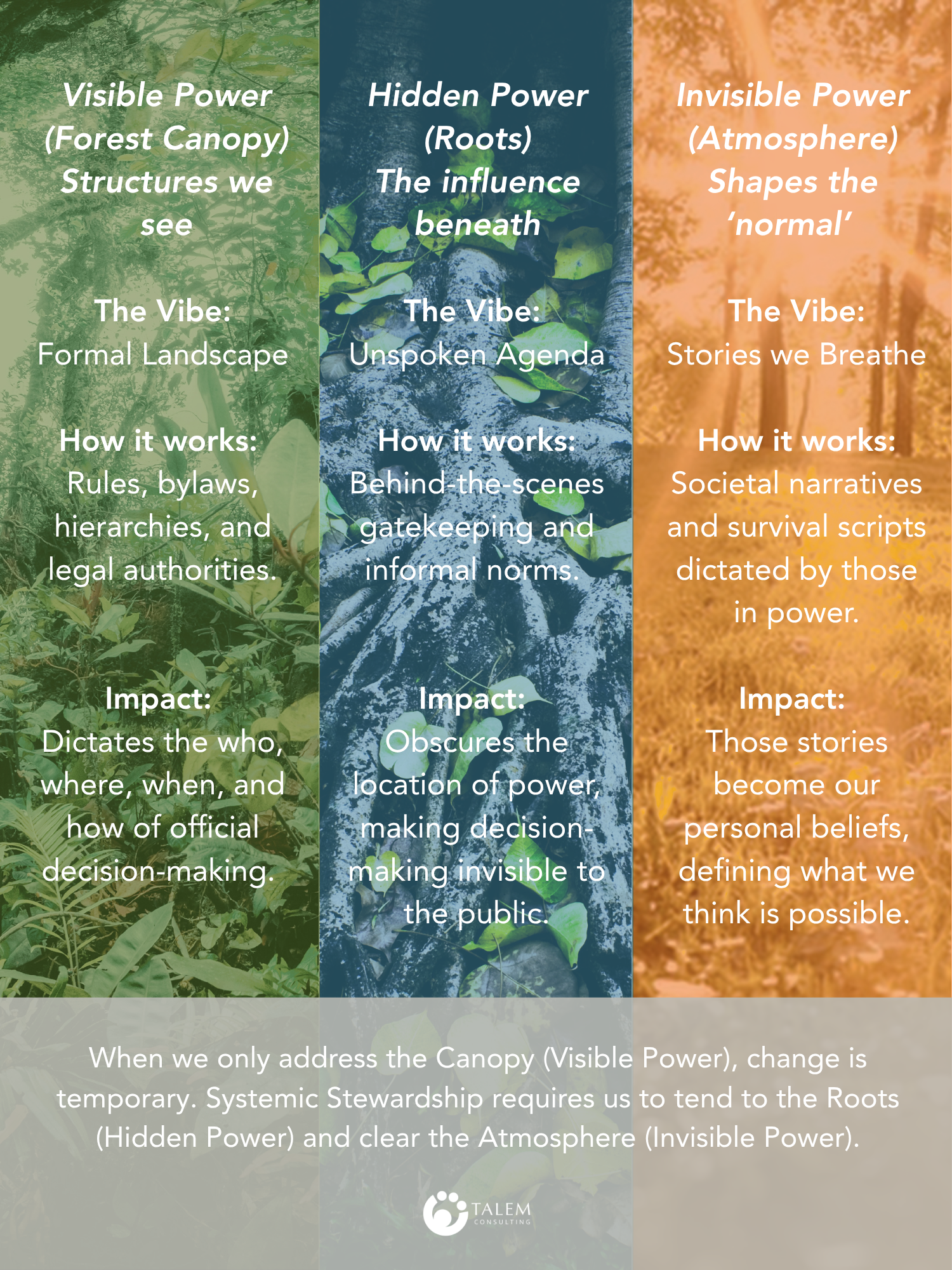
To lead effectively through upheaval, leaders must begin to see chaos not simply as disruption, but as a diagnostic tool that reveals deeper misalignments of power. When an organization feels chaotic, the three dimensions of power are often in conflict:
Visible Power
Formal structures such as rules, bylaws, hierarchies, and policies fail to provide sufficient clarity or direction. This often triggers a leader’s instinct to micromanage in an effort to regain control and restore safety.
Hidden Power
Unspoken agendas, gatekeepers, and informal influence structures complicate progress. Leaders may feel forced to navigate these invisible barriers alone, creating exhaustion and strategic isolation.
Invisible Power
This is where survival scripts thrive. These internalized narratives tell leaders they must work harder, move faster, sacrifice more, and endure greater suffering in order to remain credible or valuable.
When leaders address chaos only at the visible level—by changing policies, replacing personnel, or restructuring teams—they often achieve only temporary relief. Systemic stewardship requires a deeper intervention: dismantling the hidden and invisible power structures that keep organizations trapped in cycles of dysfunction and reactive survival.
The Mycelium Model: From Heroics to Resilience
Traditional leadership frameworks often emphasize personal resilience: how individuals can withstand more pressure, perform better, or survive longer under strain. Systemic stewardship reframes the goal toward ecosystem resilience.
Imagine your organization as a forest floor.
Above ground, a fallen tree may appear to symbolize destruction. But beneath the surface, the mycelium network is active—redistributing nutrients, communicating across systems, and stabilizing the environment so regeneration can occur.
Similarly, sustainable growth during organizational chaos happens when leaders stop trying to function as solitary oaks resisting every storm and instead begin cultivating the mycelium:
- Networks of trust
- Shared leadership
- Transparent communication
- Collective care
This is how organizations evolve from fragile systems dependent on singular heroes into resilient ecosystems capable of adaptation and renewal.
Three Operational Shifts for the Systemic Steward
To move from hypervigilant fixer to transformative steward, leaders must embrace three critical operational shifts:
1. Deconstruct the Fixer Instinct
Recognize the impulse to save the day as a survival strategy rather than a leadership virtue. Every time you independently solve systemic problems to shield your team, you may unintentionally limit their agency and development.
Stewardship is not about being indispensable. It is about building systems that no longer require heroic intervention.
2. Audit the Ecosystem
Identify where power bottlenecks exist.
Ask critical questions:
- Is information being hoarded?
- Are hidden cultural norms silencing key voices?
- Are decision-making structures overly centralized?
During periods of disruption, leaders have a unique opportunity to create what might be called a Shared Power Library—transparent processes, frameworks, and systems that decentralize authority and strengthen organizational autonomy.
3. Prioritize Collective Care
Crisis often triggers scarcity thinking, fear-based decisions, and intensified hypervigilance. Systemic stewardship demands that leaders intentionally prioritize human sustainability over short-term performance metrics.
Organizations that fail to protect and nurture their people during crisis rarely sustain meaningful growth once immediate pressures subside.
Collective care is not a soft strategy. It is structural resilience.
The Invitation
Chaos is not merely something to survive. It is an invitation to redesign.
When leaders shift from a fixer mindset to stewardship, they do more than manage crisis—they democratize power, strengthen resilience, and create systems capable of long-term transformation.
This shift moves organizations beyond transactional survival and into sustainable systemic evolution.
So rather than asking, “How do I fix this?” consider asking:
“How do I build a system where this problem no longer has the power to destabilize the collective?”
That is the work of stewardship.
That is the future of transformative leadership.
Women leaders often become organizational "fixers," absorbing stress and stabilizing crises. This article explores why the hero narrative is unsustainable and advocates for systemic stewardship—building collective agency and shared power structures instead of relying on individual heroism.
Beyond the Hero Narrative: Why Women in Leadership Need Systemic Stewardship
Why Women Leaders Must Trade Their Hero Cape for Systemic Stewardship

For many women in leadership, the path to the C-suite or the Executive Director’s chair requires a specific, exhausting kind of labor: fixing.
We act as the designated first responders for organizational distress. When team dynamics fracture, budgets crater, or cultures turn toxic, organizations funnel the labor of de-escalation and stabilization directly toward us. Society socializes many women to become “office moms” or “shock absorbers.” We step in, neutralize the anxiety in the room, and carry the collective weight on our shoulders.
We play the hero, and the organization relies on us to keep the peace—until we burn out. After 15 years of stabilizing at-risk organizations, I’ve learned a hard truth: the hero narrative is a trap. It keeps leadership transactional, centers the individual over the ecosystem, and eventually leads to devastating exhaustion.
To create lasting change, we must stop fixing and start practicing systemic stewardship.
The Invisible “Fixer” Tax
Acting as your organization’s designated fixer is not simply extra work; it is an invisible tax on your mental and emotional capacity.
When you serve as a shock absorber, you absorb the anxiety of your staff, the frustrations of your board, and the fears of your community. This creates a dangerous cycle:
Hero High: You receive a rush of validation for “saving the day,” which reinforces the belief that your value depends on your ability to endure high stress.
Survival Script: Eventually, you stop leading from vision and begin leading from hypervigilance. You spend your energy keeping the floor from falling out rather than architecting the future.
This model is inherently unsustainable. It relies on a hierarchy where power remains at the top—only now it is carried by a “nicer” person.
From Transactional Advocacy to Collective Agency
Transactional advocacy is when a leader uses her power to “save” her team. It feels effective in the moment, but it is ultimately a solo marathon that reinforces the status quo.
Systemic stewardship, however, builds collective agency. It shifts the narrative from “I will fix this for you” to “I am building a structure where we all have the power to fix this together.”
Stewardship focuses on the mycelium—the invisible networks of trust, power, and shared responsibility that sustain organizational health. When you trade your hero cape for an architect’s blueprint, you move the organization from a state of fight-or-flight to one of collective care.
Takeaway: A 3-Point Audit for the Systemic Steward
If you are ready to stop managing and start stewarding an ecosystem, ask yourself these three questions:
1. Who holds hidden power in meetings?
Management focuses on the org chart (visible power); stewardship focuses on unspoken norms (hidden power). In your next team meeting, notice who speaks, who gets interrupted, and whose ideas are attributed to others. A steward builds processes that prevent hidden power from silencing marginalized voices.
2. Am I building a bridge or a bottleneck?
If you took a month-long sabbatical tomorrow, would your team’s decision-making grind to a halt? If the answer is yes, you are a bottleneck. Stewardship involves creating a shared “power library”—checklists, transparent budgets, and decision-making frameworks—that allow the team to function without you at the center.
3. What “survival script” am I performing?
When a crisis hits, is your instinct to take over and do the work yourself to save the team? That is a survival script rooted in the fear that if you are not doing, you are not leading. Practice pausing. Stewardship holds space for a team to build its own agency, even in moments of pressure.
Moving Toward the Collective
The goal of leadership is not to be the most influential woman in the room; it is to ensure the room itself reflects equity. When we retire our hero capes, we gain the capacity to redesign the structures of power.
We do not just stabilize our organizations—we transform them.
Explore how nonprofit leaders trapped in the "expert script" can shift from burnout-inducing heroism to sustainable ecosystem stewardship through power-conscious practices and collaborative leadership.
Systems Over Saviors: Flipping the Script on High-Achieving Burnout
How the "Expert Script" Drives Burnout and Why Ecosystem Architects Thrive

We often enter nonprofit and social impact sectors driven by a fierce desire to solve problems. As high-achieving women, society socializes us to believe that our value lies in our expertise.
We tell ourselves a specific story: I have the education, the resources, and the training to succeed.
I call this the “expert script.”
While it feels like a professional asset, this script often functions as a psychological survival mechanism. When we face high-stakes missions and chronic underfunding, our nervous systems default to this familiar pattern. We stop collaborating and start “solving.” We move from “power with” our communities to “power over” our projects, convinced that the mission’s success rests solely on our shoulders.
The result? A direct path to burnout.
When you believe you must be the hero of every narrative, you carry the weight of the entire ecosystem. This doesn’t just exhaust you—it undermines the very systemic change you are trying to create.
Identify Your Survival Scripts
Survival scripts are the internal narratives that activate under stress.
For many leaders, the “expert script” sounds like:
“I can do this faster myself,” or “I need to maintain control to ensure quality.”
These scripts seek safety through control. However, structural healing—the kind that outlasts your tenure—requires you to audit them honestly.
Ask yourself: Am I preserving the mission, or am I preserving my need to be the expert?
To break the cycle of burnout, you must catch these scripts before they harden into institutional behavior.
From Hero to Ecosystem Architect
The most radical shift you can make is relinquishing the “hero” lens.
Heroes are solitary—they solve, they rescue, and eventually, they burn out.
Architects, however, design systems where power is shared and resilience is distributed.
Transitioning to an “architect” mindset means you stop trying to resolve every issue independently. Instead, you trade the perceived safety of expertise for the vulnerability of collaboration.
You begin building movement infrastructure—a mycelium of community care and mutual aid that supports everyone, rather than a single pillar carrying the entire weight.
Practical Tips: Moving from “Power Over” to “Power With”
To shift the pattern and protect your well-being, consider these three power-conscious practices within your team dynamics:
- Stop Doing, Start Being:
- Before jumping into solutions, prioritize relational integrity. Spend time listening to your team’s and community’s needs without immediately trying to fix them.
- Audit Hidden Power:
- Notice when you may be unintentionally gatekeeping resources or information under the guise of efficiency. Ask your team: “What structures can we build together so I am not the single point of failure?”
- Choose Stewardship Over Charity:
- Move away from a savior mindset. Frame your role as stewardship—caring for and managing a shared resource—rather than acting as the sole holder of power.
The Bottom Line
You cannot pour from an empty cup, and you cannot lead a movement from a place of depletion.
Sacrificing your health for the mission is not a badge of honor—it is a strategic failure.
By dismantling the “expert script,” you do more than avoid burnout. You reclaim your agency and help build a more distributed, resilient system that actually serves the community.
Flip the script: take care of yourself first so you can sustain the work for the collective good.
Join Influential Women and start making an impact. Register now.