
Her Story
About Ruby
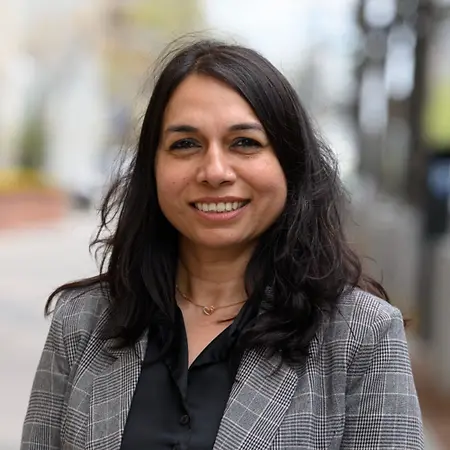
Ruby Ojha is a Principal Environmental Specialist with the International Finance Corporation (IFC), a member of the World Bank Group, based in New Delhi, India. With over 25 years of experience in environmental and social sustainability within international development and finance, she works on identifying and managing environmental and social risks associated with investment projects, while supporting clients in achieving sustainable and inclusive development outcomes.
Ms. Ojha holds a degree in Civil Engineering and a Master's in Environmental Sciences from India, and has completed an Executive Education Program in Public-Private Partnerships at Harvard Kennedy School. She is a lifetime member of the Institute of Town Planners, India, and actively supports non-governmental organizations working with underprivileged children and elderly populations.
She credits her success to the unwavering support and sacrifices of her parents, who prioritized education despite limited financial resources. Their belief in the transformative power of learning laid the foundation for her professional journey.
Reflecting on the evolution of her field, Ms. Ojha notes that environmental and social considerations, once viewed as peripheral concerns, have become integral to business and development decision-making. She sees significant opportunities ahead, driven by growing government attention to sustainability, increased sector-wide commitment, and the adoption of stronger environmental and social standards by multilateral institutions.
For young women considering a career in the sector, her advice is simple: pursue it only if you are genuinely passionate about the work. “This profession involves extensive travel, engagement with diverse communities, and collaboration with a wide range of stakeholders. You can truly excel and make a meaningful impact only if you enjoy every aspect of the journey.”
Her Interview
Ten minutes with Ruby
01What do you attribute your success to?
I attribute much of my success to my parents and the values they instilled in me. I come from a modest middle-class family. My father worked in government service, and my mother had limited formal education, but both believed deeply in the transformative power of education. Despite financial constraints, they made my education their highest priority and encouraged me to dream beyond our circumstances.
Their sacrifices, unwavering support, and emphasis on learning gave me the confidence and opportunity to pursue my goals. Whatever I have achieved professionally is built on the foundation they created through their hard work, resilience, and belief in the importance of education.
02What’s the best career advice you’ve ever received?
The best career advice I have ever received is to focus on doing meaningful work rather than chasing titles or positions. If you are passionate about what you do, opportunities and recognition will follow naturally. Throughout my career, I have found that curiosity, continuous learning, integrity, and a willingness to take on challenging assignments have been far more important than any job title.
Equally important is the advice to remain grounded and never stop learning. Every project, community, and stakeholder interaction offers an opportunity to gain new perspectives. Staying open to those experiences has helped me grow both professionally and personally.
03What advice would you give to young women entering your industry?
My advice to young women considering a career in this field is to choose it because you are genuinely passionate about the work. Environmental and social development is a highly rewarding profession, but it also requires commitment, curiosity, and resilience. The role often involves extensive travel, engagement with diverse communities, and collaboration with a wide range of stakeholders, from governments and businesses to local communities.
If you enjoy learning from people, solving real-world challenges, and making a positive impact, you will find the work both meaningful and fulfilling. The most successful professionals in this field are those who embrace every aspect of it and are motivated by the opportunity to contribute to sustainable and inclusive development.
04What are the biggest challenges or opportunities in your field right now?
One of the biggest challenges when I started my career was that environmental and social considerations were often viewed as peripheral issues or compliance add-ons rather than integral components of development and investment decisions. Over the past 25 years, however, the field has evolved significantly. Today, environmental and social issues are increasingly mainstreamed into business operations, project design, and risk management frameworks.
This transformation has created tremendous opportunities. Growing government attention to sustainability, increased private sector engagement, and the adoption of robust environmental and social standards by multilateral development institutions have all elevated the importance of the field. As a result, there is greater demand for professionals who can help organizations manage risks, create positive social outcomes, and contribute to sustainable development.
05What values are most important to you in your work and personal life?
Integrity, empathy, and continuous learning are the values that guide both my professional and personal life. In my work, integrity is essential because our decisions affect people, communities, and the environment. Empathy helps me understand diverse perspectives and build meaningful relationships with stakeholders. I also believe in lifelong learning, staying open to new ideas and experiences that help me grow and make a greater impact.
Join Influential Women and start making an impact. Register now.